
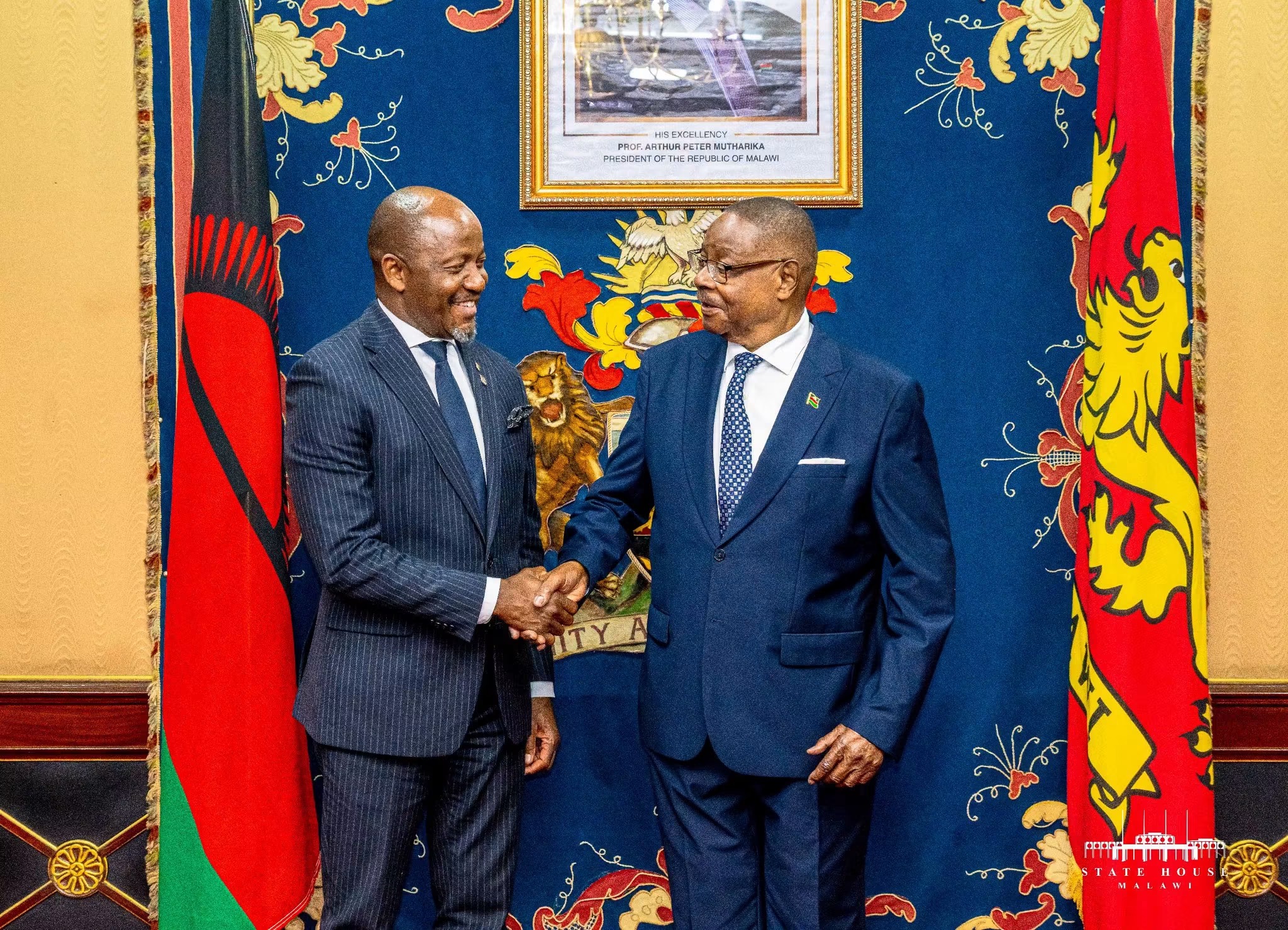
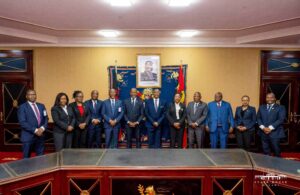
BAM president Phillip being welcomed by President Mutharika at the engagement
* As the banking sector outlines its strategy towards its role in the government-private sector development partnership during an audience with President Arthur Peter Mutharika
* The banking industry presents itself not merely as a provider of financial services, but as a committed partner in the development of our country
* Banks mobilise domestic savings and channel financial resources towards productive investment — BAM president Phillip Madinga
By Duncan Mlanjira
At its audience with President Arthur Peter Mutharika at Kamuzu Palace on Friday, Bankers Association of Malawi (BAM) underscored the private sector’s commitment in working with the Government to build a more productive, inclusive, resilient and prosperous country.
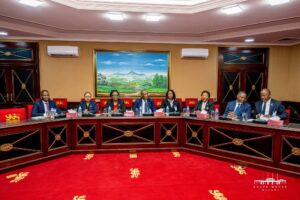
At the engagement, that was also attended by Minister of Finance, Economic Planning & Development, Joseph Mwanamveka; Reserve Bank of Malawi (RBM) Deputy Governor responsible for Economics & Regulation; and senior Government officials, BAM president Phillip Madinga outlined their strategy towards its role in the government-private sector development partnership.
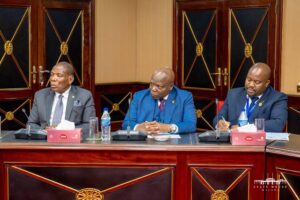
He first acknowledged “the encouraging progress” observed since [President Mutharika) assumed office — that includes the declining inflation that has helped restore confidence, improved food security has strengthened household resilience.
He also highlighted that the automatic pricing mechanism has enhanced transparency in the economy: “These achievements provide a strong foundation upon which the banking sector stands ready to partner with Government in advancing Malawi’s transformation agenda.
BAM’s commitment to national development
Madinga asserted that “the banking industry presents itself not merely as a provider of financial services, but as a committed partner in the development of our country”.
“Banks mobilise domestic savings and channel financial resources towards productive investment. We provide financing to businesses and households, facilitate domestic and international trade, support entrepreneurship and business expansion, and promote financial inclusion and economic resilience.

“Our central message today is simple: The Bankers Association of Malawi stands ready to work closely with your Government in advancing economic growth, supporting productive sectors, expanding financial inclusion and contributing to the achievement of the country’s long-term development aspirations under MW2063.”
On macro-economic stability, Madinga recognised that it is “the bedrock of investment, business confidence and sustainable growth — emphasis that BAM is committed to working closely with the Government and the RBM “to support measures that strengthen stability, restore confidence and create an enabling environment for productive investment”.

Advertisement
Alignment with Government priorities
The banking industry, added Madinga, “recognises MW2063 as the country’s long-term vision for inclusive wealth creation, industrialisation and self-reliance”.
“We see a clear role for the banking sector in mobilising investment capital, financing industrialisation, supporting agricultural commercialisation, promoting innovation and entrepreneurship, and expanding access to financial services.
“We also recognise the strategic importance of Agriculture, Tourism, Mining and Manufacturing — including Energy & Infrastructure as sectors capable of accelerating economic growth, creating employment and generating much-needed foreign exchange.
“The banking industry is committed to supporting these sectors through appropriate financing solutions, trade services and investment support.”

Supporting the productive sectors
In agriculture, banks are already supporting crop production, agricultural inputs, commercial farming, agro-processing, exports and value-chain development.
In tourism, banks provide financing for hospitality investments, tourism-related small and medium enterprises, working capital requirements, and foreign payment and transaction services.
In manufacturing, banks continue to provide working capital, capital expenditure financing and trade finance, including support for the importation of machinery and the expansion of production facilities.
In mining, significant capital requirements call for innovative financing and risk-sharing arrangements involving Government, local banks, development finance institutions and international investors.
The banking industry can support mining through equipment finance, project finance, working capital, trade facilitation and financial services for contractors operating within the sector.
Mining licensing request
While acknowledging the great work the new Minister of Mining, Thoko Tembo is doing in partnership with all stakeholders across the country, including banks, Madinga appealed for President Mutharika’s administration’s support in facilitating the resumption of mining project licensing.
“This would unlock significant investment, attract foreign exchange, create employment opportunities and enable the banking sector to participate meaningfully in financing the growth of this strategic industry.”
BAM observed that reliable energy and adequate infrastructure are essential foundations for sustainable economic growth, adding: “The banking industry has supported renewable energy, solar investments, commercial property developments, infrastructure-related businesses and participants in the construction sector.
“Reliable electricity is particularly important for industrialisation, mining development, tourism growth and manufacturing competitiveness.
“Continued investment in generation, transmission and alternative energy solutions will be critical to the country’s economic transformation.”
He added that strategic road infrastructure is equally important, giving recent examples of FDH Bank and National Bank of Malawi partnering with the Roads Fund Administration & Ministry of Transport to finance roads construction in the country.

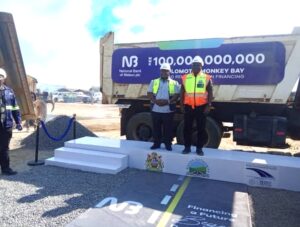
He highlighted that good road network leads to better access to agricultural production centres, tourism destinations and mining areas can stimulate investment, improve market connectivity and support domestic trade.
Trade and foreign exchange
The banking sector also plays a central role in facilitating trade and investment and Madinga stated that banks support the importation of fuel, fertiliser, pharmaceuticals, industrial machinery and other essential goods.
“We also facilitate exports, international payments and foreign exchange transactions. These services are indispensable to domestic production and international commerce.
“A stable and predictable foreign exchange environment is important for investment, industrial operations and business confidence.
“We, therefore, welcome continued engagement between Government and the banking industry on measures that can strengthen export generation, improve foreign exchange availability and support productive investment.

Digital transformation and financial inclusion
Banks have invested significantly in technology and innovation to make financial services more accessible.
These investments include mobile and internet banking, agency banking, digital payments and financial literacy programmes.
Collectively, these initiatives have extended financial services to more individuals and enterprises across the country.
Thus Madinga asserted that BAM is “particularly committed to increasing the participation of young people and women in the economy”.
“Our interventions include entrepreneurship support, start-up financing, financial literacy, digital finance solutions, tailored financial products, financing for women-owned businesses and capacity-building programme.
Supporting small and medium enterprises
“Small and medium enterprises (SMEs) remain important drivers of employment and economic activity.
“The banking industry recognises that stronger SMEs will contribute to broad-based economic growth.
“We are, therefore, committed to working with Government on practical interventions that improve access to finance, strengthen enterprise capabilities and enable promising businesses to grow sustainably.
A partnership agenda
“The challenges facing our economy require partnership, shared responsibility and disciplined execution.
“The Bankers Association of Malawi is ready to deepen its collaboration with Government in the following areas:
1. Financing agriculture, tourism, mining and manufacturing;
2. Supporting industrialisation and domestic value addition;
3. Mobilising capital for investment and infrastructure;
4. Expanding digital financial services and financial inclusion.”;
5. Supporting renewable energy initiatives;
6. Strengthening SMEs and entrepreneurship;
7. Facilitating trade and promoting export-led growth; and
8. Developing innovative financing and risk-sharing arrangements for strategic national projects.
“These areas are consistent with the commitments set out by the banking industry for closer collaboration with Government.
“We respectfully propose a structured and continuing dialogue between Government and the banking industry. Such engagement would allow us to identify priority interventions, address constraints affecting investment and agree on specific actions that can accelerate implementation.”
In his conclusion, Madinga expressed the banking industry’s confidence in the potential of Malawi, saying: “BAM stands ready to serve as a trusted development partner.
“We are committed to mobilising resources, financing productive sectors, expanding economic participation and supporting initiatives that improve the lives of Malawians.
“We look forward to working with your Government in building a more productive, inclusive, resilient and prosperous Malawi.”

Advertisement