
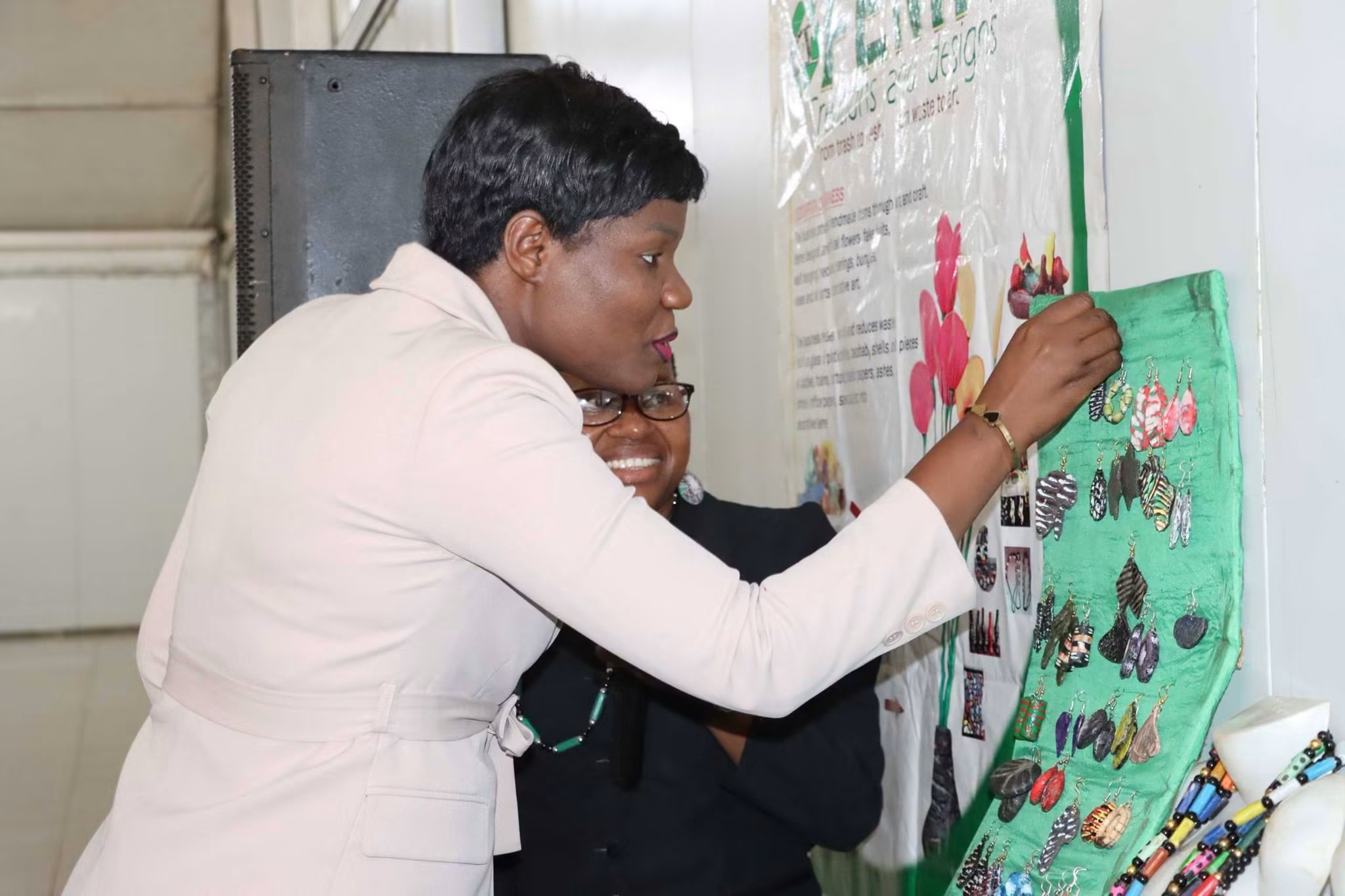
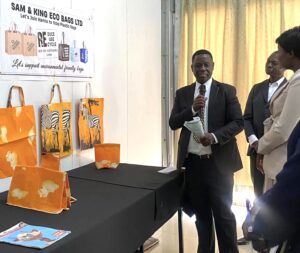
Natural Resources Minister Patricia Wiskes during an engagement with the manufacturers, potential buyers, retailers, supermarkets and other businesses that require carrier bags in their daily operations
* Taking note that despite the Environment Management (Plastics) Regulations, 2015 legal framework that was put in place more than a decade ago, plastic carrier bags have not disappeared
* With court proceedings against the thin plastics ban continuing, which has dragged for over 10 years as manufacturers and importers keep seeking legal relief
* As Qingdao Recycling Ltd has just been granted further legal relief that challenges Justice Howard Pemba’s January 2025 High Court in January ruling on enforcement of the ban
* Justice Pemba observed that the actions of manufacturers, including Qingdao Recycling Ltd, “pretty much points to some kind of abuse of the court process”
By Yamikani Sabola, Malawi News Agency (MANA) & Duncan Mlanjira, Maravi Express
Minister of Natural Resources, Patricia Wiskes is encouraging manufacturers and suppliers of recyclable and environmentally friendly carrier bags to invest in innovation, modern production technologies and recycling systems.

Advertisement
She made the challenge on Monday, September 21, in Lilongwe during an engagement with the manufacturers and potential buyers — including retailers, supermarkets and other businesses that require carrier bags in their daily operations.
Wiskes observed that despite the Environment Management (Plastics) Regulations, 2015 legal framework that was put in place more than a decade ago, plastic carrier bags have not disappeared — noting that traders including vendors, retailers and wholesalers continue to use the thin plastics.
The Minister thus called for collaboration among various stakeholders, including manufacturers of carrier bags, retailers and recyclers, to curb the environmental and health impacts of thin plastic use and overall plastic pollution.
She said Government has demonstrated its commitment to improving environmental management through the legal frameworks — which prohibits the importation, manufacture, trade and commercial distribution of plastic bags and plastic sheets made from plastic film with a wall thickness of less than 60 micrometres.

She, therefore, urged manufactures to provide safer alternatives to thin plastics by increasing investment in production of thicker, reusable carrier bags as part of a broader effort to support cleaner communities, improved sanitation, responsible waste management and protection of public health.
“To our manufacturers and suppliers, I wish to encourage you to take advantage of the opportunity before you,” she said. “It is an opportunity to innovate, to create businesses, to create jobs, to protect public health, and to build a cleaner and more sustainable Malawi.
“We do not only need products that are reusable and recyclable but also which are available, affordable and durable.
“Where there are challenges relating to production costs, access to markets, technology or standards, let us identify those challenges and discuss practical solutions,” Wiskes said.

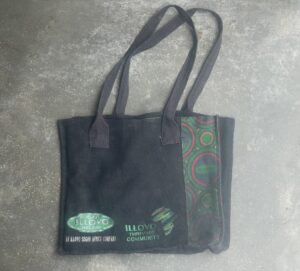
Wiskes further emphasised that “environmental management is not only about enforcing laws but also about creating practical solutions, building partnerships and ensuring that environmental policies are supported by viable alternatives that people and businesses can actually use”.
Environment information & education manager for Malawi Environmental Protection Authority (MEPA) said local scarcity of thin plastics following the strict enforcement of Environmental Management (Plastics) Regulation of 2015 has created a parallel black market, driving vendors to source single use plastic bags from some neighbouring countries where bans are less restrictive.
Chirwa indicated that MEPA is carrying out awareness campaigns to ensure that people change their mindset and stop using banned thin plastic bags by embracing recyclable and environmentally friendly carrier bags which are biodegradable.
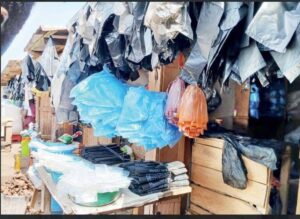
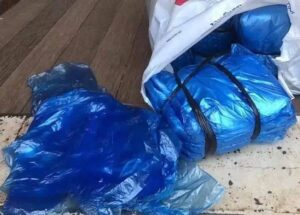
Elia Elias, quality assurance manager for Easypack Limited — a company that was involved in dragging the government to court along 11 others — said preparations are at an advanced stage for them to start producing eco-friendly carrier bags following consultations with MEPA and the Malawi Bureau of Standards (MBS).
But Qingdao Recycling Limited would have none of it as it has further dragged the enforcement of the thin plastics ban to the court despite Justice Howard Pemba’s January 2025 ruling, which the judge maintained that prolonged litigations against enforcement “pretty much points to some kind of abuse of the court process by the companies”.
In what seems in many ways than one as contempt of the court, in which Justice Pemba ruled that it should be an end for good for any further litigation, Qingdao Recycling Ltd has obtained a fresh court order against MEPA — maintaining that government cannot enforce the ban without the establishment of Environmental Tribunal.
But Attorney General Mbeta argues that the unavailability of an Environmental Tribunal cannot stop MEPA from enforcing the ban on thin plastics, as reported by Times 360 last week.

Attorney General Frank Mbeta
During hearings, Justice Pemba was made aware of the numerous previous court proceedings relating to the successive actions in respect of the case that began in 2015.
That year, observes environmentalist, Tawachi Kaseghe, Government had banned production and importation of thin plastics under 60 microns of size as per the Environmental Management (Plastics) Regulations.
Between 2016-2019, 14 manufacturers — led by Golden Plastics and included Qingdao Recycling Ltd — got an injunction and challenged it in High Court as violation of business rights.
On June 20, 2019, the Malawi Supreme Court of Appeal upheld the ban in which the 7-judge panel maintained that thin plastics are environmental hazard.
“That was the landmark ruling,” observes Kaseghe, but between 2020-2024, the “manufacturers kept coming back with new judicial reviews (this was the 4th and 5th reviews)”.

Advertisement
Kaseghe further chronicles that on June 20, 2024, Supreme Court of Appeal again dismissed the case with costs while the manufacturers — represented then by their lawyer Frank Mbeta, now the Attorney General — filed a notice of withdrawal.
The 11 companies, including Qingdao Recycling Ltd, that have filed for the fresh proceedings, “were not parties to that 2024 appeal,” observes Kaseghe on HardTalk Forum.
“After the Supreme Court dismissed it, they went to High Court in June 2024 and obtained a fresh injunction — extension of time, permission for judicial review, and referral as a constitutional issue — stopping MEPA from enforcing on July 8, 2024.
“[The then] Attorney General Thabo Chakaka Nyirenda called it abuse of court process, saying if they had interest, why didn’t they join the original case that ran for years?
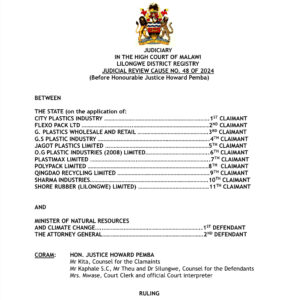
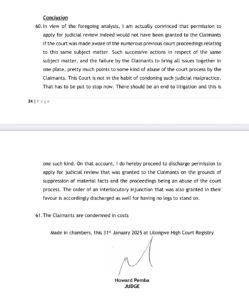
“That fresh injunction was then challenged. On January 31, 2025, High Court Judge Howard Pemba discharged that permission and injunction — calling it suppression of material facts and abuse of process, and condemned the companies with costs.”
Kaseghe further observes court records indicating that MEPA pointed out that Qingdao’s director, Ma Xiao Bing, had already been convicted in 2020 (Criminal Case 571 of 2020) for manufacturing thin plastics, got suspended sentence, nine machines confiscated, and was issued a closure order.
Qingdao indicated that it got a 14-day injunction in Commercial Case 04 of 2021, saying it had appealed to the Environmental Tribunal, but MEPA maintained that it was never served with that appeal.
Thus Judge Allan Hans Muhome has granted a stay stopping MEPA from enforcing again and allowed judicial review to proceed because of the missing Environmental Tribunal argument — “which is effectively the 6th round of the same battle”.
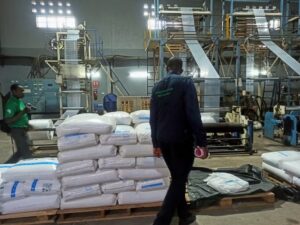
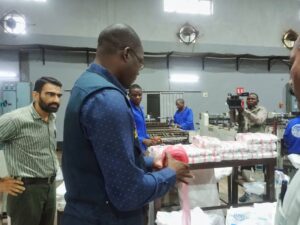
MEPA during factory inspections in February 2025
Reports indicate that, represented by lawyer, John Chisomo Kalampa, Qingdao Recycling Ltd argued that the ban violates the economic rights of companies involved in the production and sale of thin plastics.
Despite the government’s argument — through Attorney General Frank Mbeta that the absence of such Environmental Tribunal does not prevent MEPA from enforcing the ban — Justice Muhome granted a stay on the enforcement of the ban, allowing the judicial review process to proceed.
In his ruling in 2025 — when he maintained that the case is “pretty much points to some kind of abuse of the court process by the companies” — Justice Pemba emphasised that the Court “is not in the habit of condoning such judicial malpractice [and] that has to be put to stop now [and that] there should be an end to [such] litigation and this is one such kind”.
“On that account, I do hereby proceed to discharge permission to apply for judicial review that was granted to the Claimants on the grounds of suppression of material facts and the proceedings being an abuse of the court process.
“The order of an interlocutory injunction that was also granted in their favour is accordingly discharged as well for having no legs to stand on,” ordered Justice Pemba, made in chambers, on January 31, 2025 at Lilongwe High Court Registry.

Thus in order to encourage the consumer from buying one-off use of plastic carrier bags, the government entices Malawian-owned manufacturing businesses, small & medium enterprises (SMEs) and all stakeholders in recyclable and environmentally friendly products to invest in innovation, modern production technologies and recycling systems.
This is to allow MEPA enforce the law against thin plastics produced by companies involved in the controversy court cases that include Qingdao Recycling Ltd, City Plastics Industry, Flexo Pack Ltd, G. Plastics Wholesale Ltd, G.S. Plastic Industry (2008) Ltd, Plastimax Ltd, Polypack Ltd, Sharma Industries and Shore Rubber Ltd.

Advertisement