
* Let us be clear: a reduction in the fiscal deficit is not the same thing as an economic recovery
* The question we should be asking is: what has improved in the lives of ordinary Malawians, and at what cost?
By Duncan Mlanjira
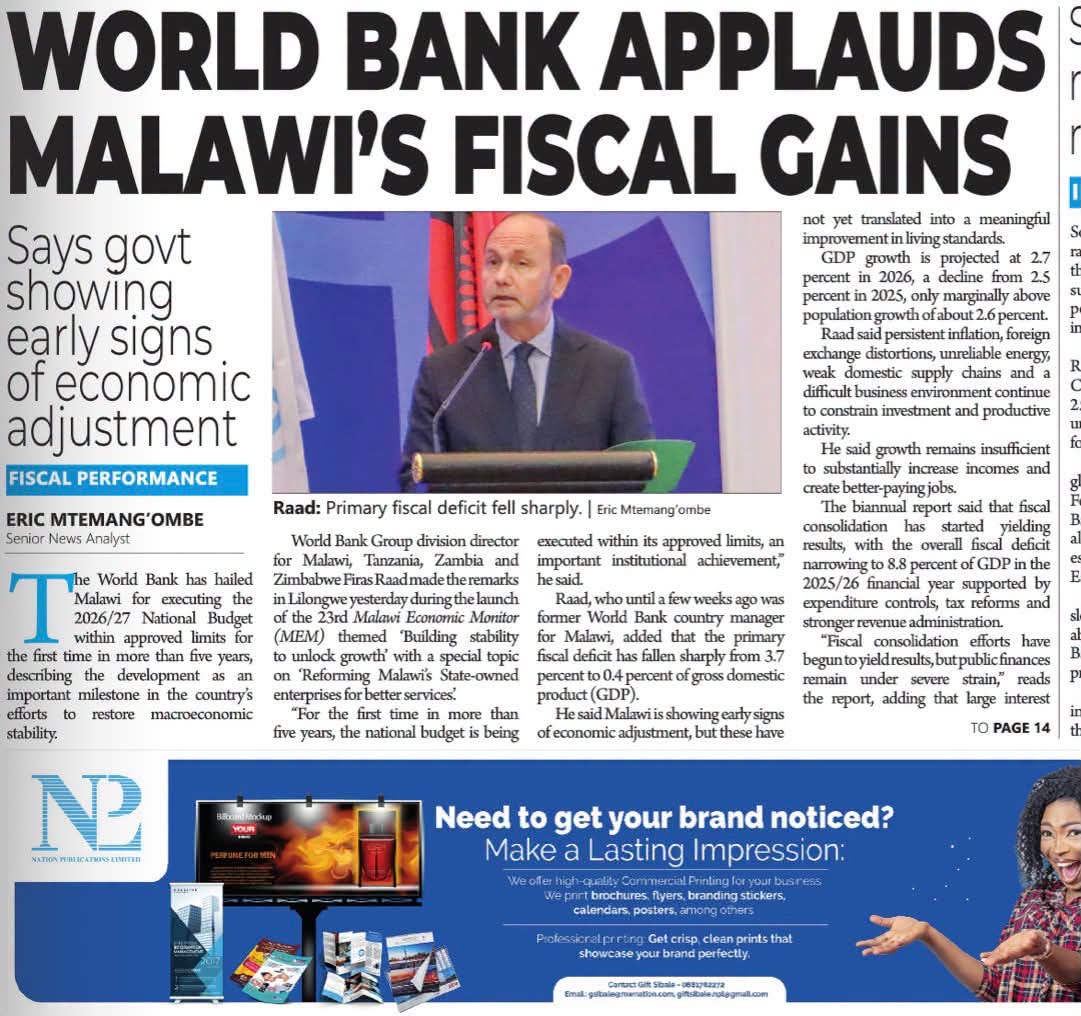
Canada-based economist, Dr. James Kadyampakeni has faulted remarks by the World Bank, applauding Malawi for executing the 2026/2027 National Budget within approved limits for the first time in more than five years.
When launching the 23rd Malawi Economic Monitor, Firas Raad, World Bank Group’s division director for Malawi, Tanzania, Zambia and Zimbabwe in Lilongwe, described the budget execution as “an important institutional achievement”.
He added that the primary fiscal deficit has fallen sharply from 3.7% to 0.4% of gross domestic product (GDP) — while observing that the country is showing early signs of economic adjustment.
But he was quick to add that the economic adjustment has not yet translated into a meaningful improvement in living standards.
Kadyampakeni, who is an accountable governance advocate, thus maintains that he has serious concerns about the applause from the World Bank on the fiscal gains.

Dr. James Kadyampakeni
“Let us be clear: a reduction in the fiscal deficit is not the same thing as an economic recovery,” he said, and agreed with Raad in his observation that the fiscal deficit has not improved the lives of ordinary Malawians.
“The question we should be asking is: what has improved in the lives of ordinary Malawians, and at what cost?
“The World Bank says Malawi’s fiscal deficit has narrowed and describes this as evidence that fiscal consolidation is beginning to yield results.
“Fine. But even the Bank acknowledges that public finances remain under severe strain, economic growth remains weak, and living standards are not improving fast enough.
“So, what exactly are we applauding? Malawi’s fundamental problems have not disappeared; foreign-exchange shortages remain a major constraint; businesses struggle to access foreign currency and imported inputs.
“Industries cannot operate at full capacity while ordinary Malawians continue to face high prices and declining purchasing power.
“And then there is the elephant in the room: debt. Are we genuinely fixing the problem, or are we simply becoming better at managing the symptoms of a problem that keeps getting bigger?” questions Kadyampakeni.

Advertisement
He added that “sometimes it feels as though Malawi has entered a financial revolving door by borrowing money and as it struggles to repay it, borrow again — restructuring the debt, receive praise for meeting a fiscal target, and then borrow some more”.
“At what point does development financing become a mechanism for keeping an indebted government afloat rather than financing the structural transformation of the economy?
“I am not opposed to World Bank financing — far from it. Malawi needs development capital; but the purpose of that capital matters enormously.
“I will gladly praise the World Bank when the money it lends Malawi is directed decisively toward building productive industries, creating decent jobs, expanding manufacturing, supporting exporters and producing goods that Malawi currently has to import.
“That is the kind of borrowing that can change the trajectory of a country,” says Kadyampakeni, emphasising the World Bank financing should help the country to establish industries that process agricultural products; manufacture basic consumer goods; develop pharmaceuticals; support construction materials; expand energy production and build competitive export industries.
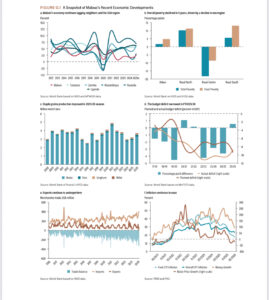
The graphics contained in the Malawi Economic Monitor
“Then I will be among the first to applaud. Because that would help Malawi generate the foreign exchange it desperately needs.
“We cannot continue borrowing foreign currency while doing almost nothing to expand our capacity to earn foreign currency — that is the fundamental contradiction.
“You cannot permanently solve a foreign-exchange crisis by continually borrowing foreign exchange. You solve it by producing, exporting and earning it.
“Malawi needs a development-financing model that helps us move from consumption to production, from imports to manufacturing, and from perpetual borrowing to sustainable foreign-exchange generation.
“So I ask the World Bank, respectfully but bluntly: What figures are you looking at? Are you looking at spreadsheets in Washington and Lilongwe, or are you looking at the Malawi where businesses struggle to access foreign exchange, industries struggle to operate, investors face uncertainty, government interest payments consume scarce resources, and millions of citizens see little improvement in their standard of living?
“A smaller fiscal deficit is welcome. But a smaller hole is not the same thing as a repaired roof.
“Give Malawi financing that builds factories; financing that creates jobs; that expands exports and that generates foreign exchange — then I will applaud.
“Until then, perhaps we should be asking a much harder question: Are we financing Malawi’s development, or simply financing Malawi’s dependence?”

Advertisement
The September edition of the Malawi Economic Monitor — that analyses the country’s economic and structural development issues — highlights that “Malawi’s growth performance continues to lag most regional peers”.
“While the economy has been showing signs of an uptick, the pace of growth remains constrained by persistent structural bottlenecks — including unreliable energy supply, foreign exchange distortions, shallow domestic supply chains, and a challenging business environment.
“Firms operate at low capacity, face rising costs, and struggle to access long-term credit — all factors that limit productive investment and export diversification.
“As a result, the economy remains highly vulnerable to external shocks, and unable to generate broad-based growth.”
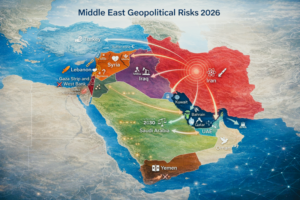
The report thus contends that the country’s economy continues to face significant macroeconomic and structural challenges amid a difficult global environment — the conflict in the Middle East.
Released under the theme; ‘Building Stability to Unlock Growth’, the Malawi Economic Monitor also raised red flags on state-owned enterprises (SOEs) in its Special topic; ‘Reforming SOEs for Better Services.
The report takes note that SOEs are crucial to service delivery and economic growth, but they “pose major fiscal risks amid poor performance and lax governance”.
The report emphasises that SOEs “play a central role in Malawi’s economy, delivering essential services in energy, water, and agriculture — that underpin household welfare and private sector activity”.
“In sectors characterised by natural monopolies and market failures, SOEs have historically filled critical gaps in service provision.
“However, their suboptimal performance has imposed increasingly significant fiscal and economic costs on the state, and their challenges are deeply intertwined with the country’s broader macroeconomic and structural constraints.”

Advertisement