

* The question is going forward, shall we continue on this trajectory, or retrogress
* Contends MEC chairperson Justice Annabel Mtalimanja in her keynote speech at 4th Biennial Conference of the Political Science Association
* Under the theme; ‘Malawi’s Democracy at the Crossroads? Maturing Institutions or a Tailspin into Uncertainty’
By Duncan Mlanjira
Malawi Electoral Commission (MEC) chairperson Justice Annabel Mtalimanja contends that Malawi “has arguably stood as a beacon of democratic resilience on the continent “ — but the question is going forward; “shall we continue on this trajectory, or retrogress”.
Justice Mtalimanja posed the argument in her keynote speech at the 4th Biennial Conference of the Political Science Association (PSA) in Salima today, September 26 — under the theme; ‘Malawi’s Democracy at the Crossroads? Maturing Institutions or a Tailspin into Uncertainty’.

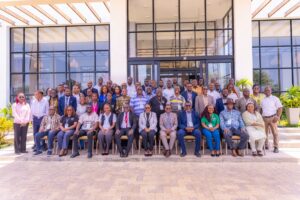
Mtalimanja addressing the delegates

She took note that the PSA is celebrating 15 years of its existence and that Malawi is reflecting on 33 years of transition from a one-party system to multiparty democracy.
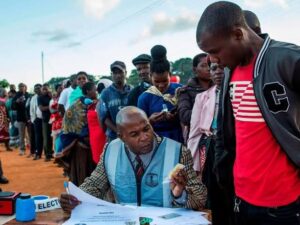
“This is also happening a year after the country held its General Elections on 16th September 2025,” she said. “Incidentally, the timing of the PSA conference is interestingly significant, as it rewinds the clock to almost exactly one year to the day the presidential election results were declared on 24th September, 2025.”
On the theme, Mtalimanja said it is not intellectually stimulating for the 33 years post transition to multiparty democracy, “but critically, it is timely, much more so should it be that Malawi is on a tailspin into uncertainty”.
“This theme invites us all, as we sit here, in our individual and collective roles in electoral management, democratic and political spaces, to soberly and brutally reflect on where we have come from, where we stand today and what we must do to strengthen Malawi’s democratic institutions and our political and democratic culture as a nation as we go forward.
“Looking back, Malawi has arguably stood as a beacon of democratic resilience on the continent. Malawi peacefully transitioned to multiparty democracy.

“Our judiciary has famously demonstrated its fiercely independent role in protecting the rule of law. Our citizens have proven time and again, through peaceful turnouts and a profound respect for the ballot, that, as our Constitution loudly pronounces, sovereign power belongs strictly to the people of Malawi.
“The question is going forward, shall we continue on this trajectory, or retrogress.
“We have witnessed a vibrant civil society, an active media sector defending freedom of expression, and an institutional commitment to constitutional integrity.
“We have also witnessed distinct threats of public frustration, complex economic pressures, and questions regarding the ultimate delivery of democratic dividends.
“Therefore, the danger of a tailspin into institutional uncertainty or voter disillusionment is a challenge we cannot ignore.”
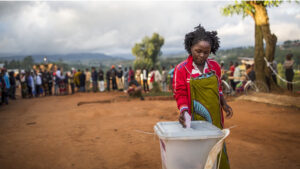
She highlighted that the 2020 Fresh Parliamentary Elections and the 2025 General Elections are generally regarded as successful elections, on many levels and it taking cognizance of this positive classification, for posterity, it is thus apt for the PSA conference “to dedicate a moment to reflect closely on these elections — particularly the 2025 elections being the immediate past elections”.
“As we look at the elections, we must look at the pre-election, election and post election phases. In doing this, we have an opportunity to take stock of the lessons learnt, consolidate the gains and build resilient systems for future elections.
“It will be a missed opportunity not to mention the fact that a failure to have this consolidation process may risk not only the elections themselves, but broadly, the very democratic gains amassed this far.
“It must be emphasised that the post election phase is particularly crucial, because as with many things in life, we tend to relax and let out guard down after successful moments. “However, it is in the immediate post election period that gains can be quickly lost with changes in policies, systems, weakened institutions etc.”



Mtalimanja then challenged the delegates that as they reflect on the elections, by asking some pertinent questions that could be:
i. What did the 2025 elections reveal about our electoral institutions?
ii. What can be done to strengthen our electoral institutions?
iii. What lessons can we draw about political parties, citizen participation, the maturity of our media and civil society organisations, leadership and public confidence?
iv. Which areas require further research, dialogue or institutional reform?

Advertisement
She impressed on the delegates that the questions “deserve more than commentary or superficial answers” and that this where the PSA “has a particularly important role to play”.
“As a professional and intellectual body, the Association must help Malawi to understand its democratic experiences beyond the immediate headlines and political rhetoric and debates.
“It should contribute to documenting lessons, examining institutional performance and developing practical recommendations that can inform policy and public discourse,” said Mtalimanja.

Advertisement