

Chifipa Mhango
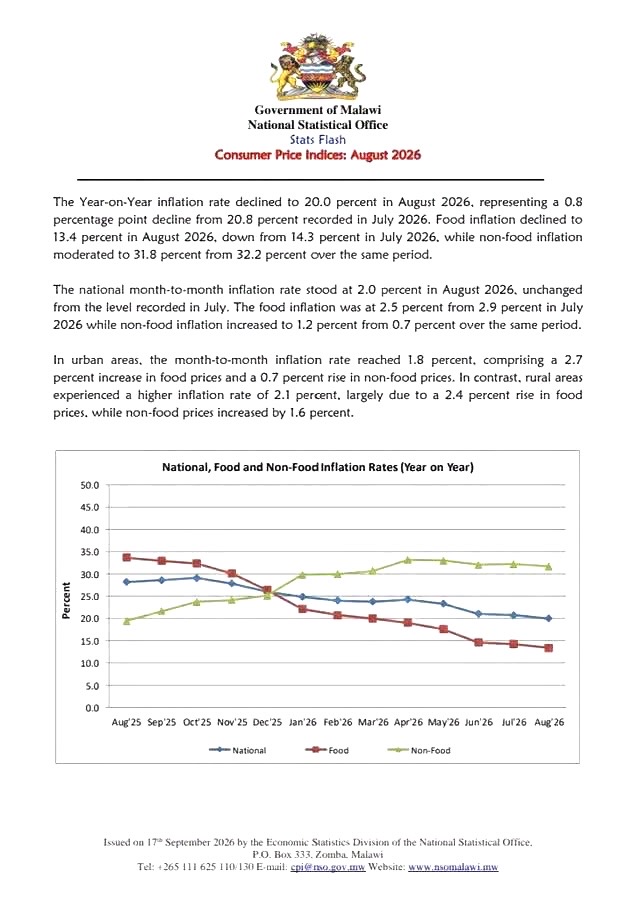
* Headline inflation declined from 20.83% in July to 20.01% in August — representing a reduction of 0.82 percentage points
* The latest figures from the National Statistical Office (NSO) provide further evidence that the disinflation process underway in Malawi is continuing
* Nevertheless, inflation at approximately 20% remains high and continues to affect household purchasing power, business operating costs, investment decisions and the overall cost of doing business
Analysis by Chifi Mhango, Chief Economist & Executive Director-Economic Research & Strategy, Don Consultancy Group
Malawi’s inflation trajectory continued to improve in August 2026, with headline inflation declining from 20.83% in July to 20.01% in August — representing a reduction of 0.82 percentage points.

Advertisement
The latest figures from the National Statistical Office (NSO) provide further evidence that the disinflation process underway in Malawi is continuing.
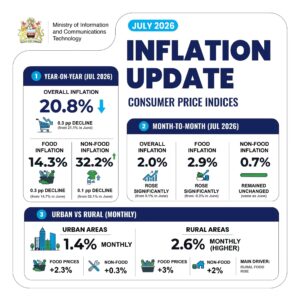
The movement is encouraging, particularly because it follows the decline from 21.12% in June to 20.83% in July and now 20.01% in August.
Food inflation also continued to moderate, falling from 14.3% in July to 13.4% in August, while non-food inflation declined from 32.2% to 31.8%.
However, the significance of the August number becomes even clearer when we take a longer-term view: Headline inflation stood at 28.23% in
August 2025, compared with 20.01% in August 2026, a decline of approximately 8.22 percentage points over twelve months.
This is a meaningful improvement and should be welcomed. At the same time, the underlying composition of inflation suggests that Malawi’s inflation challenge is not yet fully resolved.
The immediate question for policymakers is, therefore, shifting from simply whether inflation is falling to whether the decline can become broad-based, sustained and embedded across the wider economy.
A clear downward trend
The headline inflation trend over the past year provides a clear indication of the changing inflation environment.
Headline inflation stood at 28.23% in August 2025, rose to 28.69% in September and peaked at 29.11% in October 2025.
It subsequently declined to 27.91% in November, 26.02% in December, 24.87% in January 2026, 24.09% in February, 23.82% in March, 24.30% in April, 23.35% in May, 21.12% in June, 20.83% in July and 20.01% in August 2026.
The overall direction is, therefore, clearly more favourable. Nevertheless, inflation at approximately 20% remains high and continues to affect household purchasing power, business operating costs, investment decisions and the overall cost of doing business.
It is also important to distinguish between lower inflation and lower prices. The current data indicate that prices are still increasing, but they are increasing at a slower rate than they were a year ago.

Reserve Bank of Malawi
Food inflation has been central to the improvement
The strongest source of disinflation has been the food component. Based on the August 2026 Consumer Price Index (CPI) data, food inflation declined from approximately 36.07% in August 2025 to 13.41% in August 2026 — a reduction of about 22.66 percentage points.
This is particularly significant because food carries a 53.73% weighting in Malawi’s CPI. In practical terms, more than half of the inflation basket is represented by food.
Consequently, a substantial moderation in food-price inflation has a powerful influence on the overall headline inflation rate.
The NSO data confirms that food prices remain the primary driver of the inflation dynamics, with the food index increasing in August 2026 but by less than it did during the corresponding period in 2025.
This is encouraging for households, but it also highlights the importance of sustaining agricultural production, improving food supply chains and reducing the structural vulnerabilities that can cause food prices to rise sharply.
The broader inflation picture remains more challenging
While food inflation has moderated significantly, the August data sourced from NSO show that several non-food categories continue to experience substantial price increases.


The above figures highlight an important feature of Malawi’s current inflation environment.
Transportation recorded the highest inflation rate at 47.42%, while housing, water and electricity recorded 34.59%.
Clothing and footwear recorded 35.69%, alcoholic drinks and tobacco 31.89%, health 25.28%, and restaurants and hotels 24.66%.
The weighting of the categories is equally important: Food accounts for 53.73% of the CPI basket, while housing, water and electricity accounts for another 23.65%.
Together, these two categories represent approximately 77.4% of the entire inflation basket. This means that developments in food and housing-related costs will continue to have a particularly significant influence on Malawi’s headline inflation rate.
However, the nature of the inflation challenge is changing in Malawi. A year ago, the most significant pressure was clearly concentrated in food. Today, food inflation has moderated considerably, while a number of non-food categories continue to record much higher rates of inflation.
This does not mean that food inflation has ceased to matter. Given its 53.73% weighting, it remains the single most important component of the CPI. Rather, the data suggest that the next phase of disinflation will require greater attention to the broader cost structure of the economy.
Transportation costs, energy, housing-related expenses, health costs, clothing and other services can feed into business operating costs and, ultimately, into the prices of goods and services throughout the economy.
The objective should, therefore, be to ensure that the current food-led improvement gradually becomes a broader economy-wide disinflation process.
What does this mean for monetary policy in Malawi?
The latest figures provide the Reserve Bank of Malawi (RBM) with encouraging evidence that inflationary pressures are easing — however, the data also argue for a carefully calibrated monetary-policy approach.
The key consideration is not simply the decline in headline inflation, but whether the decline is sufficiently broad-based and durable to justify a sustained easing in monetary conditions.
If food inflation remains contained and inflation in major non-food categories begins to moderate more decisively, the environment for gradual monetary-policy adjustment would become more supportive.
On the other hand, persistent inflation in transportation, housing, energy and other non-food categories could slow the disinflation process and create second-round effects through business costs, wages, expectations and pricing behaviour.
The RBM will, therefore, need to continue monitoring the exchange rate, foreign-exchange availability, money and credit growth, fuel prices, electricity costs, fiscal developments, inflation expectations and supply-side conditions.
The policy challenge is to support the recovery in economic activity without allowing the current improvement in inflation to be undermined by renewed demand or exchange-rate pressures.

Monetary policy alone cannot solve Malawi’s inflation problem
The August 2026 data also reinforce a broader economic point that Malawi’s inflation challenge is not exclusively a monetary phenomenon.
Several of the categories experiencing relatively high inflation are directly or indirectly affected by supply-side constraints. Foreign-exchange shortages can raise the cost of imported inputs and finished products.
Energy constraints can increase production costs. Transport and logistics challenges can raise the cost of moving goods. Weak agricultural productivity can increase food-price volatility.
These pressures cannot be resolved through interest rates alone. Sustainable disinflation, therefore, requires stronger coordination between monetary policy, fiscal policy and structural economic reforms.
Improving agricultural productivity, strengthening foreign-exchange availability, increasing energy reliability, improving transport and logistics infrastructure, strengthening domestic production and maintaining fiscal discipline would complement monetary policy and help reduce the underlying cost structure of the economy.

Advertisement
Malawi in the global inflation context
The international environment also remains relevant. In the United Kingdom, annual CPI inflation increased to 3.1% in August 2026 from 2.9% in July, with transport and motor-fuel costs among the important contributors.
The Bank of England subsequently maintained bank rate at 3.75%, while continuing to focus on bringing inflation sustainably back to its 2% target.
In the United States, August CPI inflation was 3.4% year-on-year, with gasoline prices accounting for more than one-third of the monthly increase in the overall CPI.
These developments demonstrate that even advanced economies continue to face inflationary pressures, particularly from energy and transportation costs.
However, the scale of the challenge in Malawi is materially different. At 20.01%, Malawi’s headline inflation remains several times higher than the inflation rates currently being recorded in the United Kingdom and United States.
The appropriate policy response should, therefore, reflect Malawi’s own economic structure rather than simply mirror the monetary-policy responses of advanced economies.
The international experience does, however, provide an important reminder that energy, fuel, exchange-rate and supply-side shocks can complicate the inflation outlook even when underlying inflation is moving in the right direction.
What should we expect in the Malawi economy?
The August 2026 inflation figures provide grounds for cautious optimism. If the current moderation in food inflation is sustained, and if pressures in transportation, housing, energy and other non-food categories begin to ease, headline inflation should remain on a downward trajectory.
However, there are several risks that could interrupt this progress: Renewed foreign-exchange pressures, exchange-rate depreciation, higher international energy prices, supply disruptions, rapid domestic credit expansion or fiscal pressures could place renewed upward pressure on prices.
The outlook will, therefore, depend not only on monetary policy, but also on developments in agricultural production, energy supply, foreign exchange, public finances and international commodity markets.
For households, continued disinflation would gradually reduce the pace at which the cost of living is increasing. However, because inflation remains around 20%, the pressure on household purchasing power remains significant.
For businesses, a sustained decline in inflation would improve cost visibility and make financial planning, investment and pricing decisions easier.
For investors, sustained macroeconomic stabilisation could gradually improve the predictability of the operating environment, provided that the improvement in inflation is accompanied by greater foreign-exchange stability and stronger economic fundamentals.
The policy priority: Make disinflation durable
The most important task now is to ensure that the recent improvement does not remain a temporary, food-led phenomenon. Malawi needs to move from short-term inflation relief to durable macroeconomic stability.
That requires continued vigilance on monetary conditions, but also decisive action on the supply-side constraints that continue to push up the cost of doing business.
In particular, policymakers should maintain focus on:
* strengthening agricultural productivity and food supply;
* improving foreign-exchange availability and market efficiency;
* reducing energy and electricity constraints;
* improving transport and logistics efficiency;
* strengthening domestic production and supply chains;
* maintaining fiscal discipline; and
* protecting the credibility of the monetary-policy framework.
These measures would help ensure that lower inflation is supported by stronger economic fundamentals rather than by favourable temporary movements in individual prices.

RBM
Conclusion
Malawi’s August 2026 inflation figures are encouraging. The decline in headline inflation from 20.83% in July to 20.01% in August 2026 confirms that the downward trend is continuing.
More significantly, headline inflation has fallen by approximately 8.22 percentage points, from 28.23% in August 2025 to 20.01% in August 2026.
The substantial moderation in food inflation has been central to this improvement and should be welcomed.
But the numbers also tell us that the inflation challenge is evolving. With transportation inflation at 47.42%, housing, water and electricity at 34.59%, and several other non-food categories still recording inflation above 20%, Malawi cannot afford to regard the decline in headline inflation as the end of the inflation problem.
The task now is to convert food-led disinflation into broad-based, durable disinflation across the economy.
That will require a balanced combination of prudent monetary policy, fiscal discipline, improved foreign-exchange conditions, stronger agricultural production, reliable energy supply, efficient logistics and structural reforms aimed at lowering the cost of producing and moving goods and services.
The direction of travel is encouraging. The priority now is to make the improvement durable, broad-based and supportive of sustainable economic growth.
Editor’s Note:
Chifipa Mhango is the Chief Economist & Executive Director-Economic Research & Strategy at Don Consultancy Group (DCG), who has more than 30 years of experience spanning economic research, macroeconomic and fiscal analysis, corporate strategy, financial services, development finance, trade policy, investment advisory and strategic planning across Africa.
He has held senior leadership roles in both the public and private sectors in South Africa, providing economic intelligence and strategic advice to businesses, government institutions and other decision-makers.
His work focuses on translating economic and policy developments into practical strategic insights that support informed decision-making, competitiveness and sustainable growth.

Advertisement