
* Road levy is at K521/litre; rural electrification levy at K207/litre; under-recovery K350/litre; price stabilisation fund K168.77/litre; excise duty K279.32/litre; duty at K253.92/litre
* Along with carbon tax, SFR levy, energy regulatory levy, distribution fund, import base landed cost (IBLC) loss recovery
* These are not global oil prices; these are domestic policy choices — line by line, levy by levy, decision by decision
* Well over 30% to 40% of the final pump price is driven not by international oil costs, but by choices made right here in Malawi and the government has the legal authority to adjust every single one of them
By Duncan Mlanjira
While the government maintains that the respective 34% and 35% hike on pump prices for petrol and diesel was necessary and unavoidable given the situation across the globe, the opposition UTM Party disagrees, contending that Malawi’s fuel prices are stacked with “a cascade of domestically imposed levies and charges”.

Advertisement
The UTM, whose president if former Reserve Bank of Malawi (RBM) Governor, Dailitso Kabambe, analyses that Import Base Landed Cost (IBLC) for petrol stands at 404,551.33 tambala (K4,045.51/litre, yet stacked on top of that landed cost is a cascade of charges, that include:
* Road levy is at K521/litre; rural electrification levy at K207/litre; under-recovery (K350/litre); price stabilisation fund (K168.77/litre); excise duty (K279.32/litre); duty (K253.92/litre) — along with carbon tax, SFR levy, energy regulatory levy, distribution fund and IBLC loss recovery.
“These are not global oil prices; these are domestic policy choices — line by line, levy by levy, decision by decision,” says the UTM in its statement on April 1 issued by secretary general Willet Karonga. “The government has the legal authority to adjust every single one of them.
“Well over 30% to 40% of the final pump price is driven not by international oil costs, but by choices made right here in Malawi. This fundamentally changes the narrative: Malawians are not only paying for a global shock — they are paying for government policy.”
At a press briefing held at the Parliament Building in Lilongwe by Minister of Energy & Mining, Jean Mathanga — accompanied by Ministers of Information & Communications Technology, Shadric Namalomba and of Transport & Public Infrastructure, Jappie Mhango, along with chairperson for Parliamentary Committee on Natural Resources & Climate Change, Tiaone Hendry — it was indicated that the price increase follows the war conflict in the Middle East consumers the-price-increase-follow-the-war-in-the-Middle-East, which has disrupted the supply chain.
She said at least 106 countries, including Malawi, world over have been affected by the disruption of oil supply chain amid the closure of Hormuz Strait amid the current Middle East conflict.
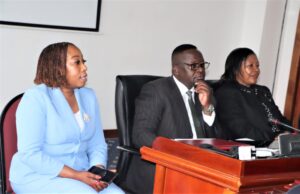
The press briefing yesterday
But the UTM maintains that the fuel price hike is “a policy failure that shifts the burden to Malawians”, citing that this is a “second major pump price increase in just eight months since the current administration took office — citing the ongoing Iran conflict as justification”.
“While we acknowledge the existence of global pressures in the oil market, we categorically reject the manner in which this decision has been made and implemented. This is a profound policy failure that exposes a lack of strategic thinking, weak economic judgment, and an absence of empathy for the suffering of Malawians.
“At the core of this decision is a troubling reality: that the government has chosen the easiest option for itself and the hardest option for its people. The global oil shock is real, but responsible governments do not simply pass external shocks directly onto their citizens.
“They design policies that absorb, smooth, and manage these shocks over time. What Malawi has witnessed instead is a full and immediate transfer of global economic pain onto households and businesses, without any meaningful cushioning mechanisms.
“This is not economic management — it is economic surrender,” says the UTM, and goes on to give examples of how Malawi’s neighbours have reacted to the effects of war in the Middle East; that on the very same April 1 that Malawi Energy Regulatory Authority (MERA) announced the price hike, “Zambia’s President Hakainde Hichilema convened a special Cabinet meeting and approved the zero-rating of VAT and the suspension of Excise Duty on petrol and diesel imports for three months, effective immediately”.
“Namibia moved even earlier, cutting fuel levies by 50% for three months specifically to cushion its citizens and businesses from the same global pressures MERA cites as its justification.
“Even South Africa — with a far more complex and structured fuel pricing system — has historically intervened during price shocks by cutting the General Fuel Levy, freezing increases in fuel-related taxes, and using regulatory mechanisms to cushion consumers from the full impact of global oil volatility.
“Kenya’s President issued a formal national address to manage the economic anxiety of his people. These are not wealthy countries, these are our neighbours, facing the same global oil market, the same conflict in the Middle East, the same supply chain pressures — and they chose their citizens over their revenue lines.
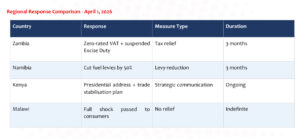
“Malawi chose differently. The contrast is not subtle. It is damning. When the crisis hit, our neighbours asked: ‘how do we protect our people?’ Our government asked: ‘how do we protect our revenue?’ The answer each government gave tells you everything about who they are governing for.”
The UTM emphasises this has a “human cost”; saying: “Fuel is the bloodstream of the economy — when its price rises sharply, the consequences are immediate and far-reaching.
“Transport costs increase overnight; food prices follow; the cost of doing business escalates; inflation spreads rapidly across all sectors. What this means in real terms is that the ordinary Malawian — whose income has not increased — is now forced to pay significantly more for basic survival.
“Families will be compelled to cut down on essential consumption; small businesses will struggle to remain viable; workers will face a silent but severe erosion of their wages. This decision is a direct assault on the cost of living, and it disproportionately punishes the poorest and most vulnerable in our society.”

UTM Party president Dalitso Kabambe
The UTM goes further to indicated that “the implications go far beyond the pump price; by triggering a sharp increase in fuel costs, government has set off a chain reaction that threatens the stability of the entire economy.
“As prices rise, consumer demand will weaken. As demand weakens, businesses will scale down. As businesses contract, employment diminishes. At the same time, government revenues will begin to fall as economic activity slows.
“This creates a dangerous cycle in which the initial attempt to stabilise fuel supply ultimately leads to broader economic instability. It is a short-sighted intervention with long-term consequences.”
The opposition party believes that “a smarter alternative existed” to counter the global petroleum price trends, saying: “What makes this decision particularly indefensible is the clear availability of a more intelligent option.
“The same Zambia that zero-rated VAT on fuel today sits beside us in the same landlocked geography, with similar import dependencies, facing the same global price pressures.
“Yet Zambia found room to act; Namibia found room to act. The tools were available [for Malawi but] the choice was made not to use them. A temporary reduction in fuel levies would have immediately lowered the burden on consumers while maintaining supply.
“It would have demonstrated that government is willing to share the cost of a crisis rather than offloading it entirely onto citizens.”

Advertisement
The UTM further argues that “if the global shock proves temporary — as many geopolitical crises do” — the levies on Malawi’s fuel pump prices “could be gradually restored without having triggered a severe inflationary spiral”.
“By refusing to adjust levies, government has effectively chosen to protect its revenue at the expense of the economy. By implementing a full and immediate price adjustment, government has acted as though the current crisis is permanent.
“This risks locking Malawi into a high-cost economic structure even if global prices ease. Sound economic management requires flexibility, not rigidity. It requires the ability to respond proportionately to uncertainty, not to overreact in a way that damages the domestic economy.”
The UTM thus for the country’s leadership be “both economically intelligent and socially responsive”, maintaining that it should have been “willing to balance competing pressures, protect its citizens, and sustain economic stability”.
“…economic policy must always serve the people — especially in times of crisis. We believe that Malawi must adopt a shock-absorbing approach to global economic disruptions, not a shock-transmitting one.
“Government must be prepared to temporarily sacrifice certain revenue streams, such as fuel levies, in order to protect the broader economy and preserve long-term fiscal stability.
“UTM, therefore, calls on government to urgently reconsider its position. A calibrated approach that includes temporary reductions in fuel levies and taxes, combined with targeted support measures, would provide relief while maintaining supply and economic stability.
“That is the approach our neighbours took. That is the approach responsible governance demands. Ultimately, the role of government is not to pass on hardship, but to manage it wisely.
“In this instance, that responsibility has not been met. Our neighbours have shown that another choice was possible — this government simply refused to make it.”
Meanwhile, Consumer Association of Malawi (CAMA) has appealed to-traders-and-transporters-not-to-unfairly-push-prices-beyond-reach-of-consumers-due-to-the-fuel-price-increase/, saying consumers and traders are both affected by the fuel price increases and that “it will be necessary for both parties to recognise that they need each other during these difficult times”.

Advertisement