

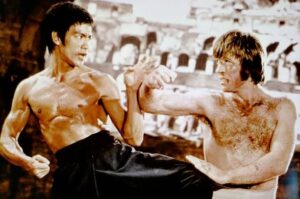
* He had made an early screen appearance battling Bruce Lee in high-kicking combat sequences, which the pair choreographed together, in ‘The Way of the Dragon’ (1972)
* Both men were trained fighters, so there was no call for stunt doubles or the obfuscating frenzy of quick cuts; their face-offs were filmed in medium and wide shots to preserve the sense of integrity
Orbituary by Ryan Gilbey, The Guardian
Action cinema of the 1980s was a podium where Arnold Schwarzenegger and Sylvester Stallone fought over gold and silver position. Bronze belonged indisputably to Chuck Norris, who died on Thursday, March 19, aged 86.

Advertisement
The premature death of Bruce Lee in 1973 had left a vacancy for a martial arts movie superstar that was eventually filled to some extent by Chuck Norris, Bruce Lee’s friend and colleague.
He had made an early screen appearance battling Bruce Lee in high-kicking combat sequences, which the pair choreographed together, in ‘The Way of the Dragon’ (1972).
Both men were trained fighters, so there was no call for stunt doubles or the obfuscating frenzy of quick cuts; their face-offs were filmed in medium and wide shots to preserve the sense of integrity.
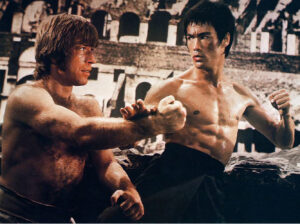
Chuck Norris with Bruce Lee in The Way of the Dragon, 1972. (Screen Archives/Getty Images)
A six-time world middleweight karate champion, who retired undefeated in 1974, Chuck Norris ran his own chain of karate schools. One of his celebrity pupils, the actor Steve McQueen, encouraged him to pursue a screen career.
Chuck Norris developed a sizable following in the 1980s as the star of gung-ho hits including ‘Lone Wolf McQuade’ (1983), ‘Missing in Action’ (1984) and ‘Invasion USA’ (1985). Violent and explosive they may have been, but the star insisted on the philosophy behind them. “I don’t initiate violence, I retaliate,” he said. “In my films, I’m forced into a situation that I must cope with.”
He saw himself as a one-man corrective to prevailing trends: “The movie industry is in dire need of this kind of image on screen after the antiheroes of the 1960s and 70s who were advocating the use of drugs and who were detrimental to society … I’ll never play a drug addict or an alcoholic.”
Chuck Norris called himself “a real flag waver, a big Ronald Reagan fan”, and his movies mixed combat with conservatism. ‘Missing in Action’, one of numerous 80s movies that re-fought the Vietnam war after the fact, ends with the hero shaming politicians, who have denied the existence of US prisoners of war by producing, at a press conference, the PoWs he has rescued.

Ronald Reagan, the film actor
In ‘Invasion USA’, he played a former US intelligence agent who abandons the Florida Everglades, where he has retired with his pet armadillo, to fight foreign terrorists at home.
Unlike his contemporaries, there was an air of humility, even serenity, about Chuck Norris. Real tough guys, he reasoned, did not need to boast constantly about their prowess: “[Stallone] goes around with bodyguards, two enormous dudes,” he pointed out. “The paradox of karate is that I’m well equipped to defend myself and never fight.”
After witnessing a display of his skills at the Cannes film festival in 1980, a Daily Express journalist described Chuck Norris as “poetry in motion” and added: “His hands are surprisingly delicate.”
In 1985, a Daily Mail headline anointed him “The Real Rambo”. In the same year, the New York Times critic Vincent Canby noted that “his darkish blond beard and hair that falls low over his forehead” gave him in repose the look of “a shy but friendly Airedale”. His most memorable trait, said Canby, “appears to be a kind of remarkable competence”.
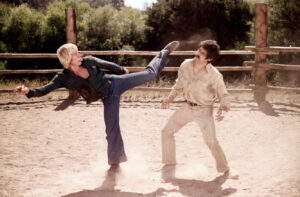
Chuck Norris in Breaker! Breaker!, 1977. (Paragon Films/Allstar)
In his 2004 autobiography ‘Against All Odds: My Story’, Chuck Norris described himself as “equal parts Irish and Native American”, with Irish and Cherokee on both sides of his family.
He was born Carlos Ray Norris in Ryan, Oklahoma, to Wilma (nee Scarberry), who worked part-time as a waitress and in a laundry, and Ray Norris, a mechanic and shipyard worker whose presence at home was sporadic.
The family moved frequently during Chuck Norris’ childhood, living in towns in California, Arizona and Florida. His parents divorced when he was 16.
Two months after graduating from high school, he enlisted in the US Air Force, where he picked up the nickname ‘Chuck’. It was while stationed in Korea that he began learning karate. Returning to the US in 1961 as a black belt, he moonlighted as a karate instructor while working as a file clerk. Two years later, he opened his first karate schools.
In Bruce Lee’s capacity as stunt coordinator on ‘The Wrecking Crew’ (1968), he gave Chuck Norris his first screen role as a bodyguard who fights the film’s star, Dean Martin.

Chuck Norris and Bruce Lee at the Colosseum in Rome, 1972
His acting career began in earnest when he played a truck driver fighting corrupt law enforcement in ‘Breaker! Breaker!’ (1977). He came up with the idea for ‘Good Guys Wear Black’ (1978), in which he was a race-car-driving Vietnam veteran turned sociology professor.
His opening hat-trick of self-conceived vehicles – ‘Good Guys Wear Black’ was followed by ‘A Force of One’ (1979) and ‘The Octagon’ (1980) – grossed more than US$100 million.
‘Silent Rage’, ‘Forced Vengeance’ (both 1982), ‘Code of Silence’ and the prequel ‘Missing in Action: The Beginning’ (both 1985), ‘The Delta Force’ (1986) and ‘Braddock: Missing in Action III’ (1988), the latter directed by Chuck Norris’ brother Aaron, were among his other hits, his popularity only waning toward the end of the decade.
One of his biggest successes still lay ahead of him. In the TV action series ‘Walker, Texas Ranger’, which ran for nine seasons from 1993, he put his martial arts skills to the cause of fighting crime once again as the wholesome hero, Cordell Walker.
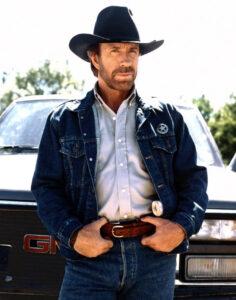
Chuck Norris in ‘Walker, Texas Ranger’, 1993. (AJ Pics/Alamy)
For all his popularity, Chuck Norris never came close to equalling Bruce Lee’s cult-hero status, though he did acquire an ironic kind of cool as the subject of 21st Century internet memes riffing on the idea of his invulnerability.
Examples, later collected into several books, included: “Chuck Norris makes onions cry”; “Chuck Norris can slam a revolving door”; and “When the bogeyman goes to sleep every night, he checks his closet for Chuck Norris”.
The actor alluded to the memes on-screen in The Expandables 2’ (2012) when he revealed he was bitten by a cobra but “after five days of agonising pain, the cobra died”.
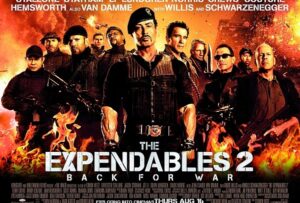

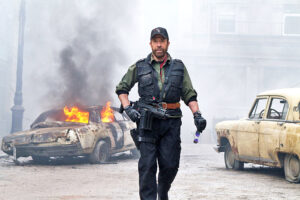

That levity contrasted unhappily with some objectionable political views. He promoted the “birther” movement, which accused Barack Obama of having been born outside the US; argued that gay people had no place in the scouting movement; and contributed columns for the far-right website World Net Daily with headlines such as “Jihadi terrorism on the rise in the US: What you need to know!”
He saw no apparent contradiction in dedicating his autobiography to Rachel Joy Scott, the first victim of the Columbine high school mass shooting, while continuing to serve as one of the firearms industry’s most enthusiastic cheerleaders.
Chuck Norris is survived by his second wife, Gena O’Kelley, and their twin daughters, Dakota and Danilee, as well as by his sons, Mike and Eric, from his previous marriage to Dianne Kay Holecheck, which ended in divorce, and by another daughter, Dina, from a relationship during that marriage.
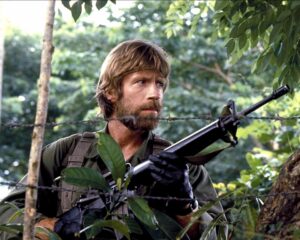
Scene in ‘Missing in Action’