

The image that goes together with the analysis that was generated using AI tools based on creative prompts and may not be literal representations of real people or places
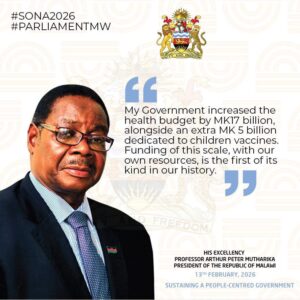
* The principle behind the Presidential Order is clear — public office must not be used for private gain
* President Mutharika has taken a bold and courageous step. Corruption in healthcare is not theoretical — it directly affects ordinary Malawians
By Duncan Mlanjira
An analysis that was published on social media by former Secretary General of the Society of Medical Doctors of Malawi, Dr. Parth Patel, on the implications of President Arthur Peter Mutharika’s Executive Order No. 1 of 2026 — that warns public health careworkers from owning business interests in private health facilities — has sparked hot debate.

Advertisement
In the Executive Order, issued on February 16, 2026, President Mutharika emphasises that he solemnly made an “oath to uphold and defend the Constitution of Malawi, which guarantees every citizen the right to access health services without discrimination or deprivation”.
However, he said he “is deeply disturbed by the information that certain health personnel in public health facilities have been soliciting payments from patients as a condition for providing medical services”.
“Other health personnel have been advising patients to attend to their private clinics in order to access better medical treatment. Such conduct is unlawful, unethical, and wholly unacceptable. It is an affront to the patients’ constitutional right to access health services.”
Thus in order to safeguard the constitutional rights of our citizens and restore integrity in the health sector, he has constituted the Executive Order No. 1 of 2026 “that no employee of a government hospital or any other public health facility shall solicit, demand, or accept fee or monetary favours from patients as a condition for receiving health services”.
“Any person found engaging in such malpractice shall be summarily dismissed from service and subjected to prosecution under the laws of Malawi,” says the Order, while also indicating that “no person employed by a public hospital or health facility shall own, operate or hold shares in a private health clinic or pharmacy”.
“Any employee currently holding such ownership or shares must divest within 30 days from the date of this Executive Order. Failure to comply shall result in dismissal and further legal action as appropriate.
Entitled ‘Conflict of Interest vs Conflict of Incentives: The Real Debate Behind the Executive Order No. 1 of 2026’, Dr. Patel observes that the Order “has sparked one of the most important conversations Malawi’s health sector has had in years”.

Dr. Patel addressing a panel talk during ‘Future of Health’ conference in October 2025 hosted by the Economist Impact in London
“At its heart, the Order tackles two issues: the solicitation of payments in public hospitals and the ownership or financial interests of public health workers in private healthcare facilities (clinics, pharmacies, laboratories, etc).
“In doing so, President Arthur Peter Mutharika has taken a bold and courageous step. Corruption in healthcare is not theoretical — it directly affects ordinary Malawians.
“Allegations of informal payments, unexplained drug shortages, absenteeism during official hours, and patients being redirected to privately owned facilities have deeply eroded public trust.
“The principle behind the Order is clear: public office must not be used for private gain. Healthcare systems are particularly vulnerable to conflicts of interest. When a public health worker also owns or holds shares in a private facility operating within the same ecosystem, a structural incentive is created — even in the absence of bad intent.
“Preferential referrals, artificial scarcity, diversion of drugs, and absenteeism become risks embedded within the system itself. Removing ownership interests is, therefore, not an accusation against professionals; it is an attempt to protect both patients and healthcare workers from compromised environments.
“At the same time, the concerns raised by many colleagues are legitimate. Malawi has very few specialists. Public salaries remain modest relative to years of training and responsibility.
“Private investment and after-hours work have long served as income supplements. There is understandable fear that strict enforcement could drive scarce expertise out of public hospitals.

Queen Elizabeth Central Hospital in Blantyre
“This is where the debate shifts from conflict of interest to conflict of incentives. A health system cannot rely on ethics alone; it must align incentives properly. If compensation structures and accountability systems are weak, parallel systems will inevitably emerge.
“That is not unique to Malawi — it is an economic reality observed across health systems globally.
“Importantly, the Order does not explicitly prohibit locums (moonlighting) or working in private facilities after official hours. It restricts ownership, operation, and shareholding. That distinction matters.
“There is a meaningful difference between earning income through professional labour and owning a facility that may directly benefit from dysfunction in the public system.
“Clear implementation guidelines — particularly regarding the interpretation of ‘operate’ — will be essential to prevent misinterpretation and unnecessary anxiety within the profession.
“Another sensitive issue concerns professionals who invested in private facilities under the previous regulatory framework. For them, the 30-day divestment requirement represents real financial disruption.
“Reform must, therefore, be firm but also thoughtfully managed. Structured transition mechanisms and clarity will strengthen both fairness and legitimacy.
“Ownership restrictions alone will not eliminate corruption. Sustainable reform will require stronger accountability systems, transparent conflict-of-interest frameworks, improved monitoring, and gradual attention to remuneration and workforce stability.”

Advertisement
Dr. Patel highlights that having worked across public institutions, private practice, policy environments, and in multiple leadership positions — including as the former Secretary General of the Society of Medical Doctors of Malawi and a former member of the Board of Directors of the Human Resources for Health Coalition of Malawi — he has “seen both the extraordinary dedication of the healthcare professionals and the structural distortions that strain the system”.
“Most enter this profession to serve, but systems shape behaviour. Where incentives are misaligned, even good people operate within compromised structures.
“This moment should not be framed as government versus healthcare professionals — it is an opportunity to realign ethics and incentives, to strengthen accountability without undermining capacity.
“If approached with maturity, dialogue, and clarity, Executive Order No. 1 of 2026 could mark not merely a crackdown, but a turning point in restoring trust and integrity within Malawi’s health sector — and that is a conversation worth having.”
In reaction, Zandi Kankhuni described the analysis as “a sober reflection” as opposed to some alarmist ideas that suggested that “specialists will leave public service en masse (for lack of a better word) and people will suffer”.
“People are already suffering. One, because the system is dysfunctional — there are reports of demands for bribes if one wants to access treatment. Two, because the majority of people seeking healthcare in public facilities aren’t attended to by specialists.
“Thus, much as specialists are integral to the existence of an effective and efficient healthcare system, the conversation shouldn’t just focus on them.”
Social media influencer, Onjezani Kenani responded to Kankhuni saying: “It’s not alarmist, Doc. — it’s the grim and sober reality. There is a specialist at Kamuzu Central Hospital (KCH) with one of the best private clinics of his own, best probably in Malawi, Zambia and Zimbabwe.
“He goes to KCH not because he needs the less than K2 million they pay him per month —he can make that in a day — but because he just wants to offer a service to those who cannot afford to pay at his clinic, as well as to train junior doctors who are interested in his area of expertise.
“This specialist has been given 30 days to choose between his private practice and the government. He is the only one serving Centre and North. There is also only one similar specialist in the South, again with a private clinic of his own.
“Tell me, what, do you think, will this specialist’s choice be 30 days from now?” Onjezani asks.

On his part, Gama Joseph applauded Dr. Patel’s analysis, saying it is a necessary and mature framing of the issue at hand, adding that “the distinction between conflict of interest and conflict of incentives is critical”.
“Ownership within the same ecosystem creates structural risk, regardless of individual ethics. At the same time, reform must acknowledge workforce realities and income constraints.
“Restricting ownership while clarifying locum practice is a defensible balance. However, without parallel improvements in accountability systems, remuneration, and monitoring, the Order alone will not resolve underlying distortions in the health sector.”
Timothy Singini opined that the President should have included in the Order a 100% salary adjustment, saying: “When I entered the civil service I was a very very good person, I have never been absent even for a single day, my schedule is always flooded with long working hours up to 190+ hours.
“I would escort patients to the next level of care without claiming allowance but since the deduction of the money and this order yesterday I am feeling like giving up. I worked and saved some, borrowed from banks to invest in such business not because I am a thief but because I have the knowledge of how it works.
“And now aàaah am drained and I don’t even know if I have to continue working to earn K400k or just give up.”

Diego Nyambalo Phiri also agreed with Dr. Patel, saying “Public healthcare should never be compromised by private financial interests. If properly enforced, this could help restore trust in our health system.”
He also suggests that the government “must make sure incentives are fair so that doctors and specialists remain motivated to serve the public”.
Lusungu Rasta joined the debate to suggest that the President should invite Dr. Patel invited for consultation, saying most healthcare workers enter the system to serve but the system shapes their behaviour.
Bulesing’izi Kanjakaya said “Malawi will be the first country in southern Africa to outrightly ban dual practice”, and gave an example of Zambia, South Africa, Tanzania, Kenya, who “practise dual practice”.
“What is needed is not completely banning but being proactive in regulation and monitoring. Salary ya K400K uzitani nayo pa town pano munthu chomwe umakwanitsa ndi za chipatala. Ku uliminso ndi uko tikuvutana. Eish ai zikomo!”
Kei Native said “from a governance and public policy perspective, it is important to analyse this issue beyond individual benefit and instead consider the broader functioning of government as a system designed to serve the entire population”.
“Public policy decisions, particularly those affecting the health sector, are typically responses to systemic challenges that have developed over time and have significant implications for public welfare.
“In the context of Malawi, concerns have been raised regarding conflicts of interest within the health sector. For example, allegations that some public healthcare workers may utilise government equipment or resources for private practice — or dedicate substantial time to private facilities during official working hours — raise serious ethical and administrative concerns.
“Such practices, if occurring, can reduce the availability of healthcare personnel in public institutions and negatively affect service delivery. Given that the majority of Malawians rely on public health facilities due to limited financial capacity, any reduction in public sector efficiency disproportionately affects vulnerable populations.

Advertisement
“The government, as the primary steward of the national health system, bears responsibility for ensuring equitable access to healthcare. Measures aimed at regulating dual practice or limiting ownership of private facilities by public servants may, therefore, be interpreted as attempts to strengthen accountability, safeguard public resources, and improve the overall performance of the public health system.
“These efforts can also be linked to the broader commitment to achieving Sustainable Development Goal 3, which promotes universal access to quality healthcare services.
“Furthermore, the quality of healthcare delivery is often viewed as a reflection of governance standards. Persistent challenges such as drug stock-outs, equipment shortages, and workforce constraints, indicate structural weaknesses that require corrective policy action.
“While such regulatory decisions may be perceived by some as restrictive, they may also be understood as interventions intended to address root causes of inefficiency and inequity within the system.
“That said, any policy response must remain proportionate, legally grounded, and sensitive to the working conditions of healthcare professionals. Sustainable reform should balance the protection of public interest with fair labor practices and adequate incentives for healthcare workers.
* Weather update

