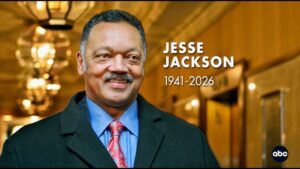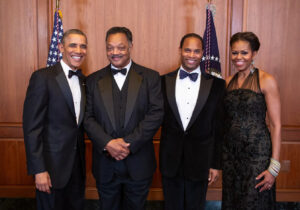
* Reverend Jackson also created opportunities for generations of African Americans and inspired countless more, including us
* Michelle got her first glimpse of political organising at the Jacksons’ kitchen table when she was a teenager
Maravi Express
As eulogies keep pouring in following the passing of America’s iconic civil rights leader, Rev. Jesse Louis Jackson, first black US President Barack Obama credited the iconic civil rights leader, who died on Tuesday aged 84, with laying the foundation for his own successful presidential run.

Advertisement
In a statement on Barack Obama Medium, the former President said: “Michelle and I were deeply saddened to hear about the passing of a true giant, the Reverend Jesse Jackson. For more than 60 years, Reverend Jackson helped lead some of the most significant movements for change in human history.
“From organising boycotts and sit-ins, to registering millions of voters, to advocating for freedom and democracy around the world, he was relentless in his belief that we are all children of God, deserving of dignity and respect.
“Reverend Jackson also created opportunities for generations of African Americans and inspired countless more, including us. Michelle got her first glimpse of political organizing at the Jacksons’ kitchen table when she was a teenager. And in his two historic runs for president, he laid the foundation for my own campaign to the highest office of the land.

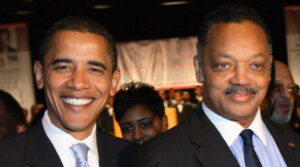
“Michelle and I will always be grateful for Jesse’s lifetime of service, and the friendship our families share. We stood on his shoulders. We send our deepest condolences to the Jackson family and everyone in Chicago and beyond who knew and loved him.”
CNN wrote: “Obama may have never made it to the White House without Jackson’s pioneering presidential runs. Jackson successfully fought to the awarding of delegates during the Democratic primaries from a winner-take-all system that benefitted frontrunners to a proportional system that helped other candidates even if they didn’t win a state.
“Jesse Jackson was once asked if it hurt that he didn’t become the nation’s first black president: ‘No, it doesn’t,’ he told a Guardiancolumnist, ‘because I was a trailblazer, I was a pathfinder. I had to deal with doubt and cynicism and fears about a black person running. There were black scholars writing papers about why I was wasting my time. Even blacks said a black couldn’t win’.

An emotional Jesse Jackson at the first inauguration of Barack Obama
“Jesse Jackson smashed the perception that a black person couldn’t be a viable presidential candidate. Some pundits predicted he would be outclassed by his more experienced political opponents during the presidential debates. They grudgingly recognised his charisma, but many never gave him credit for his analytical ability and political savvy,” wrote CNN.
Jesse Jackson had worked with Donald Trump in the 1990s on urban development programmes and in his tribute as US President, Trump said: “I knew him well, long before becoming President. He was a good man, with lots of personality, grit, and ‘street smarts.’
“He was very gregarious, someone who truly loved people! Jesse was a force of nature like few others before him,” wrote the US President, who was also quoted by Sky News as saying: “Despite the fact that I am falsely and consistently called a racist by the scoundrels and lunatics on the radical left, Democrats ALL, it was always my pleasure to help Jesse along the way.”
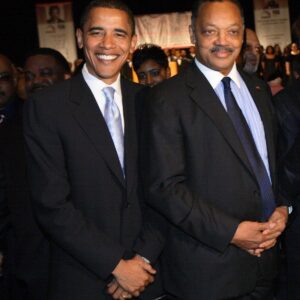
He also took a swipe at Obama, claiming that Rev Jackson had “much to do” on his election, but was not acknowledged or given credit, alleging that Jessie Jackson “could not stand” Obama.
On his part, former president Bill Clinton and his wife Hilary said in a joint statement: “Reverend Jackson never stopped working for a better America with brighter tomorrows.”
Clinton, who awarded Jesse Jackson the Presidential Medal of Freedom in 2000, the nation’s highest civilian honour, added that their “dear friend” had “championed the concerns of Black, Latino, Asian and lower-income white Americans”.
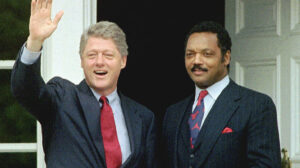

The eulogies for the protege of Rev. Dr. Martin Luther King Jnr. first started with the Jackson family itself when announcing the sad news, saying: “Our father was a servant leader — not only to our family, but to the oppressed, the voiceless, and the overlooked around the world.
“We shared him with the world, and in return, the world became part of our extended family. His unwavering belief in justice, equality, and love uplifted millions, and we ask you to honor his memory by continuing the fight for the values he lived by.”
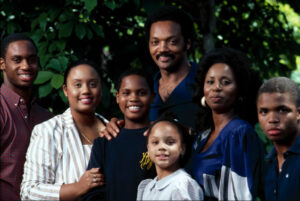
Jackson poses with his family during his 1984 presidential campaign. He and his wife, Jacqueline, had five children together: Jonathan, Santita, Yusef, Jacqueline and Jesse Jr. (Getty Images)
Jesse Jackson was with Martin Luther King when he was assassinated in 1968 Lorraine Motel in Memphis, Tennessee where the National Civil Rights Museum was set up. In its eulogy, the Museum said: “He was a frequent presence during our April 4th commemorations of Dr. King’s assassination at the Lorraine Motel, not as a guest, but as a witness to history and a steward of King’s unfinished work.
“His words, presence, and leadership during those solemn remembrances reminded us all of the price of freedom and the urgency of our continued struggle.”

With Martin Luther King moments before he was assassinated in May 1968

Civil rights ldr. Andrew Young (L) and others standing on balcony of Lorraine motel pointing in direction of assailant after assassination of civil rights ldr. Dr. Martin Luther King, Jr., who is lying at their feet.
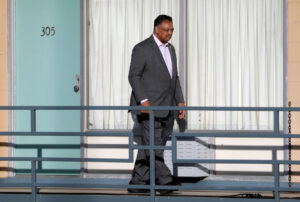
Jesse Jackson walks past room 305 at the National Civil Rights Museum in April 2018 as a tribute. (AP)
Rev. Bernice King, daughter of Martin Luther King said: “He was a gifted negotiator and a courageous bridge‑builder, serving humanity by bringing calm into tense rooms and creating pathways where none existed.
“My family shares a long and meaningful history with him, rooted in a shared commitment to justice and love. As we grieve, we give thanks for a life that pushed hope into weary places.”
Son of Martin Luther King III and his wife, Arndrea Waters King, wrote: “Reverend Jackson was more than a civil rights advocate — he was a living bridge between generations, carrying forward the unfinished work and sacred promise of the Civil Rights Movement.
“He walked with courage when the road was uncertain, spoke with conviction when the truth was inconvenient, and stood with the poor, the marginalized, and the forgotten when it was not popular to do so.”
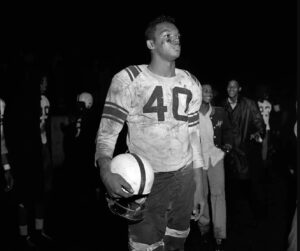
Jackson at Sterling High School’s 1958 homecoming football game, in Greenville, South Carolina. Jackson was a prolific athlete in high school
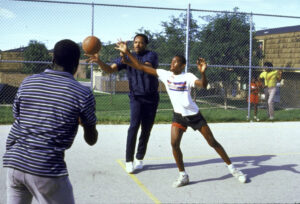
Playing basketball with his family
Along with Jesse Jackson in the civil rights movement with Martin Luther King was Rev. Al Sharpton, who turned champions of equality in America, forged a relationship that lasted more than 70 years as they continued the fight for justice inherited from great civil rights leaders — from Medgar Evers to Martin Luther King.
At a press conference Tuesday in Midtown, Sharpton mourned his longtime friend and mentor’s death crediting Jesse Jackson as a consequential and transformative leader who changed the civil rights movement broadly, as well as New York and American politics.

Rev. Al Sharpton at the press conference

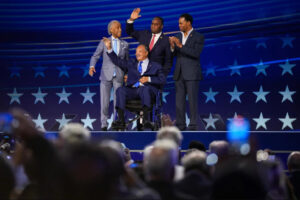
“Today, I lost the man who first called me into purpose when I was just twelve years old and our nation lost one of its greatest moral voices,” Sharpton said. “The Reverend Jesse Louis Jackson was not simply a civil rights leader; he was a movement unto himself.
“He carried history in his footsteps and hope in his voice. One of the greatest honors of my life was learning at his side. He reminded me that faith without action is just noise.
“He taught me that protest must have purpose, that faith must have feet, and that justice is not seasonal, it is daily work. It was in 1984, when he ran for President, that he changed the rules that primaries were governed by. It was Jesse changing the rules to proportional delegate representation is how Barack Obama was made the nominee.“
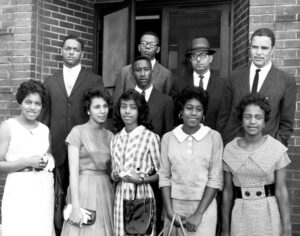
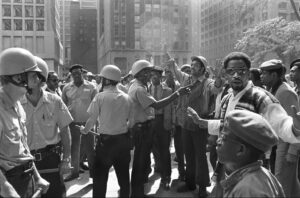

Senator Raphael Warnock of Georgia, senior pastor at Ebenezer Baptist Church, where Rev. Martin Luther King Jnr. pastored for a time, said: “With an eloquence and rhythmic rhetoric all his own, Jesse Jackson reminded America that equal justice is not inevitable — it requires vigilance and commitment, and for freedom fighters, sacrifice.
“His ministry was poetry and spiritual power in the public square. He advanced King’s dream and bent the arc of history closer to justice.”

Jackson is seen inside the doorway at the top left as Martin Luther King Jnr. speaks at a church in Washington, DC, in February 1968
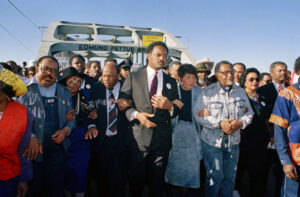
Jackson and other civil rights activists recreate Selma-to-Montgomery marches made in 1965 by Martin Luther King in this photo in Alabama in March 1990. (AP)
The National Association for the Advancement of Coloured People (NAACP), US’ oldest and largest civil rights organisation founded in 1909 to fight racial injustice, discrimination, and violence, said: “Rev. Jesse Jackson was not only a civil rights icon — he was family to the NAACP.
“His work advanced Black America at every turn. He challenged this nation to live up to its highest ideals, and he reminded our movement that hope is both a strategy and a responsibility.
“His historic run for president inspired millions and brought race to the forefront of American politics,” said the NAACP chairman, Leon W. Russell; vice-chair, Karen Boykin Towns and president & CEO Derrick Johnson in a statement.
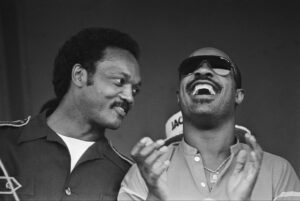
Jackson with singer Stevie Wonder as he leads a crowd in a rendition of the campaign chant ‘Run, Jesse, Run’ in June 1984. (Getty Images)

Jackson jokes around with DJ Jazzy Jeff and Will Smith while appearing on an episode of ‘The Fresh Prince of Bel-Air’ in 1990. (Getty Images)

With Cuban President Fidel Castro in June 1984 where Jackson went to secure the release of 48 Cuban and Cuban-American prisoners. (AP)
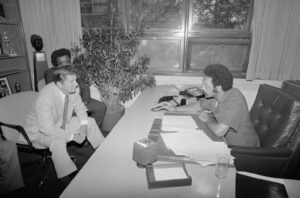
Republican presidential candidate Ronald Reagan listens to Jackson during a visit to Operation PUSH headquarters in August 1980. (Getty Images)
“Because of Rev. Jackson, millions were empowered to say, ‘I am somebody’,” says Ben Crump, civil rights attorney. “His legacy is woven into every advancement in voting rights, economic justice, and civil rights over the last half-century.”
In 2013, the Jesse Jackson was awarded South Africa’s National Order of the Companions of O.R. Tambo, in Silver, for his outstanding contribution to the fight against apartheid — thus South African President Cyril Ramaphosa paid his tribute:
“His campaigns for an end to apartheid included disinvestment from the apartheid economy and challenging the support the regime enjoyed in certain circles and institutions internationally.
“We are deeply indebted to the energy, principled clarity and personal risk with which he supported our struggle and campaigned for freedom and equality in other parts of the world.”
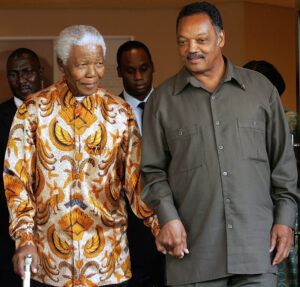
Jesse Jackson with Nelson Mandela after their meeting in Johannesburg October 26, 2005. (AP)

With Ramaphosa when he became South Africa’s president
Rev. William Barber, minister and activist, summed it up: “Indeed, Jesse Jackson was a gift from God and a witness that God exists in the ways he cared for and lifted all people, the way he called forth a rainbow coalition of people to challenge economic and social inequality from the pulpit to a historic presidential run, the way he dared to keep hope alive whenever the nation struggled with being who she says she is and yet ought to be.”—Info by Barack Obama Medium; CNN; Sky News & The Associated Press; edited by Duncan Mlanjira, Maravi Express