

* With the growing cost of service delivery, coupled with replacement of vandalised infrastructure such as road structures (street lights and signs) and sewer infrastructure system, the revenue collected is never enough
* As it includes meeting other equally crucial amenities such as garbage collection and other service management costs
* We need to realise that the Council is having serious cashflow problems. We are, however, appealing to private sector to join hands with the Council in ensuring amenities are provided
By Duncan Mlanjira
Blantyre City Council assures its residents that it is doing all it can in providing better service delivery from the revenue it generates, saying what residents pay as city rates is heavily subsidised by the Council in order to meet growing cost of maintaining most of compromised amenity infrastructure.

Advertisement
This has been said by Blantyre City Council Chief Executive Officer, Dennis Chinseu in response to concerns raised by Mpingwe and Maone residents in Limbe, who were bemoaning pot-holed condition of the stretch of road to Zomba towards the roundabout to Maone and Mpingwe residential areas access roads.
The residents also raised concerns of all other roads in the city of Blantyre, being riddled with potholes as well as replacement of street lights — which were vandalised but are not being replaced.
A concerned resident, who asked not to be mentioned, reached out to Maravi Express asking if the Minister of Transport & Works could intervene, saying: “Why are Blantyre City Council fathers sleeping on their job yet we pay city rates to maintain such amenities?”
When contacted, Chinseu said the Council is fully aware of the state of this stretch of the road towards Kachere trading centre, adding that it was unfortunate the concerned residents did not indicate that there were worse potholes before in January which were sealed in February.

Blantyre City Council CEO, Dennis Chinseu
“Unfortunately, immediately after sealing the potholes, there were heavy rains and everything done was lost,” Chinseu said. “We always work within the available resources [and] we need to realise that the Council is having serious cashflow problems.
“We are, however, appealing to the private sector to join hands with the Council in ensuring amenities are provided,” Chinseu said, adding that in the last financial year, the Council collected K9 billion — which is just less than 10% of profit for one financial institution.
But, he added — with the growing cost of services delivery, coupled with replacement of vandalised infrastructure such as road structures (street lights and signs) and sewer infrastructure system — the revenue collected is never enough as it includes meeting other equally crucial amenities such as garbage collection and other service management costs.

Advertisement
This was also in response to Maone and Mpingwe residents, who complained that it’s been over four weeks that the City Council has failed to collect garbage and that when they inquired there were told that garbage collection trucks were broken down and that sometimes they don’t have fuel to cater for the whole city.
Chinseu indicated that this was an exaggeration saying “if it was as indicated then the whole stretch of the road would have been full of refuse as the people [have the contemptible penchant of] throwing the refuse by the roadside”.
“The question should be, how much is paid as city rates? What is the cost of providing the services being asked for? In the residential area being mentioned, we get close to K50 million per annum in rates.
“How much will it cost the Council to install street lights the whole stretch? Definitely more than K50 million. How much will it cost to fix the potholes the whole stretch? possibly around K30 million — which unfortunately was already spent in February; but that does not mean the road has been abandoned.

“How much will it cost the Council to collect refuse from that neighbourhood for 52 week since we collect once a week? They shouldn’t only focus on cost of fuel — include the labour involved and wear-and-tear of our vehicles.”
Chinseu maintained that “potholes emerge during the rainy season and they are fixed generally in the dry season unless they are very deep”. He gave examples of affected roads such as Kenyatta Drive which had potholes from Kanjedza to Kamba, which were fixed.
“Visit Bangwe Road at Nthandizi and tell us if the Council is not working; visit Mudi Bridge [along Victoria Avenue] which was in a mess and tell us if nothing was done; visit Makata Road at Blantyre Netting [Ndirande] or Maselema Roundabout, which had deep potholes and tell us if Council has done nothing.“
On refuse collection, Chinseu indicated that “it is also unfair to claim that nothing is being done” as the Council has provided rubbish skips in residential areas which they collect — giving immediate examples of Chiwete Market, Chemussa Market, Nthandizi; Ndirande — and several other places to ease the burden of constant weekly collection.
He thus appealed to residents to be responsible by managing their waste utilising the rubbish skips, emphasising that it is for the good welfare of everyone in as far as health safety is concerned.

Keeping city clean is a must
He also bemoaned rampant vandalism of public infrastructure, saying it was costly to rehabilitate and replace — affecting the operations of the Council in its mandate to deliver better services.
The City Council has always implored on residents to have the responsibility of taking care of public property and to report to the police any suspicion they may have on people suspected of been involved in vandalism.
Recently, a man was caught desecrating graveyards to steal parts of the expensively assembled tombstones — an act of vandalism which the public describing is as “simply downright wickedness”.
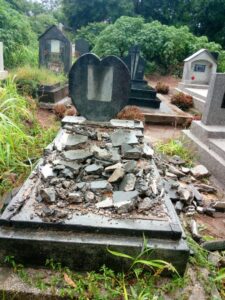
Of course, there have been many reports previously that people with wicked minds have gone on dig up fresh graves to steal the expensive caskets and leaving the dead body without even re-burying it — some even being removed of their expensive clothes.
Others have gone on to steal the plastic wreaths placed on graves to resell them — prompting beareved families to opt to tear off the beautifully-crafted wreaths and burn them, a decision that has perplexed many sympathisers.
Pictures were awash on social media in January depicting tombstones that were destroyed at Blantyre Synod’s and City Council’s HHI Cemetery — a departure from the norm of constant vandalism of city infrastructure, which is very costly to replace and eats away the revenue collected that could have been used to improve on many service delivery the Council always plans to execute.


Advertisement