


* All property owners encouraged to register with MRA through the Msonkho Online Portal to obtain a tax identification number (TIN) as well as declare rental income in their annual tax return
* Some property owners are not yet registered for tax purposes and thus warns that failure to declare income is an offence under revenue laws
By Duncan Mlanjira
The Malawi Revenue Authority (MRA) is reminding residential and commercial property owners that rental income from their premises is taxable by law and thus advises them to get registered.

Advertisement
A statement published on its official Facebook account, advises all property owners to register with MRA through the Msonkho Online Portal to obtain a tax identification number (TIN) as well as declare rental income in their annual tax return.
The tax collector indicates that it has taken note that some property owners are not yet registered for tax purposes and thus warns that “failure to declare income is an offence under revenue laws”.
“MRA is informing all property owners that from the month of February, 2026, it will embark on a nationwide exercise to identify property owners,” says the statement. “Those who have not yet registered are, therefore, encouraged to register voluntarily to avoid statutory penalties.”
For more information, MRA is encouraging property owners to visit their nearest MRA office or to call toll free number 672 of WhatsApp +265 996 278 690.
Meanwhile, ZBSNews reports that MRA has recruited 100 interns to facilitate the identification and registration of property owners as part of the implementation of Rental Income Tax.
The report quotes MRA Commissioner General Felix Tambulasi saying the interns will help identifying the number of rental houses across the country, an exercise expected to assist the authority in estimating the amount of revenue to be generated.

MRA Commissioner General Felix Tambulasi
He indicated that the exercise will be implemented in phased approach, starting with a pilot project in selected low-density areas and in Blantyre, the pilot phase will cover areas such as Namiwawa, Nyambadwe and Sunnyside, while in Lilongwe it will include areas like Area 10 and Area 47, among others.
MRA also indicated that following the publication of the Value Added Tax (Electronic Invoicing System) Regulations, 2025 on January 9, 2026, the transition period for the Electronic Tax Invoicing System (EIS) ends on Saturday, January 26, 2026.
“Taxpayers are strongly advised to utilise the remainder of the transition to ensure full compliance with the laws and regulations governing EIS,” says a statement also published on the MRA official Facebook page.
“At the end of the transition period on 31 January, 2026, taxpayers will no longer be allowed to use Electronic Fiscal Devices (EFDs) for issuing tax invoices, and a tax invoice issued from EFD after 31 January, 2026 shall not be acceptable for claiming of input tax.”
For further guidance and support, the concerned taxpayers are also encouraged to contact Call Centre toll free number 672 or to visit nearest MRA office in their areas.
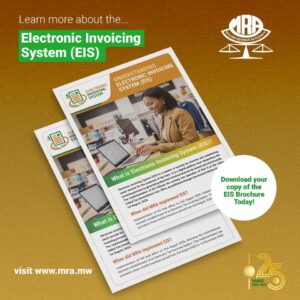
The electronic invoicing is a system which generates, sends, receives and stores invoices, receipts or tax invoices in digital form, which is integrated with the point of sale (POS).
The reason for implementing the EIS is to improve tax compliance and revenue collection, prevent under-reporting of sales by businesses, reduce VAT evasion and fraud but also ease burden on small businesses since they can use smartphones because there will be no need to buy or replace EFDs.
Another reason is to improve MRA’s efficiency, accuracy and transparency of operations by getting business sales data in real time which can facilitate quick MRA audits and checks.


Advertisement