
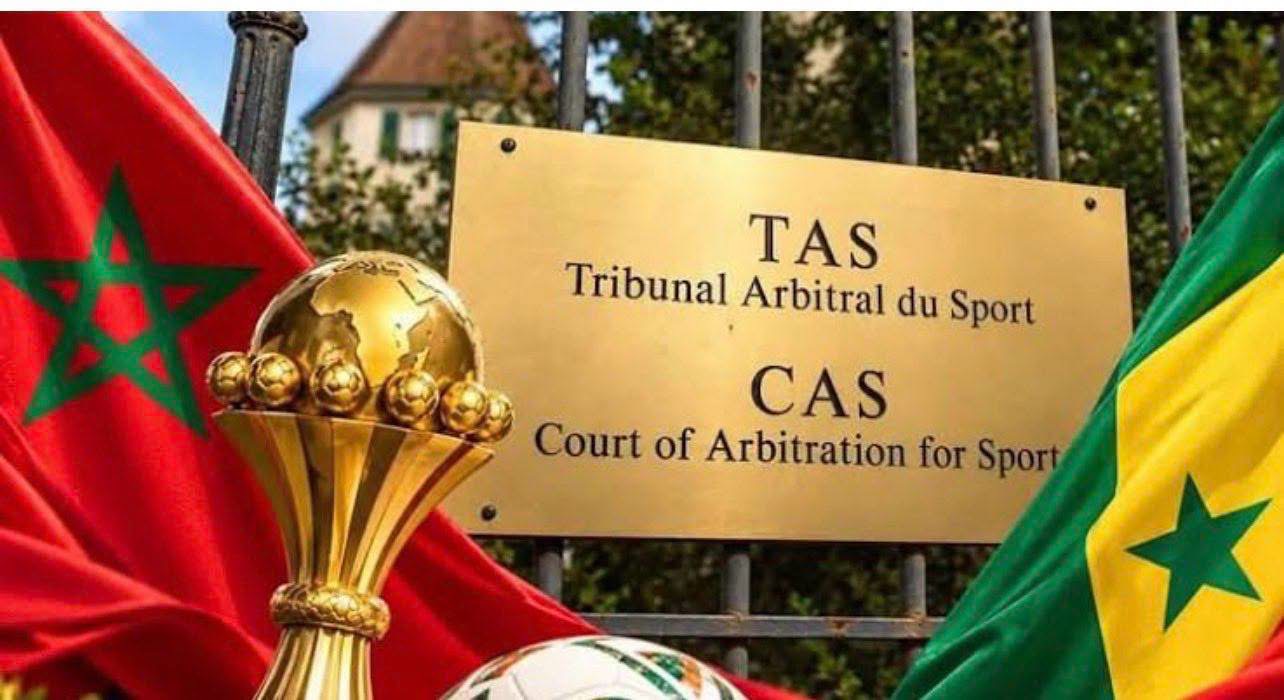
* To pursue all available legal avenues to challenge the ruling, raising questions about the integrity of the arbitration proceedings
* The position reflects a shift in the dispute from seeking to establish its national team’s entitlement to the title to challenging the soundness of the process that upheld Senegal’s 1-0 victory
The Arab Weekly
The Court of Arbitration for Sport’s (CAS) decision to restore Senegal’s Africa Cup of Nations (AfCON) 2025 title has failed to end the controversy surrounding the final, instead opening a new phase in the legal confrontation between the Moroccan and Senegalese football federations.

Advertisement
The Royal Moroccan Football Federation has announced its intention to pursue all available legal avenues to challenge the ruling, raising questions about the integrity of the arbitration proceedings and the independence of one of the arbitrators.
Morocco’s position reflects a shift in the dispute from seeking to establish its national team’s entitlement to the title to challenging the soundness of the process that upheld Senegal’s 1-0 victory.
The Moroccan federation is not only contesting the court’s interpretation of the tournament regulations — it has also raised the issue of an alleged contact between German arbitrator Ulrich Haas and Senegalese Football Federation President Abdoulaye Fall, which it said took place about 48 hours before the ruling was issued.

Fouzi Lekjaa, the President of the Royal Moroccan Football Federation (FRMF)
Before the decision was announced, Reuters reported, citing a source familiar with the matter, that the Moroccan federation had informed the court of the alleged contact.
The source was not authorised to speak publicly about the case. Reuters said it had been unable to independently verify whether the call took place or establish its content.
The CAS ruling further complicated Morocco’s position by overturning a decision by the Confederation of African Football’s (CAF) Appeals Board, which had deemed Senegal to have forfeited the match and awarded Morocco a 3-0 victory.
Instead, the court reinstated the decision of CAF’s Disciplinary Board, which had upheld the original result: a 1-0 win for Senegal.

The ruling was unanimous among the three members of the arbitration panel, chaired by Frenchman Gérald Simon and comprising Germany’s Ulrich Haas and Italy’s Luigi Fumagalli.
The court based its decision on the fact that Congolese referee Jean-Jacques Ndala had final authority to decide whether the match should resume or be abandoned.
It found that his decision to restart play after Senegal’s players returned to the pitch fell within what is known in sports law as the principle of the referee’s authority on the field.

Jean-Jacques Ngambo Ndala
CAS considered that Articles 82 and 84 of the Africa Cup of Nations regulations, on which Morocco had based its appeal, applied to situations in which the conduct of one of the teams resulted in the definitive termination of a match. It found that this had not happened in the final.
The court ruled that the referee had committed no legal error by allowing play to resume, noting that both teams had returned to the pitch and indicated their willingness to continue the match.
It also acknowledged that the decision had been taken in an atmosphere of extreme tension, but found nothing to justify describing it as arbitrary or concluding that the referee’s judgement had been influenced by factors outside the match.
CAS further explained that the sanctions imposed by CAF on the Senegalese federation, its coach and several players had been handed down through separate disciplinary proceedings and did not conflict with its decision to uphold the match result.
The significance of the dispute lies in Morocco’s attempt to pursue a parallel challenge to the sporting and legal basis of the ruling by focusing on guarantees of independence within the arbitration panel.
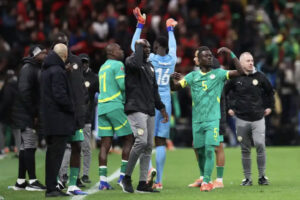
Senegal’s Idrissa Gueye gestures to his teammates to leave the pitch after a penalty is awarded to Morocco in the Afcon final in January. (Amr Abdallah Dalsh/Reuters)
From this perspective, the issue is not simply whether the referee correctly applied the tournament regulations, but also whether the proceedings leading to the decision met the standards of impartiality and equality between the parties.
Morocco’s challenge may extend beyond revisiting the incident in which Senegal’s players left the pitch to establishing whether a fundamental procedural flaw occurred that could affect the validity of the ruling.
The decision also puts CAF’s legal framework to the test. The process produced two conflicting rulings on the same match, first from the Disciplinary Board and then from the Appeals Board, before CAS reinstated the original result.
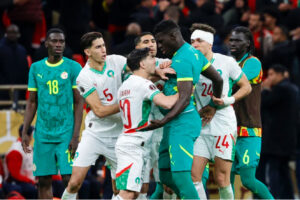
Senegal and Morocco players clash during the Africa Cup of Nations final (AFP/Getty Image)
This sequence raises questions about the clarity of the tournament regulations and how they are applied, particularly in cases where the referee’s authority on the field intersects with disciplinary sanctions arising from teams’ conduct.
The question is no longer limited to which side deserves the tournament title. It has also become a test of whether sporting institutions can convince the parties involved of the soundness of their decisions and the independence of their procedures.
With Senegal standing by the ruling that restored its title and Morocco determined to continue its challenge, the dispute is entering a new legal phase, centred on confidence in sports arbitration and the limits of reviewing its decisions.

Advertisement