
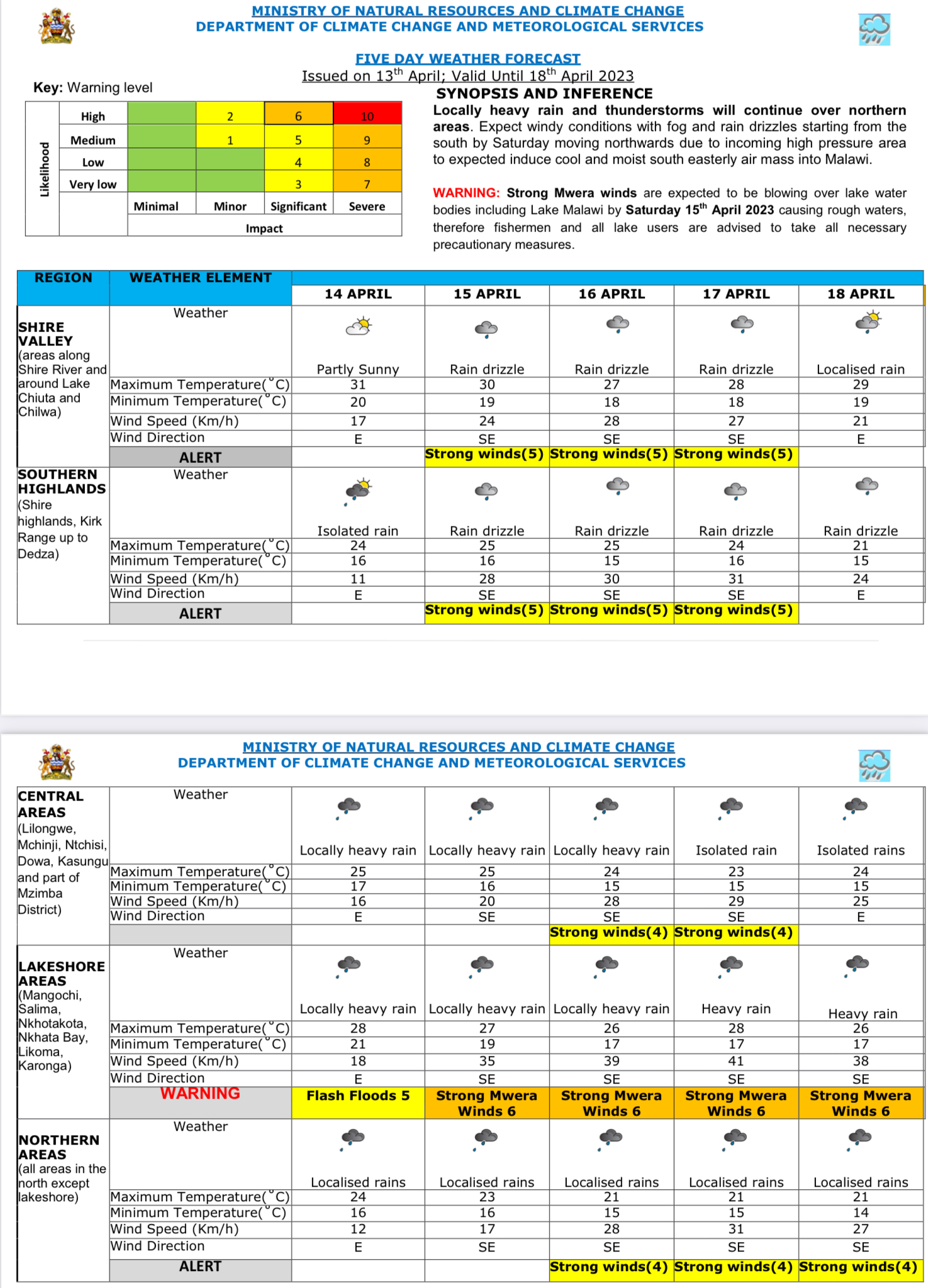
* Locally heavy rain and thunderstorms will continue over northern areas
* Expect windy conditions with fog and rain drizzles starting from the south by Saturday
By Duncan Mlanjira
The Department of Climate Change & Meteorological Services has advised fishermen and all lake users to take all necessary precautionary measures as strong Mwera winds are expected to be blowing over lake water bodies including Lake Malawi causing rough waters by tomorrow (Saturday April 15).

Advertisement
In its five day weather forecast, the Met. Department says locally heavy rain and thunderstorms will continue over northern areas and to expect windy conditions with fog and rain drizzles starting from the south by Saturday — moving northwards due to incoming high pressure area to expected induce cool and moist south easterly air mass into Malawi.
The country keeps experiencing some heavy rains long after Cyclone Freddy and just last weekend Rumphi District Council reported that 130.4 hectares of crops were destroyed following heavy rains received in the area.
Rumphi District Council public relations officer, Matthews Mkandawire reported that the crops included maize, rice, cassava and sweet potatoes belonged to 733 farmers.
The rains also destroyed 41 government houses, three bridges and roads and also displaced some people from their homes, especially those along Chihanga River which flooded and destroyed houses and washed away crops.


Advertisement
In its consolidated assessment report, Department of Disaster Management Affairs (DoDMA), the highest reported impact of effects of Cyclone Freddy was in the agriculture sector where a total of 2,267,458 (1,110,639 male, 1,156,819 female) people — translating to 523,564 households — lost their crops and livestock.
“The second highest recorded impact was food-security with 901,466 households being food insecure. In terms of shelter, 882,989 households had their houses either partially or completely damaged.
“From the population with completely damaged houses, 659,278 people were rendered homeless and sought refuge in 747 camps.

“Zomba district had the highest number of camps at 219, whereas Mulanje district had the highest displaced population at 131,830 spread across 128 camps.
“The number of deaths recorded was 679 spread across 6 districts while 511 people were reported as missing with 2,178 people were injured during the disasters.
“Various critical infrastructure were affected disrupting service provision to the affected areas and the nation, at large. Rivers were full of debris, to the extent that the Electricity Generation Company had to shut down all generators on the Shire River, thereby causing national wide blackouts.
“The direct impacts on households range from loss of crops, property and homes to widespread deaths and injuries with some people missing.”

Advertisement