
* Malawi Police and other security agencies urged to upheld their important role which is central to the credibility of elections
* Presence of security officers at electoral events — including for the ruling political party or the opposition or independents — reassures the public and contributes to an atmosphere of peace and order
* In any electoral contest, the acceptance of results — particularly by those who may not emerge victorious — is more likely if the election is conducted in a peaceful, fair, and credible environment
By Duncan Mlanjira
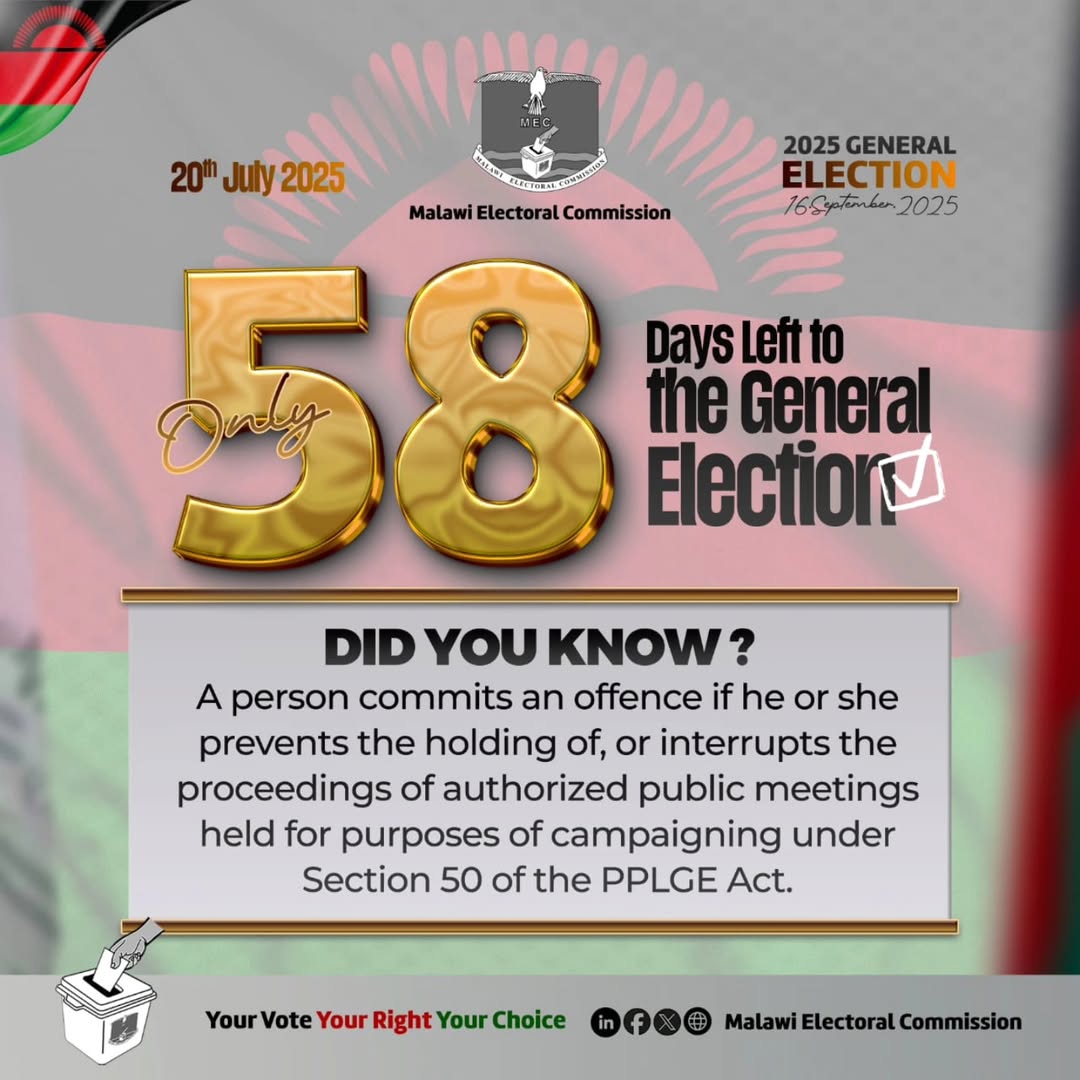
As the countdown to September 16 is 58 days remaining — coupled with the official launch of the campaign period from Monday — the Malawi Electoral Commission (MEC) is reminding the nation that a person commits an offence under the electoral law “if he or she prevents the holding of, or interrupts the proceedings of, an authorised public meeting held for purposes of campaigning”.

Advertisement
This is part of the guidelines in the Code of Conduct for Campaign as guided under Section 50 of the Presidential, Parliamentary and Local Government Act — that promotes peaceful and non-violence during the election campaign period.
At the official launch of the campaign period, MEC chairperson, Justice Annabel Mtalimanja urged the Malawi Police and other security agencies to upheld their important role — saying they are “central to the credibility of elections”.
She underscored that the presence of security officers at electoral events — including for the ruling political party or the opposition or independents — “reassures the public and contributes to an atmosphere of peace and order”.

Launch of MCP manifesto yesterday

“Conversely, when voters perceive fear, intimidation, or violence, their willingness to participate may be diminished, thus affecting the integrity of the entire process,” she said, adding that MEC “acknowledges the longstanding cooperation it has received from the country’s security agencies — particularly the Malawi Police Service.
“Since the re-introduction of multi-party electoral democracy in the country, our joint efforts have significantly contributed to ensuring peaceful and credible electoral processes.
“While each electoral cycle presents its own unique challenges, and it is encouraging that through continuous engagement, we have been able to learn, adapt, and improve our inter-institutional cooperation.

Tight security at demonstrations during the 2019 presidential election court case
“From the experiences in preceding stages of this electoral cycle — such as during voter registration and other preparatory phases — the Commission observed a commendable level of professionalism and support from the security agencies.”
She emphasised that “in any electoral contest, the acceptance of results — particularly by those who may not emerge victorious — is more likely if the election is conducted in a peaceful, fair, and credible environment”.
“Security institutions, therefore, play an indispensable role in upholding this trust. The forthcoming General Election presents an opportunity for the Malawi Police Service and other security agencies to further reinforce public confidence by continuing to act with due professionalism.


Advertisement
“The electorate expects the Malawi Police Service and any other security agency that steps in to assist them to undertake their mandate with a spirit of political neutrality.
“The perception of neutrality is just as important as neutrality itself. It is the expectation of all electoral stakeholders and the wider public that all political actors — regardless of affiliation — will be treated equally, and that law enforcement agencies will act decisively and consistently in the face of electoral offences.”
Meanwhile, MEC also reminds aspiring candidates, who paid the needful fees and collected their nomination papers, that the pollster will start receiving them from July 24-30 — with emphasis that the submission should be timely to reduce chances of being rejected.
