

Analysis by Chifi Mhango, Chief Economist and Executive Director-Don Consultancy Group
1. Introduction
Malawi needs to rethink how its banking system finances productive investment, as latest released Reserve Bank of Malawi figures reveal declining credit exposure to manufacturing, agriculture, construction and mining.

Advertisement
The latest private sector credit statistics released by the Reserve Bank of Malawi (RBM) for August 2026 raise important questions about the direction of credit allocation in Malawi’s economy and its implications for industrialisation, employment creation and sustainable economic growth.
According to the RBM, annual private sector credit growth decelerated to 23.7% in August 2026, down from 26.8% in July 2026 and significantly below the 40.6% recorded in August 2025.
More concerning is the slowdown in monthly credit expansion, with the stock of private sector credit increasing by just K5.8 billion in August, compared with K54.9 billion in July.
Although the total stock of private sector credit reached approximately K2.6 trillion, the underlying composition of lending reveals a potentially significant structural challenge that some of Malawi’s most important productive sectors are experiencing net repayments rather than credit expansion.
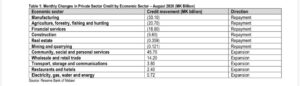
Manufacturing recorded net credit repayments of K33.1 billion, followed by agriculture, forestry, fishing and hunting at K20.7 billion.
Construction recorded repayments of K5.6 billion, while financial services, real estate and mining also experienced net repayments.
This development deserves serious attention because these sectors are central to Malawi’s ambitions to diversify its economy, strengthen domestic production, reduce import dependence and expand export capacity.
2. Manufacturing sector
The K33.1 billion reduction in manufacturing credit is particularly concerning. Manufacturing requires continuous access to working capital and long-term investment financing to acquire machinery, purchase raw materials, expand production capacity and improve operational efficiency.
When manufacturers reduce their borrowing, it may reflect several underlying developments, including high financing costs, subdued demand, tighter lending conditions, reduced investment appetite or businesses prioritizing debt repayment.
While loan repayments should not automatically be interpreted as evidence of financial distress or declining production, the trend warrants closer investigation.
Malawi cannot realistically pursue industrialization without ensuring that its manufacturing enterprises have access to affordable and appropriately structured financing.
The country needs to move beyond discussing industrialisation as a policy aspiration and address the financing conditions required to make it commercially viable.

3. Agriculture and Mining
Agriculture recorded net credit repayments of K20.7 billion. This is significant for an economy where agricultural production remains central to employment, foreign exchange generation and industrial raw material supply.
The transition from subsistence agriculture towards commercial farming requires investment in irrigation, mechanisation, improved seeds, storage, logistics and agro-processing.
Limited access to appropriately structured agricultural financing could constrain this transformation.
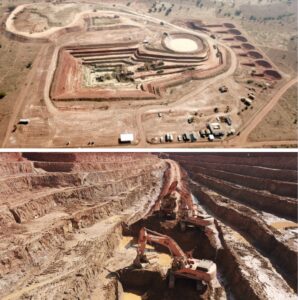
Similarly, Malawi’s ambitions to develop its mineral resources require substantial investment in exploration, extraction, processing, energy and infrastructure.
The net repayment of K120.7 million in mining and quarrying credit, although relatively modest, highlights the importance of examining whether the country’s financial system is adequately positioned to support emerging investment opportunities in the mining value chain.
4. Credit expansion picture
Interestingly, the RBM figures show that credit expansion is taking place in other parts of the economy.
Community, social and personal services recorded an increase of K45.7 billion, while wholesale and retail trade expanded by K14.2 billion.
Transport, storage and communications recorded an increase of K3.8 billion, followed by restaurants and hotels at K2.4 billion and electricity, gas, water and energy at K720 million.
At the same time, individual and household loans increased by K45.8 billion, while mortgages expanded by K1.7 billion.
There is nothing inherently wrong with financing households, trade and services. These activities contribute to economic growth, employment and financial inclusion.
However, the composition of credit matters, particularly in an economy that needs to expand domestic productive capacity.
The critical question is whether Malawi’s banking system is allocating sufficient financing towards activities that increase domestic production, strengthen value chains, generate exports and create sustainable employment.
In an economy facing foreign exchange constraints, financing consumption without a corresponding expansion in domestic production can create additional pressure through increased demand for imported goods.
This is not an argument against household lending, but rather a call for a better balance between consumption financing and productive investment.
The Reserve Bank of Malawi
5. Banking and economic transformation
Malawi’s challenge should not be measured solely by the growth of private sector credit. The country must also examine the economic returns generated by that credit.
A banking system can report strong credit growth while the productive capacity of the economy remains constrained.
What matters is whether financing translates into new factories, expanded agricultural production, improved infrastructure, mineral beneficiation, export competitiveness and employment creation.
This requires a stronger partnership between commercial banks, development finance institutions, government and the RBM. Development finance institutions should play a more complementary role in mobilising long-term capital for projects that commercial banks may find difficult to finance independently.
Credit guarantees, risk-sharing arrangements, blended finance and appropriately structured long-term investment facilities could help unlock investment in manufacturing, commercial agriculture, agro-processing and mining.
Commercial banks, meanwhile, should be encouraged to strengthen their financing of domestic value chains, particularly where investment can reduce import dependence and increase export earnings.
The RBM should also strengthen its monitoring of productive-sector credit allocation, including manufacturing, agriculture, mining, export-oriented enterprises and small and medium-sized businesses.
Understanding why these sectors are recording net repayments is just as important as monitoring the overall growth of private sector credit.

Advertisement
6. Conclusion
The August 2026 credit statistics should serve as an important policy signal. The country cannot achieve sustainable economic transformation if the financing system does not adequately support the sectors responsible for producing goods, generating foreign exchange and creating productive employment.
The objective should not be to direct banks to lend indiscriminately or compromise sound credit-risk management. Rather, it should be to create an environment in which productive investments become more commercially viable, financing costs are manageable and investment horizons reflect the realities of the sectors being financed.
Ultimately, Malawi needs to move from a credit-growth-driven financial system towards a productive-investment-driven financial system.
Malawi cannot borrow its way into industrialisation if its financial system does not adequately finance the industries, farms and enterprises that produce the goods the country consumes and exports.

Advertisement
That is the fundamental economic challenge revealed by the latest RBM credit statistics.