
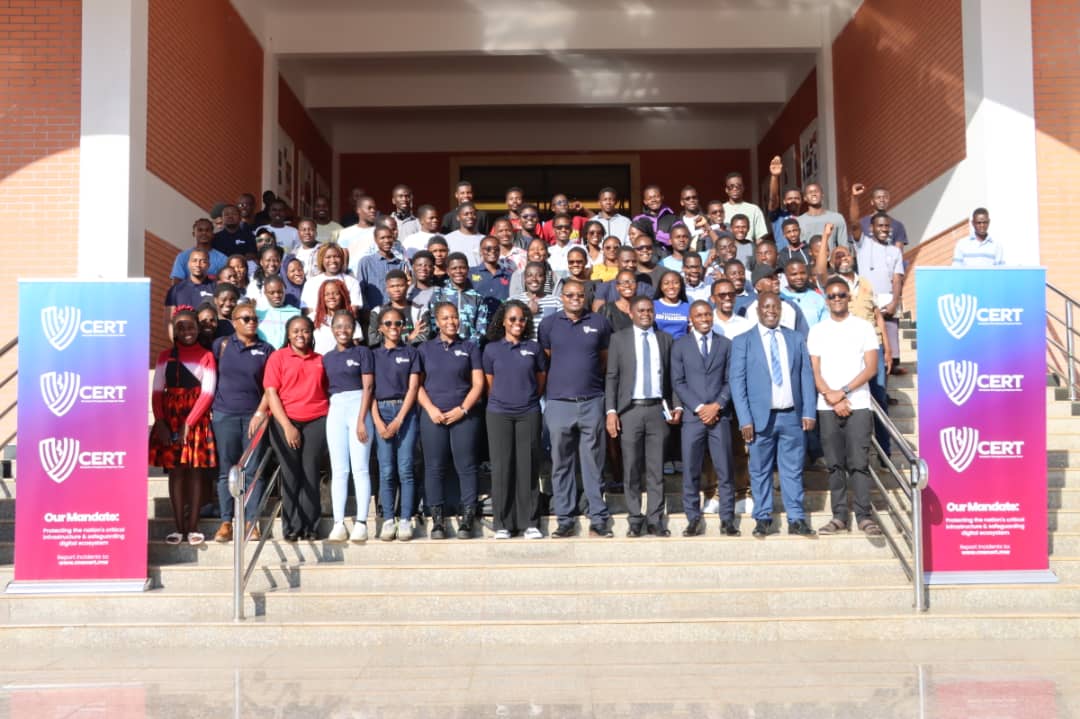
The ICT students that MACRA is reaching out at MUST
* Launches cyber drills through which university staff and students will be better prepared to effectively handle real-world cybersecurity threats
* In order to build a competent and cyber-resilient generation ready to defend the nation’s digital assets as they transition into the workforce
By Duncan Mlanjira
Malawi Communications Regulatory Authority (MACRA) is partnering with universities to train skilled cybersecurity professionals by launching cyber drills, through which staff and students will be better prepared to effectively handle real-world cybersecurity threats.

Advertisement
The programme, under MACRA’s Malawi Computer Emergency Response Team (mwCERT), will be implementing cyber drills in academic institutions across Malawi and was launched at Malawi University of Science & Technology (MUST) campus at Goliati in Thyolo on Monday — targeting its information & communication technology (ICT) staff and students.
It will further be rolled out for University of Malawi (UNIMA); Malawi University of Business & Applied Sciences (MUBAS); Lilongwe University of Agriculture & Natural Resources (LUANAR); Mzuzu University (MZUNI); Malawi College of Accountancy (MCA); National College of Information Technology (NACIT) and several other private tertiary institutions.
Head of mwCERT at MACRA, Christopher Banda said like many developing countries, Malawi faces a shortage of skilled cybersecurity professionals capable of defending its digital infrastructure against the growing cybersecurity threats — thus the cyber drills are designed to strengthen the awareness and technical capabilities of youth, who are the emerging into ICT professionals.

Head of mwCERT, Christopher Banda.—Pictures by Abel Ikiloni, MANA

“The drills are to meant to provide a technical environment and practice to build capacity in these young minds as they will highlight serious cybersecurity threats,” he said, while highlighting the immediate known threat as that of mobile money fraud.
“There are many other threats that Malawi is prone to that include mobile money fraud, phone hacking, impersonation, hate speeches, character assassinations, theft of personal data, and several others, which we need to protect in order to build a competent and cyber-resilient generation ready to defend the nation’s digital assets as they transition into the workforce.”
Banda added that MACRA recognised that key to this is to involve universities’ staff and students, who are already in the ICT programmes — thus rolling out the cyber drills with MUST with the other universities to follow — whose private institutions include University of Livingstonia; Malawi Assemblies of God University; DMI-St. John The Baptist University and Daeyang University.

The scope of the drills is focusing on students pursuing studies in cybersecurity, ICT, and other related fields, which will receive hands-on training designed to enhance their technical competencies and cybersecurity skills — to be delivered by mwCERT experts.
The academia staff, responsible for managing and overseeing the network and digital infrastructure, will receive specialised training focused on securing and maintaining institutional systems — to be conducted by Malawi Research and Education Network (MAREN), with technical support from mwCERT.
Additionally, an invitation on lessons to be covered will be extended to the Data Protection Authority (DPA) to deliver topics on data privacy and MUUNI Fund to deliver topics on digital innovation and entrepreneurship.
MUST’s head of Department of Computer Science & Technology, Associate Prof. Bennett Kankuzi said the launch of the programme couldn’t have been better placed to take place than at MUST as it is the pioneer institution that introduced a cybersecurity programme that was rolled out in 2016.

Associate Prof. Bennett Kankuzi (right)
“We are proud to partner with MACRA in this programme since we are producing the human capital into the ICT industry towards enhancement of cyber incident response capabilities among the students,” he said.
MACRA contends that the cyber drills represent a strategic initiative aimed at strengthening cybersecurity capacity within academic institutions and that by targeting both students and institutional staff, “the program ensures a holistic approach to building technical skills and enhancing the security of educational networks and systems”.
“The increasing digital transformation across Malawi driven by the adoption of e-services, financial technology, and online communication platforms has delivered numerous socio-economic benefits.
“However, it has also exposed the nation to growing cybersecurity threats. Cyberattacks such as distributed denial of service (DDoS), ransomware, phishing, and the exploitation of vulnerable systems pose serious risks to national security, economic stability, and public trust.”
Furthermore, MACRA says given the notable increase in cybersecurity challenges at the institutional level, the program aims to impact network administrators and technical staff with enhanced cybersecurity training and practical, hands-on skills.

The proposed cyber drills are to achieve the following objectives:
* enhance cyber incident response capabilities among students, aspiring professionals, and future cybersecurity practitioners at tertiary education levels;
* build awareness and develop technical skills through hands-on, scenario-based simulations that reflect real-world cyber threats and incidents; and
* foster collaboration and communication between educational institutions and key cybersecurity stakeholders to strengthen national cyber resilience.


Advertisement