

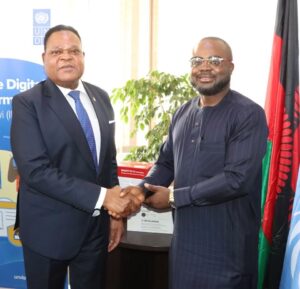
Homeland Security Minister Peter Mukhito with UNDP Deputy Resident Representative, Chika Charles Aniekwe at the handover event
* Hands over of 152 certificate printers to health facilities and National Registration Bureau (NRB) offices across the country
* Behind every birth certificate is a child whose existence has been formally recognised by the State
* Behind every death certificate is a family able to complete important legal processes with dignity
* And behind every marriage certificate is a legal record that protects families—Homeland Security Minister Peter Mukhito
By Patience Longwe, Malawi News Agency (MANA)
The Government has stepped up efforts to decentralise civil registration services following the handover of 152 certificate printers to health facilities and National Registration Bureau (NRB) offices across the country.

Advertisement
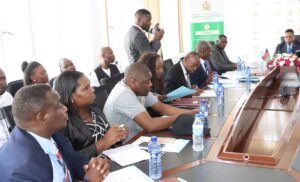
Speaking in Lilongwe on Friday during the official handover ceremony, Minister of Homeland Security, Peter Mukhito, said the event was not merely about providing the equipments, but also about promoting identity, dignity and inclusion.
“Behind every birth certificate is a child whose existence has been formally recognised by the State,” he said. “Behind every death certificate is a family able to complete important legal processes with dignity.
And behind every marriage certificate is a legal record that protects families,” said Mukhito, adding that 52 printers have been allocated to health facilities while 100 would be distributed to NRB offices at Traditional Authority level.
Mukhitho further stated that 180 health facilities have already been digitalised, and that the new printers would expand the capacity to issue birth and death certificates at the facilities where vital events occur.
He commended the United Nations Development Programme (UNDP) for supporting the initiative — through the Inclusive Digital Transformation for Malawi Project — with financial support from the European Union, Norway and Ireland.
Minister Mukhito stressed that Government was committed to ensure that every Malawian should obtain and use a secure legal identity regardless of where they lived.
“Bringing services to Traditional and Sub-Traditional Authorities will reduce transport costs, travelling distances and inconvenience for citizens.”
The initiative, said the Minister, aligns with President Arthur Peter Mutharika’s directive in the 2026 State of the Nation Address (SONA) to modernise and connect public service systems.
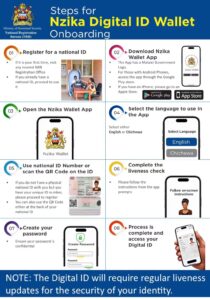
NRB is thus advancing interconnected services including Digital ID, Digital Wallet, electronic payment platforms and digital marriage registration.
However, the Minister cautioned that providing technology alone would not guarantee effective service delivery, urging NRB, Ministry of Health and Sanitation, Ministry of Local Government and Rural Development, District Councils and health authorities to ensure proper deployment, maintenance and monitoring of the equipment.
He also called on District Commissioners, Councillors, Traditional Authorities and health workers to strengthen registration of vital events, particularly deaths which remain under-registered.
Present at the handover event was UNDP Deputy Resident Representative, Chika Charles Aniekwe, who said Malawi has made a remarkable progress towards universal adult identity registration — with efforts now focusing on ensuring every birth, marriage and death was registered closer to the people.
Aniekwe said the equipment will extend birth and death registration to an additional 52 health facilities building on the initial 60 facilities.
He further said the integrated Nzika Wallet App, which had been piloted in 87 locations in five districts, is expected to reach 250 locations by 2028.
He thus commended government, through the Ministry of Homeland Security and NRB for strengthening the civil registration and also thanked the European Union, Ireland and Norway for supporting the project.
“The investment builds trusted national identity infrastructure that recognizes every person and connects essential services,” said Aniekwe.—Editing by Duncan Mlanjira; Maravi Express

Advertisement