
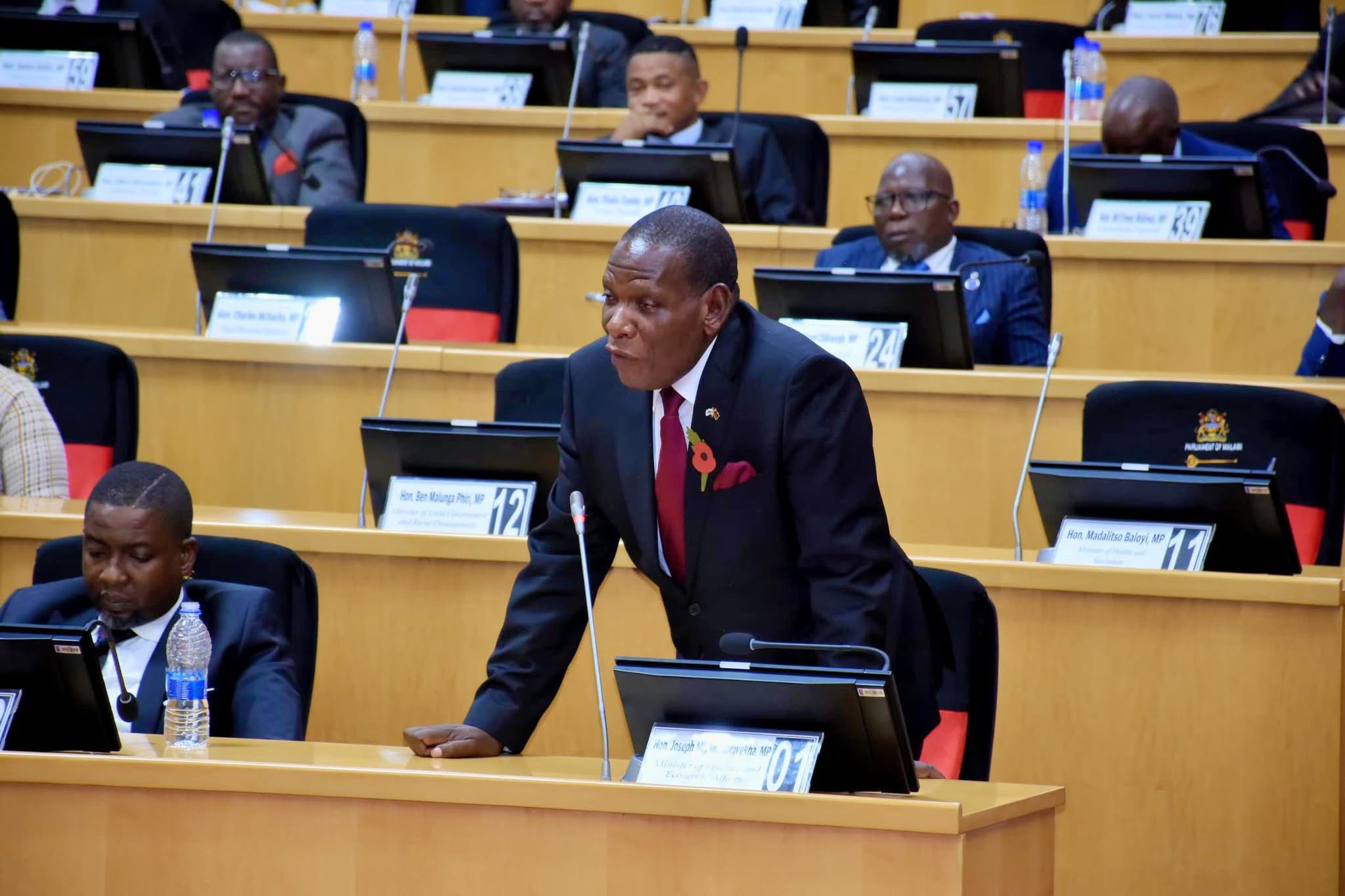
Mwanamveka in Parliament this morning
* Describing it as a realistic, corrective, and confidence-building policy intervention that places Malawi on a firmer path toward macroeconomic stability and renewed growth
* For the first time in several years, we see a budget review that openly acknowledges the structural failures of the past while proposing actionable and measurable solutions
By Duncan Mlanjira
The Chief Economist for South Africa’s Don Consultancy Group (DCG), Chifipa Mhango has welcomed the 2025/26 Mid-Year Budget review which was delivered by Minister of Finance, Economic Planning & Decentralisation, Joseph Mwanamvekha — describing it as “a realistic, corrective, and confidence-building policy intervention that places Malawi on a firmer path toward macroeconomic stability and renewed growth”.

Advertisement
In a statement from his base in Johannesburg, Mhango, noted that the review marks “a decisive shift from fiscal drift to fiscal discipline,” while commending the President Arthur Peter Mutharika’s administration for presenting a transparent account of first-half challenges as well as outlining coherent measures to stabilise the economy.
“For the first time in several years, we see a budget review that openly acknowledges the structural failures of the past while proposing actionable and measurable solutions,” he said shortly after the Minister’s presentation in Parliament.
“The shift toward cash budgeting, strict expenditure controls, and the payroll audit shows seriousness in restoring fiscal sanity. This transparency is a critical step in rebuilding donor confidence.”
Mhango added that Malawi’s fiscal and monetary imbalances — including high inflation, forex shortages, and a widening deficit—require exactly the kind of reforms outlined in the mid-year national budget review.
“The measures announced — particularly the moratorium on non-essential travel, procurement controls, and the suspension of new recruitments — are not politically easy choices, but economically they are absolutely necessary.
“The Government has shown willingness to make hard decisions for the long-term health of the economy, and that deserves commendation.”

Advertisement
The Chief Economist highlighted the foreign exchange and revenue-enhancing measures as “strong positives capable of shifting Malawi’s macro trajectory.
“Scaling up the gold purchase programme, reducing export proceeds repatriation from 120 to 90 days, establishing a Commodity Exchange, and insisting that tourism accommodation be paid in forex — these are bold and practical measures that will materially improve foreign exchange availability.”
On revenue measures, Mhango said the introduction of the Minimum Alternate Tax, the revised pay-as-you-earn (PAYE) tax system structure, and value added tax (VAT) adjustments “demonstrate genuine commitment to broadening the tax base”.
“These are reforms that development partners have long encouraged, and implementing them shows Malawi’s seriousness in taking responsibility for its fiscal future,” he said.

Chifipa Mhango
Despite the fiscal tightening, the DCG commends the protecting and expansion of strategic investments in growth-enabling sectors, saying: “Increasing FISP beneficiaries to 1.1 million, accelerating irrigation projects, recommissioning Kayerekera Mine, and introducing free primary and secondary education are socially and economically transformative moves.
“These interventions will enhance productivity, raise rural incomes, and strengthen Malawi’s long-term human capital base.”
He further noted that recommissioning Kayerekera under a new agreement is a strong signal to investors: “Reopening Kayerekera boosts investor confidence and positions mining as a key foreign-exchange earner. This is exactly the kind of medium-term growth anchor Malawi needs.”
The DCG forecasts that the combination of fiscal discipline, revenue measures, and forex reforms will progressively rebuild trust with development partners.

Advertisement
“Development partners look for seriousness, transparency, and credible reform sequencing. This mid-year budget review delivers on all three. If implementation is sustained, Malawi should expect improved engagement with the IMF, World Bank, and bilateral partners.”
Mhango summarised DCG’s position, emphasising that “this mid-year budget review is a necessary reset — it balances fiscal consolidation with targeted investments in agriculture, mining, human capital and digitalization”.
“It addresses leakages, strengthens revenue, and introduces reforms that boost confidence. The challenge now is implementation — but the direction is right, and the commitment is visible.”
Mhango, who is DCG’s Director of Economic Research & Strategy, concluded by urging for “continuous monitoring and transparent reporting to ensure that measures translate into real results” — while promising to review the 78-page Mid-Year Budget review document in detail to present a full analysis.


Advertisement