
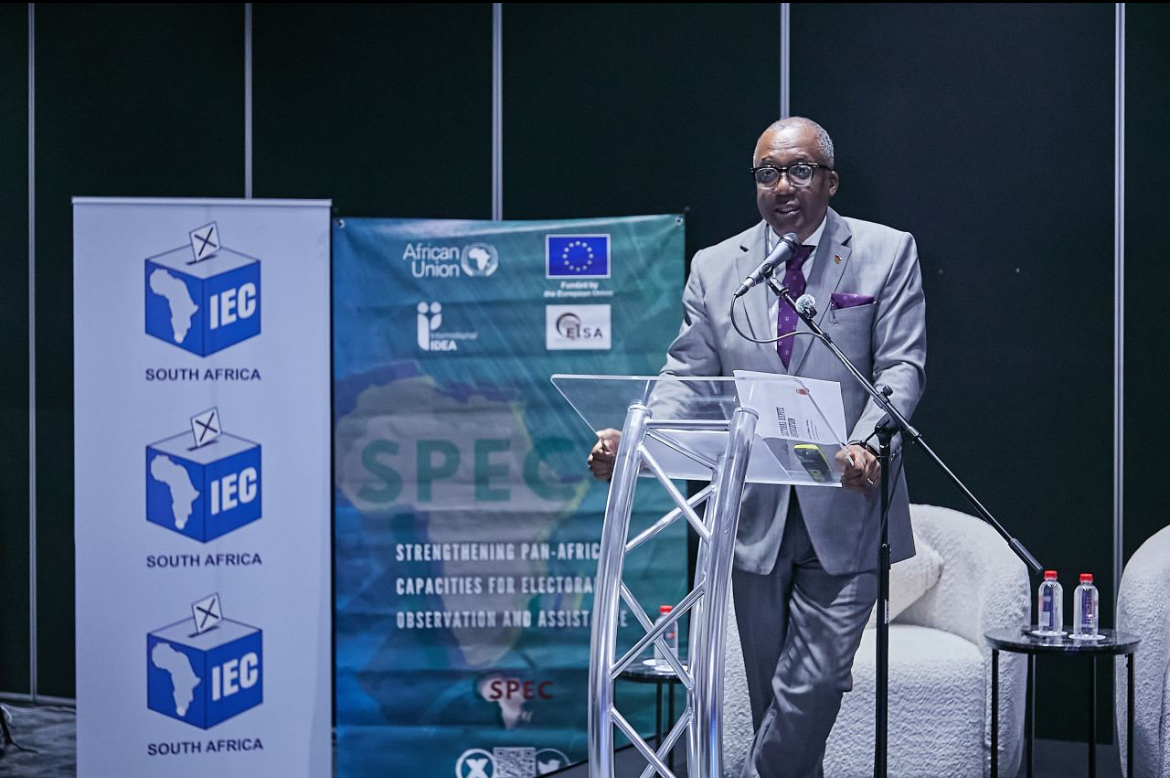
Justice Kachale during the New Commissioners Orientation Programme by Independent Electoral Commission of South Africa in Johannesburg
* Not merely an administrator of logistics, budgets, and timetables
By Justice Chifundo Kachale, former Malawi Electoral Commission (MEC) chairperson
Following the recent 13th New Commissioners Orientation Programme hosted by the Independent Electoral Commission of South Africa in Johannesburg from 3rd to 5th June 2026, one has found cause to ponder the profound weight borne by those stepping into the leadership of Electoral Management Bodies (EMBs).
It was an honour to be invited by the Electoral Commissions Forum of SADC Countries (ECF-SADC) and International IDEA to contribute to this crucial induction process.
In the present context, it is vital to remember that an electoral commissioner is not merely an administrator of logistics, budgets, and timetables; a commissioner is the visible face and custodian of public trust.
In this unique vocation, credibility is one’s primary currency. Once that currency is devalued by perceived partiality, the democratic goodwill necessary to perform one’s function through and in the EMB is completely squandered.
Reflecting on my experience, a few fundamental lessons come to the fore:
i. The Imperative of Absolute Discretion
Guarding institutional neutrality requires a deliberate, personal curtailment of one’s freedom to engage in sensitive or controversial public debates. Careless interactions, unstructured social media commentary, or private, ill-defined, and clandestine invitations to state houses or the homes of prominent politicians possess an immediate potential to undermine the perceived independence of one’s office;
ii. The Nuanced and Subtle Faces of Pressure
Overt threats are rare; more often, pressure masquerades in the quiet anxieties of contract renewal or filters subtly through the influence of well-meaning family, long-standing friends, and former political colleagues. Naivety about these political dynamics is a vulnerability no EMB leader can afford.
iii. Navigating the Peril of Extremes
An EMB belongs to, and must serve, the entire nation and electorate. Therefore, while one must resolutely resist undue familiarity with the government of the day, a perennially militant or intransigent attitude toward state machinery is equally destructive.

Advertisement
It requires immense, quiet tact to manage these political dynamics productively, lest sour relations inadvertently choke the very state resources one’s institution requires to deliver its mandate.
In framing these complex dynamics, one is frequently drawn back to James Madison’s profound thesis in the Federalist Papers: “If men were angels, no government would be necessary. If angels were to govern men, neither external nor internal controls on government would be necessary”.
Because we operate in an imperfect, deeply human political ecosystem, “auxiliary precautions” — anchored in an unwavering oath of office, transparency, and absolute accountability — remain our only true shield.
Ultimately, the stability of our constitutional democracies does not depend on the perfection of our political actors, but on our collective willingness to intentionally build and protect institutions that can endure the sharpest winds of political competition.
We neglect the character, moral attributes, and auxiliary safeguards of our electoral leadership structures at our own collective peril.

Editor’s Note:
Justice Dr. Chifundo Jairus Kachale is a career judicial officer with over two decades of service in Malawi’s justice system, committed to strengthening constitutionalism, instituonal integrity, and public accountability.
His work blends judicial practice, governance reform, and leadership development, shaped by a belief that sound institutions and ethical leadership are essential for democratic growth.
His professional life has taken him from the magistracy to the High Court, from judicial training to electoral reform, and from national service to regional engagements across Africa.
He has served in the Judicial Service Commission, chaired the Judicial Training Committee before leading MEC for the historic Fresh Presidential Election of 2020.

Beyond the bench, he is passionate about mentoring, capacity building, and cultivating values-driven leadership. He has taught and facilitated in various jurisdictions, supporting professionals acrosß disciplines to deepen their commitment to integrity, accountability, and public service.
His academic work, including a PhD from School of Oriental and African Studies (SOAS) at the University of London, focuses on constitutional jurisprudence, judicial mythology, and the role of courts in emerging democracies.
The Judge-in-Charge of the High Court Commercial Division in Blantyre, holds the Master of Laws (LLM) earned in Law and Development from Queen Mary University of London and holds his Bachelor of Laws (LLB Hons) awarded by University of Malawi (UNIMA) through Chancellor College.
He continues to support regional judicial development as part of the visiting faculty at the Judicial Institute for Africa (University of Cape Town). He advised the National Elections Commission of Sierra Leone on legal reforms and also trains jurists through the Judicial Institute for Africa (JIFA).
His goal in every sphere of service is guided by his faith: to pursue justice with integrity, building institutions that uphold human dignity, and support Africa’s democratic development.

Advertisement