
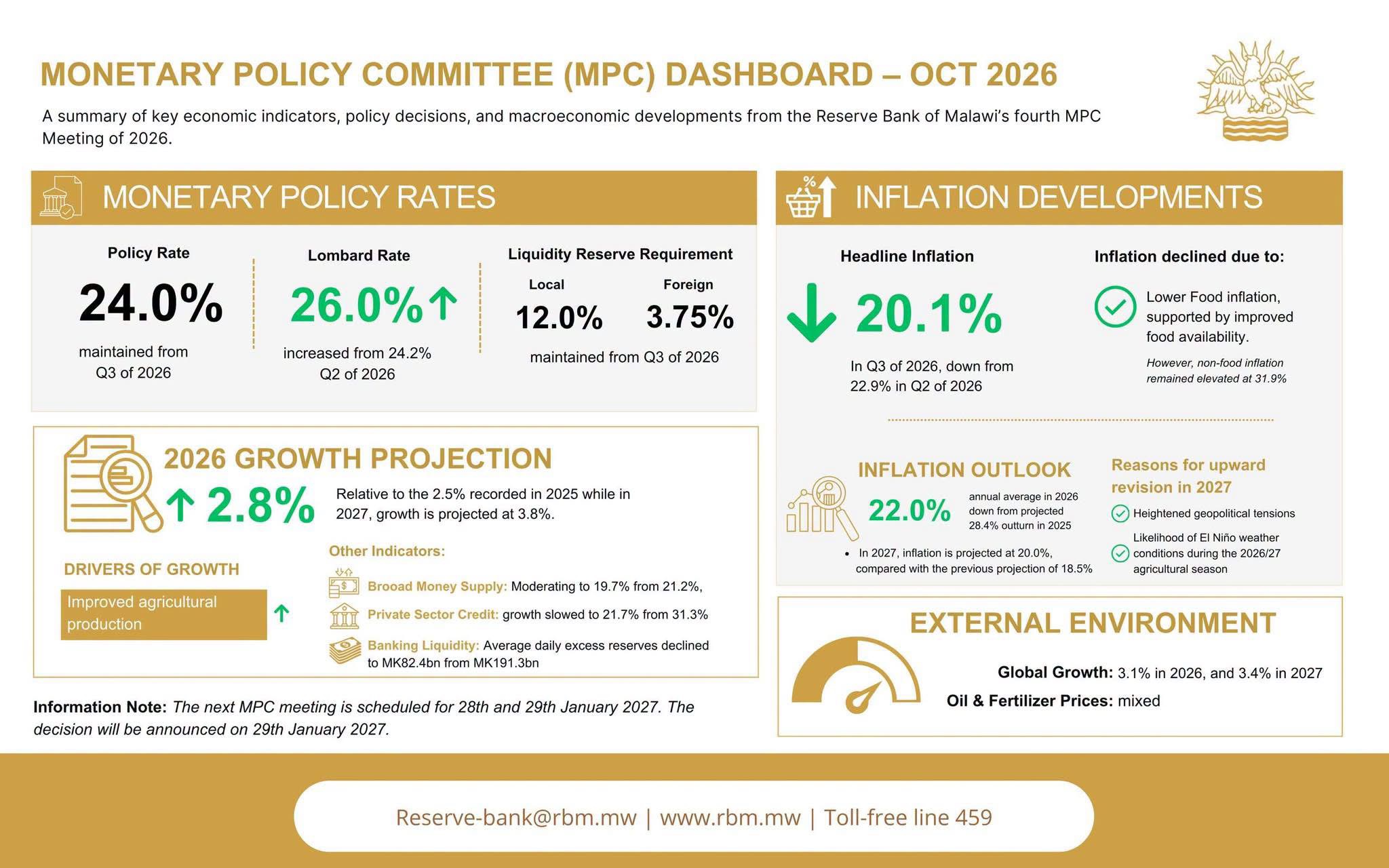
* The decline was driven mainly by lower food inflation, which averaged 13.4% from 17.1%, supported by improved food availability
* Headline inflation is projected to average 22.0% in 2026, down from 28.4% outturn in 2025
* As the RBM’s Monetary Policy Committee maintains the policy rate at 24.0% and raises the Lombard Rate to 26.0%
By Duncan Mlanjira
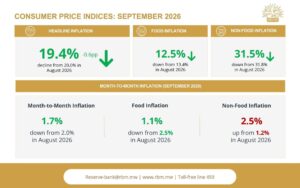
The Monetary Policy Committee (MPC) of the Reserve Bank of Malawi (RBM), has announced that headline inflation moderated to 20.1% in the third quarter of 2026 from 22.9% in the preceding quarter.

Advertisement
This follows the MPC’s 4th meeting of 2026 held on October 27-28 to assess recent macroeconomic developments and the medium-term inflation outlook.
The report — issued by the MPC chairperson, George Partridge, the RBM Governor — takes note that “although inflation has continued to moderate, it remains significantly above the Reserve Bank’s medium-term objective of 5.0%, and risks to the inflation outlook remain elevated”.
It reports that “the decline was driven mainly by lower food inflation, which averaged 13.4% from 17.1%, supported by improved food availability”.
“However, non-food inflation remained elevated at 31.9%, reflecting continued imported inflation pressures.
“Headline inflation is projected to average 22.0% in 2026, down from 28.4% outturn in 2025. In 2027, inflation is projected at 20.0%, compared with the previous projection of 18.5%.
“The upward revision implies slower disinflation than earlier anticipated. Significant upside risks remain. These include heightened geopolitical tensions and the increased likelihood of El Niño weather conditions during the 2026/27 agricultural season.
“Although near-term inflation expectations have improved, medium-term expectations remain elevated.”
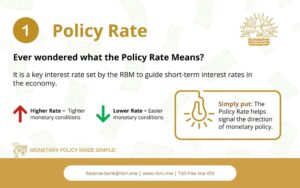
The Committee thus reports that it resolved to maintain the Policy Rate at 24.0%, the Liquidity Reserve Requirement (LRR) ratio for local currency deposits at 12.0%, and the LRR ratio for foreign currency deposits at 3.75%.
“However, the Committee adjusted the Lombard Rate to 2.0 percentage points above the Policy Rate from 0.2 percentage points above the Policy Rate in order to strengthen liquidity management and the monetary policy implementation framework,” says the.
External environment
The global economy continues to face heightened uncertainty amid geopolitical tensions in the Middle East.
Global growth is projected at 3.1% in 2026 and 3.4% in 2027, from an estimated growth of 3.5% for 2025.
Brent crude oil prices eased to an average of US$97.0 per barrel in the third quarter of 2026 from US$104.4 per barrel in the second quarter.
As of 27th October 2026, Brent crude oil prices stood at US$116 per barrel. Meanwhile, urea fertilizer prices declined notably to US$400 from US$693.5 per metric tonne in the previous quarter. Nonetheless, both remain elevated for Malawi’s import bill.
Domestic economy
The domestic economy is projected to grow by 2.8% in 2026, relative to the 2.5% recorded in 2025. This will be supported by the improvement in agricultural production. In 2027, growth is projected at 3.8%.
Annual broad money growth moderated to 19.7% in the third quarter of 2026 from 21.2% in the previous quarter, and from 51.0% a year earlier.
Private sector credit growth slowed to 21.7% from 31.3%. Banking system liquidity tightened, with excess reserves averaging K82.4 billion per day from K191.3 billion per day, and recourse to the Lombard facility rising to an average of K72.3 billion per day from K25.3 billion per day.
The interbank market rate while increased, remained outside the target corridor of +0.2/-4.0 percentage points around the Policy Rate.
Maintaining the Policy Rate and adjusting the Lombard Rate
The Committee noted that inflation is declining and that previous monetary policy actions are producing the intended effects.
However, inflation remains significantly above the medium-term objective, and supply-side risks continue to pose challenges.
The Committee assessed that an increase in the Policy Rate may not be appropriate at this time because inflation is declining while economic growth and private sector credit remain subdued.
Premature easing could, however, risk reversing the progress made in reducing inflation and anchoring expectations.
The Committee, therefore, concluded that the current Policy Rate remains appropriate. To strengthen monetary policy operational framework the Committee raised the Lombard Rate to 2.0 percentage points above the Policy Rate.
The Committee, whose next meeting is scheduled for January 28-29, 2027, assures the market that it “will remain vigilant and adjust the policy stance if emerging developments materially alter the inflation outlook”.
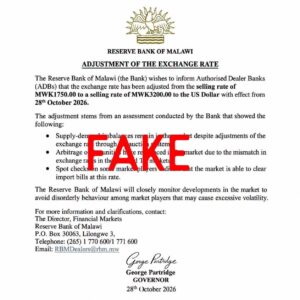
Meanwhile, the public has been urged to report on any suspicious publications claiming to be from the RBM following a fraudulent document purporting to announce an adjustment of the Exchange Rate.
In a statement published on its official Facebook account, the RBM takes note of the circulation of the fraudulent document on social media and certifies it as fake as it was not issued by the RBM.
“We urge the public, businesses, and market participants to verify all RBM announcements through our official communication channels, including our website and verified social media platforms, before acting on any information.
“If you encounter suspicious publications claiming to be from RBM, please report them to the Bank immediately.”

Advertisement