

* Economic analysis and policy recommendations by Chifi Mhango, Chief Economist and Executive Director-Don Consultancy Group
1. Introduction
Malawi’s inflation trajectory presents a mixed economic picture, reflecting encouraging progress in headline inflation alongside persistent structural pressures that continue to undermine economic stability.
Headline inflation declined from 28.7% in September 2025 to reaching 19.4% in September 2026 (down from August 2026 reading of 20%), largely supported by a significant moderation in food inflation.
However, beneath this improvement lies a concerning divergence, with non-food inflation remaining elevated at 31.5%, compared to food inflation of 12.5%.
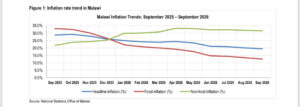
This widening disparity raises fundamental questions about the sustainability of Malawi’s disinflation process, particularly in an economy characterised by foreign exchange shortages, heavy import dependence, high production costs and limited domestic industrial capacity.
While declining food inflation offers some relief to households, persistent non-food inflation threatens to erode these gains through rising transportation, energy and other essential costs.
Addressing these underlying pressures is, therefore, critical, not only for restoring price stability and protecting household purchasing power, but also for strengthening industrial competitiveness, stimulating investment and establishing a sustainable foundation for accelerated GDP growth.

Table 1
Food inflation fell by 20.5 percentage points over the year, while non-food inflation rose by 9.8 points. By September 2026, non-food inflation exceeded food inflation by 19 percentage points.
Falling inflation does not mean prices are falling: food prices were still 12.5% higher and non-food prices 31.5% higher than a year earlier.
The slowdown in food inflation may reflect changes in supply, agricultural conditions or base effects, but the figures alone cannot establish the cause.
The important message is that headline inflation is improving while the costs of running businesses and households remain under severe pressure.
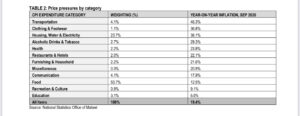
Table 2
Transportation inflation of 46.3% is especially worrying because moving goods is central to agriculture, manufacturing and retail. Higher freight costs can be passed along supply chains to consumers.
For a landlocked economy, fuel costs, transport corridors, border delays and road conditions require close policy attention.
Housing, water and electricity inflation of 36.1% also affects more than households. Manufacturers, mines, agro-processors and service providers depend on reliable utilities.
Higher tariffs combined with interruptions can increase operating costs and reduce competitiveness.
Clothing and footwear inflation of 36.8% points to further pressure on household budgets, potentially linked to imported goods and distribution costs.

Advertisement
2. What is keeping inflation high in Malawi?
The country faces overlapping pressures from imported products, foreign exchange constraints, high transport and utility costs, domestic production bottlenecks, and fiscal and monetary conditions.
Effective policy must address the causes rather than treating all price increases as the same problem.
Malawi’s heavy dependence on imported fuel, machinery, industrial raw materials and consumer goods continues to put pressure on its limited foreign exchange reserves.
When foreign currency becomes scarce or expensive, businesses face higher import and production costs, which are eventually passed on to consumers through higher prices.
This creates a vicious economic cycle in which foreign exchange shortages fuel inflation, weaken industrial competitiveness and constrain GDP growth.
The Reserve Bank of Malawi
Breaking this cycle requires Malawi to expand domestic production, strengthen exports and build sustainable foreign exchange reserves.
Persistent fiscal deficits and high domestic borrowing requirements can make inflation harder to control, particularly where financing conditions add to monetary and demand pressures.
The Reserve Bank of Malawi must maintain credible monetary discipline, while Government improves expenditure control and protects essential services and productive investment.
Neither monetary nor fiscal policy can substitute for addressing supply shortages and high production costs.
3. Practical policy interventions
Addressing Malawi’s persistent inflation requires a coordinated policy approach that goes beyond monetary interventions to tackle the structural factors driving production costs and price instability.
The priority should be to strengthen foreign exchange availability, enforce fiscal discipline, reduce transport and energy costs, and expand domestic productive capacity.
The following policy interventions outline practical measures across immediate, medium-term and long-term horizons to achieve sustainable price stability while supporting industrial growth and economic competitiveness.
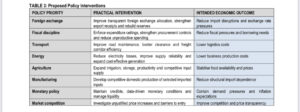
Table 3
Immediate priorities: first six months:
A coordinated inflation-monitoring mechanism is required to identify which price increases arise from supply shortages, imported costs, tariffs or weak competition.
There is a need to improve transparency and functioning of foreign exchange arrangements, while strengthening fiscal expenditure controls without undermining essential services.
Medium-term priorities: six to 24 months:
Improve freight corridors, electricity reliability, agricultural storage and irrigation. Map frequently imported industrial inputs against realistic opportunities for competitive domestic production.
Also target support where Malawi can reduce costs, create employment and strengthen productive capacity, not where permanent protection would make consumers pay more.
Long-term priorities: two to five years:
Diversify exports, expand agro-processing and manufacturing, strengthen mining-related supplier industries and grow tradable services.
These reforms can increase foreign exchange earnings and make inflation less vulnerable to external shocks.
The decline in headline inflation is welcome, but non-food inflation of 31.5% signals continued pressure.
Major interest-rate changes should be informed by whether inflation is easing broadly and sustainably, alongside exchange rate developments, liquidity conditions and economic activity.
Excessively restrictive credit can also constrain production, making coordination with fiscal and supply-side policy essential. Success should be measured by more than a lower headline inflation number.
Malawi should monitor whether non-food inflation, transport and utility costs are stabilising; foreign exchange availability is improving; domestic production is expanding; and households’ purchasing power is recovering.
Monthly CPI changes, fuel and electricity prices, reserves, fiscal financing and manufacturing activity should be assessed together.

Advertisement
4. Conclusion
Malawi’s September 2026 inflation figures show meaningful progress in headline and food inflation, but persistent non-food inflation is a warning.
Transportation, clothing and housing-related costs remain especially elevated. These pressures affect households and also the cost of doing business, investment and economic growth.
Malawi, therefore, needs a coordinated response combining monetary stability, permanent fiscal discipline, stronger foreign exchange earnings, efficient transport, reliable energy and greater domestic productive capacity.
The ultimate test of inflation policy is not only how quickly the headline rate falls, but whether businesses can produce competitively, households can preserve purchasing power and GDP growth becomes sustainable.
Malawi must tackle not only the cost of living but also the cost of producing.
Editor’s Note:
Chifipa Mhango is a Chief Economist & Executive Director-Economic Research & Strategy at Don Consultancy Group (DCG), who has more than 30 years of experience spanning economic research, macroeconomic and fiscal analysis, corporate strategy, financial services, development finance, trade policy, investment advisory and strategic planning across Africa.
He has held senior leadership roles in both the public and private sectors in South Africa, providing economic intelligence and strategic advice to businesses, government institutions and other decision-makers.
His work focuses on translating economic and policy developments into practical strategic insights that support informed decision-making, competitiveness and sustainable growth.

Advertisement