
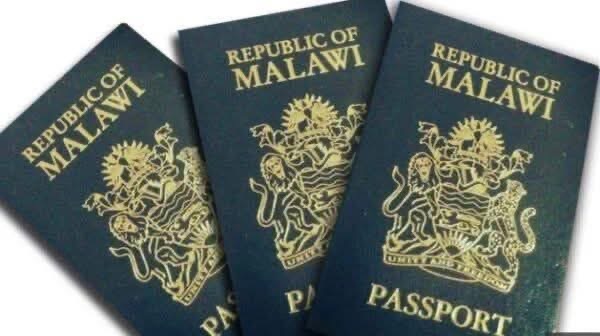
* As passport printing has been halted for almost three weeks after the Immigration Department ran out of booklets
* The office of the Ombudsman indicated in its report released on July 2, 2026 that there is deep-seated and pervasive maladministration within the Department and other associated institutions
* The systemic maladministration takes the form of chronic delays in service delivery, corruption, abuse of office, unethical conduct by some officials and gross inefficiency within the Department
By Duncan Mlanjira
The Department of Immigration & Citizenship Services has ran out of passport booklets and is only prioritising the travel document’s issuance to people with urgent travel needs as it waits for new booklets.

Advertisement
According to Zodiak Online, passport printing has been halted for almost three weeks after running out of the booklets.
Zodiak Online quotes some applicants saying they have failed to travel abroad for medical treatment, while other travelers have been unable to source goods for their businesses.
It further quotes the Department’s spokesperson Pasqually Zulu advising the applicants not to make travel arrangements before their passports are ready — encouraging them to apply well before their intended travel dates.
On July 2, 2026, the office of the Ombudsman released a report after an intensive investigation into the operations of the Immigration Department, which discovered that that there is “deep-seated and pervasive maladministration within the Department and other associated institutions”.
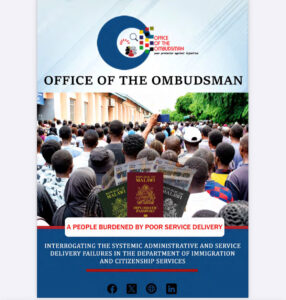
The report, which was presented to Parliament, where it was referred to the Legal Affairs Committee for further scrutiny, indicated that the “systemic maladministration takes the form of chronic delays in service delivery, corruption, abuse of office, unethical conduct by some officials and gross inefficiency within the Department”.
“The evidence demonstrates that the Department of Immigration is in a state of systemic failure, where operational paralysis, institutionalised maladministration, poor governance and incidences of corruption have become entrenched.
“As the institution responsible for functions critical to Malawi’s sovereignty, security, and socio-economic development, the Department of Immigration has not performed optimally in meeting its obligations to the citizenry.”

The Ombudsman, Grace Malera with officials from Blantyre Regional Immigration Office during data collection exercise
The report further highlights that the Department is constrained by multiple factors — that includes “systemic non-compliance with service charters, reliance on an outdated legal framework, and misaligned organisational structure.
Others are critical human resource shortages, poor inter-Agency coordination, limited services for marginalised groups — including absence of a sexual harassment policy.
It also highlighted pervasive corruption and exploitation by middlemen, commonly known as madobadoba.
After the report highlighted the issue of the intermediaries, the Immigration Department issued a press statement warned passport applicants against dealing with the madobadoba — most of whom operate in collusion with immigration staff.
In the statement, the Department warned against paying individuals who claim they can fast-track passport applications or provide preferential treatment.
“No applicant is required to pay passport fees to any individual, including members of staff, all passport-related fees must be paid directly through the designated bank located within passport processing centres,” said the statement.

Advertisement
In its report, the Ombudsman highlighted that the dobadobas continue to operate both within and around immigration offices in Blantyre, Lilongwe, Mangochi, and Mzuzu.
The Department itself confirmed that the dobadobas illegally offer expedited processing services to applicants in exchange for fees.
Immigration officers that were interviewed told the office of the Ombudsman some middlemen had been arrested before but their activities “persist due to high demand, particularly among illiterate or first-time applicants, who rely on them for assistance with forms and procedural direction”.
While indicating that the presence of dobadobas is prohibited within their premises, the Department “admitted that enforcement of this prohibition is weak, allowing middlemen to continue offering services often in collusion with some officers who facilitate expedited passport processing for a fee”.
“They stated that in certain cases, some of the officers themselves reportedly assume the role of dobadobas,” said the reporting, adding that when apprehended, the dobadobas “are charged under minor Penal Code provisions instead of immigration-specific laws, allowing the cycle of misconduct to continue”.
“One regional office stated that while some middlemen are occasionally arrested and detained, they continue to operate covertly outside the immediate vicinity of immigration offices.
“The Department further explained that the services of these dobadobas remain in high demand — particularly among illiterate applicants —highlighting the persistent reliance on unauthorised personnel to navigate immigration procedures.
“They noted that this ongoing challenge exposes applicants to fraud and other illegal activities outside the control of the Department.”

Daily situations at the Immigration offices
According to the report immigration officers acknowledged the presence of the illegal practices and “attributed them to broader systemic weaknesses in internal controls, monitoring and accountability structures”.
Thus in its executive summary, the Ombudsman identified corruption as “the most serious manifestation of systemic failure with the infestation of the service delivery by unauthorised intermediaries — leaving immigration services effectively sold to the highest bidder”.
“This has imposed a significant financial burden on Malawians while eroding the rule of law and public trust in the Department of Immigration.”
The intensive investigation also exposed multiple irregularities that include corrupt border posts that have rendered the country “vulnerable to transnational crimes, including human trafficking and smuggling”.
“The Department of Immigration has systematically failed to uphold its legal obligations toward vulnerable groups, providing limited accessibility to persons with disabilities.”

Ombudsman Grace Malera when she released her report
On operating without a sexual harassment policy, the Ombudsman observed that this “exacerbated the vulnerability of women and girls to sexual harassment as they interface with immigration and citizenship service delivery”.
It also “effectively infringed the provision in the Gender Equality Act, which makes it mandatory for public institutions to develop and implement sexual harassment policies”.
“Investigations into procurement practices reveal poor management of multi-billion Kwacha contracts for passport printing, resulting in service disruptions, financial irregularities and a persistent ‘passport crisis’.
“The absence of functional complaints redress mechanisms has allowed grievances to go unaddressed, enabling systemic issues to persist unchecked.”

Storage of hard copy passport application forms at Blantyre Immigration Offices
In summary, the Ombudsman maintains that the Immigration Department, “in its current form, is incapacitated to prevent and curb maladmistration in the form of service delivery failures, abuse of power, unethical conduct of officials, and delivery of services in a transparent, accountable, effective, efficient, inclusive and responsive manner”.
“This lays a fertile ground for perpetuation of corruption. All this stems from the combined effects of structural weaknesses, corruption, poor governance, and administrative inefficiencies — leading to an institution that is unaccountable, non-transparent and unresponsive to the needs of the citizenry.
“The rights of Malawians, including the right to development, freedom of movement and access to information are being systematically denied.”
The Ombudsman stressed that corrective measures and directives pronounced in its report are “not mere recommendations — they are essential steps for restoring the rule of law, rebuilding public trust, and ensuring that the Department of Immigration can fulfill its national obligation with integrity, efficiency, and a commitment to serving all Malawians”.

The report was presented to the National Assembly
On the directives, the report highlights Section 126 of the Constitution that provides that; “Where the investigations of the Ombudsman reveal sufficient evidence to satisfy him or her that an injustice has been done, the Ombudsman shall:
a. direct that appropriate administrative action be taken to redress the grievance;
b. cause the appropriate authority to ensure that there are, in future, reasonably practicable remedies to redress a grievance; and
c. refer a case to the Director of Public Prosecutions with a recommendation for prosecution, and, in the event of a refusal by the Director of Public Prosecutions to proceed with the case, the Ombudsman shall have the power to require reasons for the refusal.
Further, Section 8 (b) of the Ombudsman Act provides that; “the Ombudsman shall after holding an inquiry or investigation in accordance with the Act take appropriate action or steps to call for or require the remedying or reversal of matters or instances specified in section through such means as are fair, proper and effective”.
On the basis of such legal provisions, and in view of the findings outlined in the report, the Ombudsman thus issued the following directives:
* Enactment of the Immigration Bill into Law: The Minister of Homeland Security, in conjunction with the Ministry of Justice should take all necessary steps to ensure that the Immigration Bill is timely processed in compliance with applicable laws and set procedures, and expeditiously enacted into Law (within a short to medium term timeline);
* Ownership of Government data: The Department of Immigration in consultation with the E-Government Department should deliberately put in place measures for ensuring that Government take significant control over passport printing services to own data, as is the practice in some other countries, through meaningful public-private partnership. This should include reviews of any and all existing and running Contracts (within a short to medium term timeline);
* Urgent filling of vacancies: The Civil Service Commission and the Department of Human Resource Management and Development (DHRMD), should cause a review of all outstanding vacancies within the Immigration Department and ensure the prioritisation and timely and gradual recruitment of personnel to fill the vacant posts, with particular emphasis on uniformed officers, (within a short to medium term timeline;
* Compliance with Service Charter Standards and Timelines: The Director General of the Department of Immigration should take immediate and concrete steps to clear the existing passport backlog and ensure strict adherence to the Service Charter standards and timelines.
A detailed backlog elimination plan, with monthly targets, should be submitted to the Ombudsman within 30 days, from the date of release of the report;
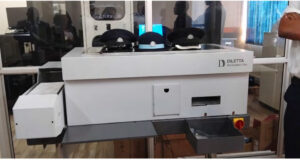
E-Tech Systems passport printing machine images during data collection exercise at Lilongwe Immigration Offices
* Forensic audit of procurement, contract management and payments: The Auditor General should conduct a comprehensive Forensic Audit of the procurement of, management of contracts and payments made to, Techno Brain Global FZE, E-Tech Systems and Madras Security Printers Private Limited.
The Audit Report should be submitted to Parliament within nine months from the date of release of the report;
* Establishment of a functional complaints redress mechanism: The Department of Immigration should design, resource, and operationalise a standardised, accessible, and independent complaints redress mechanism across all immigration offices and border posts.
This system shall include: visible and easily accessible suggestion boxes, toll-free hotlines, dedicated help desks, and a digital platform for tracking complaints and providing feedback to complainants.
And clear service standards for complaint resolution, with timelines for acknowledgement and final response (this should be done within a short term timeline);

* Accessibility for persons with disabilities: in collaboration with the Ministry of Gender, Community Development & Social Welfare and the Ministry of Lands, Housing & Urban Development, should conduct an audit of all its public offices and ensure full compliance with the Disability Act (Cap 33:06) within 12 months.
This should include the installation of ramps, the provision of sign language interpreters (or a service contract for on-demand interpretation), and the availability of materials in accessible formats (this should be done within a short term timeline);
* Development of a Sexual Harassment Policy: within 12 months from the date of release, develop and disseminate a comprehensive Sexual Harassment Policy, as mandated by Section 7(1)(a) of the Gender Equality Act.
The Policy should include clear reporting mechanisms, protection for complainants, and sanctions for perpetrators. The Department should, in this regard, work with the Malawi Human Rights Commission.
* Launching of investigations by the Anti-Corruption Bureau (ACB) and the Malawi Police Service (MPS): the ACB and the MPS should where appropriate launch investigations into allegations of malpractices surrounding cases of illegal migration allegedly linked to some senior government officials and some politicians, and if verified, follow through with appropriate legal processes and sanctioning. (this should be done within a medium to long term timeline);

* Full and effective implementation of digital transformation: in conjunction with E-Government, should put in place measures for full digitisation of all immigration and citizenship services including: developing and implementing a robust ICT system to address the challenge of vendor locking, and ensure Government has full control over ICT system platforms, software and infrastructure; enhancing data security and data integration with relevant key institutions (this should be done within a medium to term timeline);
* Data management: The National Registration Bureau (NRB) to work closely with the Department of Immigration and the Department of E-Government to establish flexible, interoperable and sustainable data integration mechanisms.
The NRB should collaborate to develop an integrated identity management framework based on the ‘capture once, reuse many times’ principle. The framework should ensure seamless and secure exchange of biometric and identity information while preventing vendor lock-in that limits Government’s ownership of data (this should be done within a short to medium term timeline);
* Staff welfare issues: should develop and implement a comprehensive staff welfare policy aimed at improving the motivation, wellbeing and retention of immigration officers.
The policy should address the provision of adequate staff housing, hardship and risk allowances for officers serving in remote border posts, psychosocial support services, transport, uniforms, appropriate working tools and recognition programmes for outstanding performance.
The Department should also review overtime arrangements to ensure officers who routinely work beyond normal working hours are appropriately compensated. (this should be done within a short to medium term timeline);
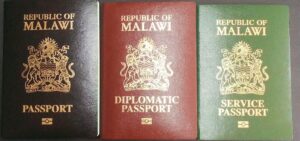
* Audit on service and diplomatic passports: in conjunction with DHRMD, Ministry of Foreign Affairs & Internal Cooperation and OPC should undertake a comprehensive Audit of all Service and Diplomatic Passports issued between 2014 and 2025 to establish their legality, identify ineligible beneficiaries and recover or revoke passports that were issued irregularly.
Following the audit, the aforementioned stakeholders should strengthen the legal and administrative framework governing the issuance, renewal, monitoring and cancellation of service and diplomatic passports by establishing clear eligibility criteria, maintaining an up-to-date electronic register of beneficiaries, conducting periodic compliance audits and introducing stronger verification procedures before approval and ensure that all future approvals are fully documented and traceable (this should be done within a short to medium term timeline;
* Training and capacity building: should conduct a comprehensive institutional capacity and training needs assessment covering all categories of staff to identify competency gaps in technical, managerial and operational functions.
Based on the assessment, the Department should develop and implement a structured Continuous Professional Development (CPD) programme incorporating induction training, leadership development, customer care, administrative justice, human rights, ethics and integrity, anti-corruption, investigations, border management, digital systems, cyber security, procurement management, data protection, migration management, human trafficking and migrant smuggling, disability inclusion, gender responsiveness and change management.

Advertisement
The programme should include annual training plans, mentoring arrangements, performance evaluation and dedicated budgetary provisions to ensure sustainability (this should be done within a short to medium term timeline);
* Border management policies: The Ministry of Homeland Security with support of the Ministry of Foreign Affairs & International Cooperation and Ministry of Justice should work on harmonisation of immigration and border management policies with neighbouring countries to improve cross border coordination by taking advantage of bilateral and regional cooperation with neighbouring countries such as SADC, COMESA and other regional frameworks (this should be done within a medium to short term timeline);
* Regulation of businesses by foreign nationals: The Ministry of Trade with support from the Department of Immigration should review and adopt policies for improvement of regulatory control over businesses and other business-related activities by foreign nationals that require issuance of permits and Visas to ensure compliance with investment, labour and Immigration laws (this should be done within a medium to long term timeline);
* Construction of detention facilities for illegal immigrants: The Ministry of Homeland Security should prioritise the construction and operationalisation of dedicated immigration detention centres that meet national and international human rights standards to avoid the use of prisons and police cells as detention facilities for illegal immigrants (this should be done within a medium to long term timeline);
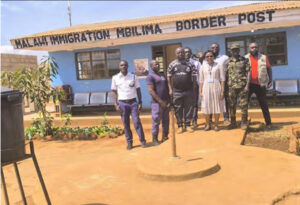
The Ombudsman’s team with immigration officers at Mbilima Border Post between Malawi and Tanzania in Chitipa District during evidence gathering exercise
* Border revenue assessment: in collaboration with the Malawi Revenue Authority (MRA), the Department of Immigration should undertake a comprehensive assessment of all official border posts to determine the extent of revenue losses arising from porous borders, illegal entry, smuggling, tax evasion and other forms of illicit cross-border trade.
Based on the findings, the MRA should develop and implement measures to strengthen customs and revenue collection systems, improve border surveillance, and enhance compliance monitoring (this should be done within a medium to long term timeline);
* Inter-agency coordination mechanisms: The Immigration Department and its key stakeholders (MPS, NRB, NIS and Ministry of Trade and MRA) should put in place measures for strengthening inter agency coordination like establishing a formal multi-agency coordination framework with clearly defined roles, regular joint operations, information-sharing protocols, integrated databases, coordinated investigations and periodic strategic meetings (this should be done within a short term timeline);
* Relocation of Dzaleka Refugee Camp: The Ministry of Homeland Security should, in collaboration with OPC and other relevant Government institutions, should expedite implementation of the proposed relocation of Dzaleka Refugee Camp to Chitipa District after resolving outstanding compensation and land acquisition issues.

The relocation process should be accompanied by adequate infrastructure development, comprehensive refugee registration, strengthened security measures and sustainable financing (this should be done within a medium to long term timeline);
* Progress reports: All Ministries, Departments, and Agencies tasked with the implementation of these Directives should provide written reports to the Ombudsman on the progress of execution of the Directives.
The Ombudsman stresses that the implementation of the directives “is expected to improve operational effectiveness, efficiency, accountability, inclusiveness and responsiveness within the Department and restore public confidence in the delivery of Immigration Services.

Advertisement