
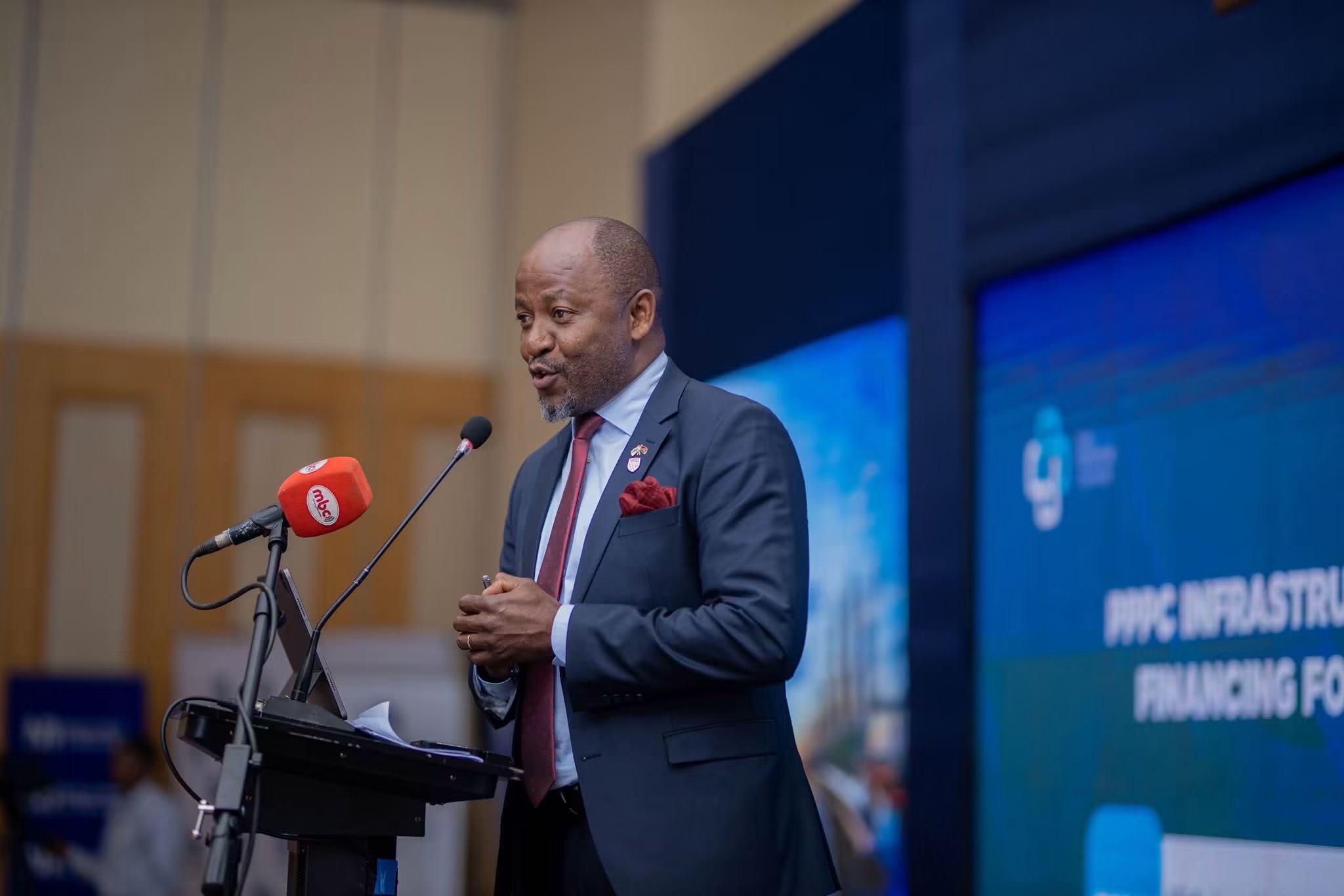
* Maintained Standard Bank Chief Executive Phillip Madinga during the Public Private Partnership Commission (PPPC) Infrastructure Financing Forum
* That focused on unlocking private capital to accelerate infrastructure development in Malawi
* Although Africa and Malawi, in particular, have a significant infrastructure gap standing in the way of development, the capital exists
By Duncan Mlanjira
During the Public Private Partnership Commission (PPPC) Infrastructure Financing Forum held on Thursday, September 17 — that focused on unlocking private capital to accelerate infrastructure development in Malawi — Standard Bank Chief Executive, Phillip Madinga maintained that this country “unquestionably needs more infrastructure to convert endless possibilities into opportunities that will drive economic growth”.
The PPPC unveiled a number of public-private partnership (PPP) infrastructure projects valued at billions of US dollars that require private sector financing to unlock the country’s infrastructure development.
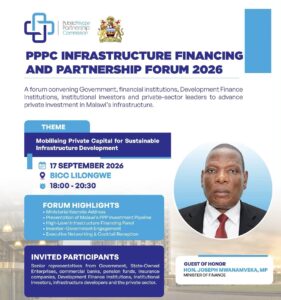
Held at Bingu International Convention Centre (BICC) in Lilongwe — under the theme; ‘Mobilising Private Capital for Sustainable Infrastructure Development’ — Madinga commenced his presentation by highlighting “the fact that although Africa and Malawi, in particular, have a significant infrastructure gap standing in the way of development, the capital exists”.
“Be it through: pension funds, banks or other investors. Whilst the funding exists, it is important that the projects must pass the bankability test and answer one key question: ‘Would a private financier fund this project?’”
He thus centred his presentation around the five governance conditions that need to exist, starting from — project preparation, cash flow planning, risk allocation, delivery governance and stewardship.

Advertisement
The financier’s question
He took cognizance that the PPPC highlighted that Forum was to showcase investment-ready PPP opportunities; understand investor concerns; and convert the discussion into concrete project engagements.
“But from a financier’s perspective, need is not the same as bankability. For every project presented today, be it a road, power plant, water system, irrigation scheme or digital network; I suggest that we keep asking one candid question: ‘Would I put my own personal or private money into funding this project?’
“And not just: ‘Is the project important? Or is the project nationally desirable?’
“But rather: ‘Are its revenues credible, its contracts enforceable, its risks manageable, and its governance dependable enough for us to put depositor savings or pensioners’ money behind it?’
“Because the truth is that the funds that go into these projects belong to people like you and me, and as financiers it’s our duty (and legal obligation) to ensure that we look after these funds wisely and don’t gamble with your financial futures.”
The case for private capital
Madinga, who is also Bankers Association of Malawi (BAM) president, took note that Africa needs an estimated US$130-US$170 billion of infrastructure investment each year, leaving an annual financing gap of US$68–US&108 billion.
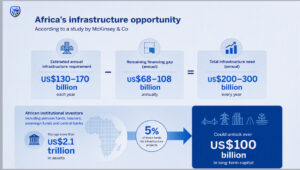
“Yet African institutional investors manage more than US$2.1 trillion in assets. Mobilising even a small share for well-structured infrastructure project could materially narrow the gap.
“On the other hand, Malawi’s requirement is immediate. The 2026/27 National Budget at K10.978 trillion, has close to K1 trillion required for infrastructure in the form of transport, energy, water, irrigation, digital connectivity and public facilities.
“The African Development Bank (AfDB) estimates that Malawi also needs an additional US$3.3 billion — about K5.8 trillion — each year to close its wider development financing gap by 2030.
“This is equivalent to 29.4% of GDP and more than 58% of the national budget.
“The 2026/27 Public Sector Investment Programme confirms a large multi-year pipeline of infrastructure, project-preparation and PPP initiatives well beyond Government’s current financing capacity.
“Given what we all know, fiscal space is already severely constrained. Public debt reached approximately K23.9 trillion at the end of 2025, while interest payments are projected at K2.79 trillion in 2026/27 — about 8.9% of GDP.”

Madinga thus noted that “the government must, therefore, use scarce public funds to prepare projects, finance essential public components and mitigate specific risks that can unlock private and development capital”.
He broke it down that the size of the infrastructure gap is visible across the economy, that include:
* Transport: Malawi’s trade competitiveness depends on efficient road, rail and border corridors. In 2025, approximately 116kms of roads were delivered against 245kms planned — underscoring the delivery gap.
* Energy: Reliable power remains a binding constraint on industry, mining, irrigation and digital services, requiring coordinated investment in climate-resilient generation, transmission and distribution.
* Irrigation and water: Malawi had developed approximately 156,351 hectares of irrigated land by 2025 — only 38% of estimated potential. Expanding irrigation, water supply and sanitation is essential for food security, resilience and year-round production.
* Digital and urban infrastructure: Broadband, logistics platforms, serviced industrial areas, drainage and waste management are critical to productive cities and a lower cost of doing business.
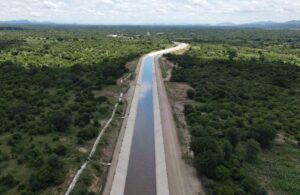
The canal irrigation project in the Shire Valley Transformation Programme
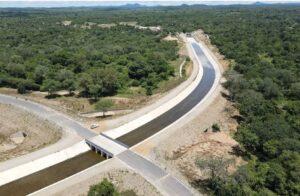
He thus observed that “closing these gaps will determine whether Malawi can commercialise agriculture, support reliable mining and manufacturing, strengthen exports and build resilience to climate shocks”.
“The diagnosis of the AfDB is equally important: Malawi must strengthen its capacity to mobilise and deploy capital at scale amid low domestic savings, shallow capital markets and reduced access to affordable concessional finance.
“The practical response is a bankable project pipeline supported by institutional capital, commercial lenders, development finance, targeted guarantees, and well-structured PPPs.
“That brings us to the central question: ‘what will convert Malawi’s infrastructure needs into investable opportunities?’
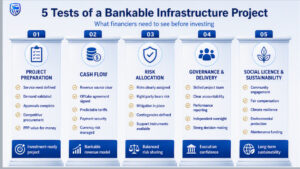
I suggest five simple tests of bankability:
* Test 1 — Has the project been properly prepared? Would a private financier fund this project if the feasibility study, demand forecast, engineering design or environmental approvals were incomplete?
Before procurement, the Contracting Authority should be able to demonstrate:
* A clearly defined service need in the population or market is not merely a construction ambition;
* Credible demand, technical and lifecycle-cost assumptions supported by experts;
* Completed land, permitting, environmental and social impact studies completed;
* Transparent, competitive procurement process with a defensible evaluation process; and
* An analysis showing why a PPP offers better value than conventional public procurement.
Madinga further quoted the World Bank’s infrastructure-governance framework placing project selection, design, procurement and implementation at the centre of good infrastructure outcomes.
“The World Bank also warns that governance inefficiencies can erode around one-third of infrastructure expenditure globally, and even more so in low-income countries, where data or development frameworks are weaker.
“If the project fundamentals are still changing during financing discussions, the project is not investment-ready.
“Spending the time to prepare these facts at the beginning of the project can save vital time and resources in renegotiations, redesign, and refinancing as a result.
* Test 2 — Can the project generate predictable and enforceable cash flow? Who will pay and how certain is that payment?
For a toll road, will traffic and tariffs generate sufficient revenue? For a power project, is the tariff viable and is the off taker creditworthy?
For an availability-payment PPP, is the Government obligation budgeted, indexed and legally enforceable?
The financier will ask:
* Is there a signed and credible offtake or availability-payment agreement?
* Are tariff reviews, indexation and subsidy arrangements predictable?
* What happens if the public counterparty pays late?
* Are termination payments and dispute-resolution provisions enforceable?
* Is there a mismatch between local-currency revenue and foreign-currency debt?
“This matters enormously during project design and negotiations. Predictable payments are not a technical footnote, they are the foundation of bankability.
* Test 3 — Has each risk been allocated to the party best able to manage it? Would a financier accept risks that neither the sponsor nor the lender can control?
The public sector is ordinarily best placed to manage matters such as land access, permitting, certain changes in law and Government-payment obligations.
“The private partner should manage design, construction, operations, and performance risks within its control.
“For each material risk whether it is construction, demand, offtake, political, foreign exchange, climate, land and community, the Contracting Authority should ask:
1. Who controls this risk?
2. Who carries it contractually?
3. What mitigation is available?
4. What happens if it materialises?
“Where these risks cannot be fully absorbed commercially, targeted guarantees, insurance, blended finance or DFI participation may be appropriate.
“But these instruments should address a defined market failure, not disguise a project that is fundamentally unviable.
“The AfDB specifically highlights calibrated public-private risk sharing, rigorous preparation and governance as key to mobilizing institutional capital.

Advertisement
* Test 4: Is there a credible governance and delivery structure? Who is actually accountable for taking this project from signature to service delivery?
A bankable project needs more than a steering committee. It needs:
* A capable project team with clear decision rights.
* Reliable financial, construction and performance reporting.
* Independent technical, environmental and financial monitoring.
“Weak delivery governance translates into delayed decisions, scope changes, cost overruns and disputes.
“A lender responds by increasing contingencies, tightening covenants, shortening tenors, requiring additional guarantees or declining the transaction entirely.
“Spending the time to address these upfront not only improves chances of securing an approval but also reduces transaction and project costs, all benefits which accrue to the public.

* Test 5 — Will the project retain its social licence and protect long-term value? Would a financier fund a project whose land, community, climate or environmental risks could halt construction or undermine operations?
“Environmental and social safeguards are not compliance paperwork. They protect the project’s timetable, reputation, and future cash flows.
“Before approaching financiers, ask:
* Have affected communities been engaged early and transparently?
* Are compensation and resettlement obligations fully costed and funded?
* Is the asset resilient to floods, droughts and other climate hazards?
* Is there a funded maintenance plan after construction?
“The causal chain is simple: good governance reduces uncertainty. Reduced uncertainty improves pricing, tenor and investor competition.
“Unresolved uncertainty leaves capital on the sidelines and projects gathering dust in drawers.”
Madinga then turned to his own experience as Standard Bank on what successful transactions teach, saying they observed that “capital moves when preparation, partnerships and risk allocation come together”.
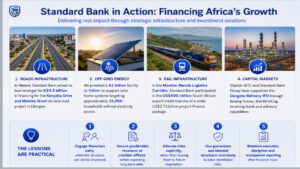
He unpacked Standard Bank served as lead arranger for K34.5 billion in financing for the Kenyatta Drive and Mzimba Street — the six-lane road project in Lilongwe.
The Bank also provided a K2 billion facility to Yellow to support solar home systems targeting approximately 35,000 households without electricity access.
In the Moatize-Nacala Logistics Corridor, which crosses Malawi, Standard Bank participated in the US$400 million South African export-credit tranche of a wider US$2.73 billion project-finance package helping rehabilitate and expand a strategic rail link connecting inland production to the Port of Nacala and transforming the inland cargo handling potential.

The Moatize to Nacala corridor that passes through, Nkaya in Balaka all the way to the border with Mozambique towards Nacala Port

More recently, Stanbic IBTC and Standard Bank Group have supported the Dangote Refinery IPO through issuing-house, stockbroking, receiving-bank and wider advisory capabilities helping broaden investor access and mobilise growth capital for the refinery’s next phase and Africa’s largest IPO.
“The lessons are practical:
1. Engage financiers early, while the structure can still be improved;
2. Secure predictable revenues or credible offtake before expecting long-term debt;
3. Allocate risks explicitly, rather than leaving them to future negotiation;
4. Use guarantees and blended structures selectively to solve identifiable risks; and
5. Maintain execution discipline and transparent reporting after financial close.
In closing, Madinga maintained that “bankability is not a certificate attached to a project at the end of procurement [but rather] it is a governance discipline built from the first feasibility study, and all the way through procurement and contracting, construction, operations, and final repayment”.
“So, as we review Malawi’s PPP pipeline, let us repeatedly ask: ‘Would a private financier fund this project? Or in other words, would I put my own money in this project?
“And if the answer is not yet, let us ask three further questions: What uncertainty remains? Who owns it? And by when will it be resolved?

“If we answer those questions honestly, Malawi will move beyond presenting projects and begin presenting investable opportunities.
“The capital exists. Our task is to create the governance conditions that give it the confidence to move,” concluded Madinga.
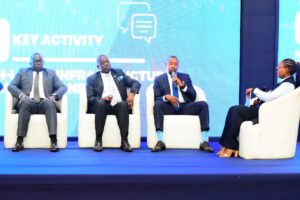
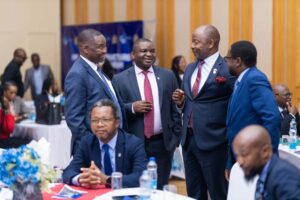
In his speech, PPPC Chief Executive Officer, Arthur Nanthuru highlighted that economic opportunities that Malawi can tap from range from energy, mining, education, transportation, agriculture, among others.
He added that government plans to double electricity access from the current 26% to 50% by 2030 through projects like Fufu and Kholombidzo hydropower stations valued at US$702 million (K1.2 trillion) and US$500 million (K875.5 billion) respectively.
Other projects, according to Nanthuru, include the US$968 million (K1.67 trillion) Chilumba Mbeya railway line in transport sector, US$1billion (K1.7 trillion) in mining and US$165 million (K289 billion) in education sector for public university students accomodation and staff housing.
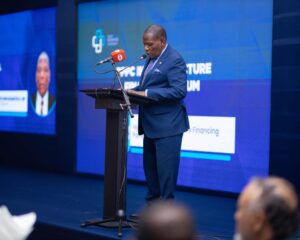
Finance Minister Mwanamveka
In his address, Minister of Finance, Economic Planning & Decentralisation Joseph Mwanamvekha stressed the need for a collaborative approach in mobilising resources for the pipeline public infrastructure projects.
Mwanamvekha highlighted that currently the sectors that need an urgent investment include energy and transportation to help transform people’s lives for sustainable development at a time government is constrained with huge debts and high expenditure obligations.

Advertisement