

Nelson Mkwende
* If Malawi can improve forex availability, stabilise inflation, increase export earnings, and strengthen fiscal discipline
* Which can attract new listings, through which the MSE could enter another major growth cycle after its most remarkable stock market performances in Africa in 2025
* Maintains Nelson Mkwende, a seasoned stockbrocking and financial analysis expert, who is duly registered with the Reserve Bank of Malawi (RBM) as an investment advisor
By Duncan Mlanjira
In his exclusive analysis of 2025/26 stock market synopsis, seasoned stockbrocking and financial analysis expert, Nelson Mkwende contends that the biggest determinant of long-term Malawi Stock Exchange (MSE) performance will be the country’s broader economic trajectory — if Malawi can improve forex availability, stabilise inflation, increase export earnings, and strengthen fiscal discipline.
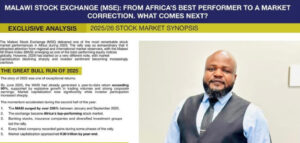
The expert, who is Chief Executive Officer of EmpowerX Consult Limited, maintains that such economic turnaround can attract new listings, through which the MSE could enter another major growth cycle after its most remarkable stock market performances in Africa that was recorded in 2025.
“Conversely, persistent macroeconomic instability would limit future market gains,” says Mkwende, who is duly registered with the Reserve Bank of Malawi (RBM) as an investment advisor.
He analysis is collaborating with the clarification that MSE-Chief-Executive-John-Kamanga-made-over-a-week-ago-rejecting-media-reports-that-suggested-that-the-stock-market-has-collapsed — saying: “Stock markets worldwide naturally experience periods of rapid appreciation followed by price corrections, particularly after unusually strong market rallies.”

MSE CEO John Kamanga
Thus Mkwende attests to that the MSE delivered one of the most remarkable stock market performances in Africa that was recorded in 2025, adding that “the rally was so extraordinary that it attracted attention from regional and international market observers”.
“The Malawi All Share Index (MASI) emerging one of the best performing equity indices globally. However, 2026 has started on a very different note, with market capitalisation declining sharply and investor sentiment becoming increasingly cautious.”
He explains that MSE’s 2025 performance “was one of exceptional returns [such that] by June 2025, the MASI had already generated a year-to-date return exceeding 90%, supported by explosive growth in trading volumes and strong corporate earnings”.
“Market capitalisation rose significantly while investor participation increased sharply. The momentum accelerated during the second half year as the MASI surged by over 236% between January and September 2025.
“The exchange became Africa’s top performing stock market; banking stocks, insurance companies and diversified investment groups led the rally. Every listed company recorded gains during some phases of the rally and market capitalisation approached K30 trillion by year-end.”

Advertisement
He indicates that several factors fueled this performance, that included:
* Exceptional corporate earnings — listed companies reported some of the strongest profits in recent history. Major banks such as National Bank of Malawi, Standard Bank and FDH Bank posted substantial profit growth driven by higher interest rates, inflation-linked revenue and strong balance sheets;
* Inflation hedge effect — as inflation remained elevated and the kwacha continued facing pressure, investors increasingly viewed equities as a better store of value than cash. Many investors moved fund from traditional savings into shares, creating buying pressure;
* Limited investment alternatives — Malawi has relatively few large-scale investment opportunities. With property markets facing shallenges and foreign investment opportunities constrained by forex shortages, domestic capital increasingly flowed into listed equities — pushing valuations higher; and
* Increased liquidity and corporate activity — corporate actions such as TNM’s K30 billion capital raise and Standard Bank’s share split improved market liquidity and investor participation.
“After such a powerful rally, the market entered 2026 with extremely high valuations and heightened expectations. The correction began in January and intensified through the first half of the year.
“Recent reports indicate that total market value declined from approximately K33 trillion in December 2025 to about K28-29 trillion by May 2026 — representing a loss of nearly K5 trillion in market capitalisation.”
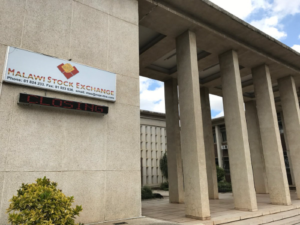
According to the financial service expert, key causes of the correction include;
* Profit-taking after massive gains — a market that rises over 200% in a single year inevitably attracts profit-taking. Many investors who entered the market early in the rally chose to lock gains, increasing selling pressure across the market — which is a normal feature of market cycles;
* Valuation concerns — by late 2025, many counters were trading at valuation that assumed continued explosive earnings growth. As investors re-assessed future prospects, some share prices began adjusting downward toward more sustainable levels;
* Economic uncertainties — Malawi continuous face persistent forex shortages, high inflation, fuel supply challenges, fiscal pressures, and slower economic growth. These macroeconomic issues have created uncertainty regarding future corporate earnings and economic expansion;
* Policy and tax concerns — market participants have cited uncertainty sorrounding new tax measures and broader economic policy shifts as factors affecting investor confidence in early 2026.
* Market psychology — the MSE’s rapid rise created expectations that prices would continue climbing indefinitely. When prices began falling, sentiment shifted quickly with some investors moving from optimism to caution, amplifying the correction through increased selling activity.

Advertisement
“Many market corrections often become partly psychological events,” says Mkwende, who collaborates the MSE Chief Executive that the evidence suggests this is not a ‘collapse’, but is better described as a correction.
“The MSE itself has publicly characterised the recent decline as a market correction. Market corrections typically involve declines of 10%-20% following strong advances and are often necessary to restore more realistic valuations.
“Importantly, most listed companies remain profitable; banking sector earnings remain strong; telecommunications companies continue generating cash flows; insurance and investment groups remain fundamentally sound — and while valuations have fallen, the underlying businesses have not experienced a comparable collapse.”
On what the future holds, Mkwende observes that on the short-term outlook, the remainder of 2026 is likely to remain volatile as investors should expect continued market fluctuations; selective recovery in fundamentally strong counters; increased focus on earnings rather than speculation; and the market may continue searching for a bottom before a sustainable recovery begins.
Medium-term outlook (2027-2028) remains constructive for several reasons;
* Strong corporate fundamentals — many listed firms continue to generate strong profits and maintain dominant market positions within Malawi’s economy;
* Attractive valuation emerging — the current correction is creating opportunities for long-term investors to acquire quality companies at more reasonable prices than were available during the 2025 peak;
* Pension and institutional demand — pension funds, insurers and institutional investors will continue requiring long-term investment assets, and the MSE remains one of the primary destinations for domestic capital. This creates a structural demand bases.

Advertisement
Thus he observes that the biggest determinant of long-term MSE performance for the long-term outlook (2028-2030), will be Malawi’s broader economic trajectory if Malawi can improve forex availability, stabilise inflation, increase export earnings, and strengthen fiscal discipline.
“MSE’s extraordinary 2025 performance was driven by genuine profit growth, liquidity, inflation-hedging and investor optimism. However, the speed of the rally pushed valuations to levels that required adjustment.
“The correction seen in 2026 is painful but not unusual after a market has risen more than 200% in a single year. The key question is no longer whether the market can repeat 2025’s growth — it almost cannot in the near term.
“The more important question is whether Malawi’s strongest listed companies can continue growing earnings despite economic challenges. If they do, the current correction may ultimately be remembered as a healthy reset that laid the foundation for the next phase of sustainable growth than the end of the MSE success story.”

Advertisement