
* It reflects the Bank’s commitment to transparency, responsible banking, financial inclusion, climate resilience, and long-term value creation in Malawi
* The report, available on the Bank’s website; www.nbs.mw, further outlines its continued investment in financial inclusion through the expansion of its ‘Banki Pafupi’ agency banking network
* And the tailored financial solutions for underserved communities, women entrepreneurs, youth, and smallholder farmers
By Duncan Mlanjira
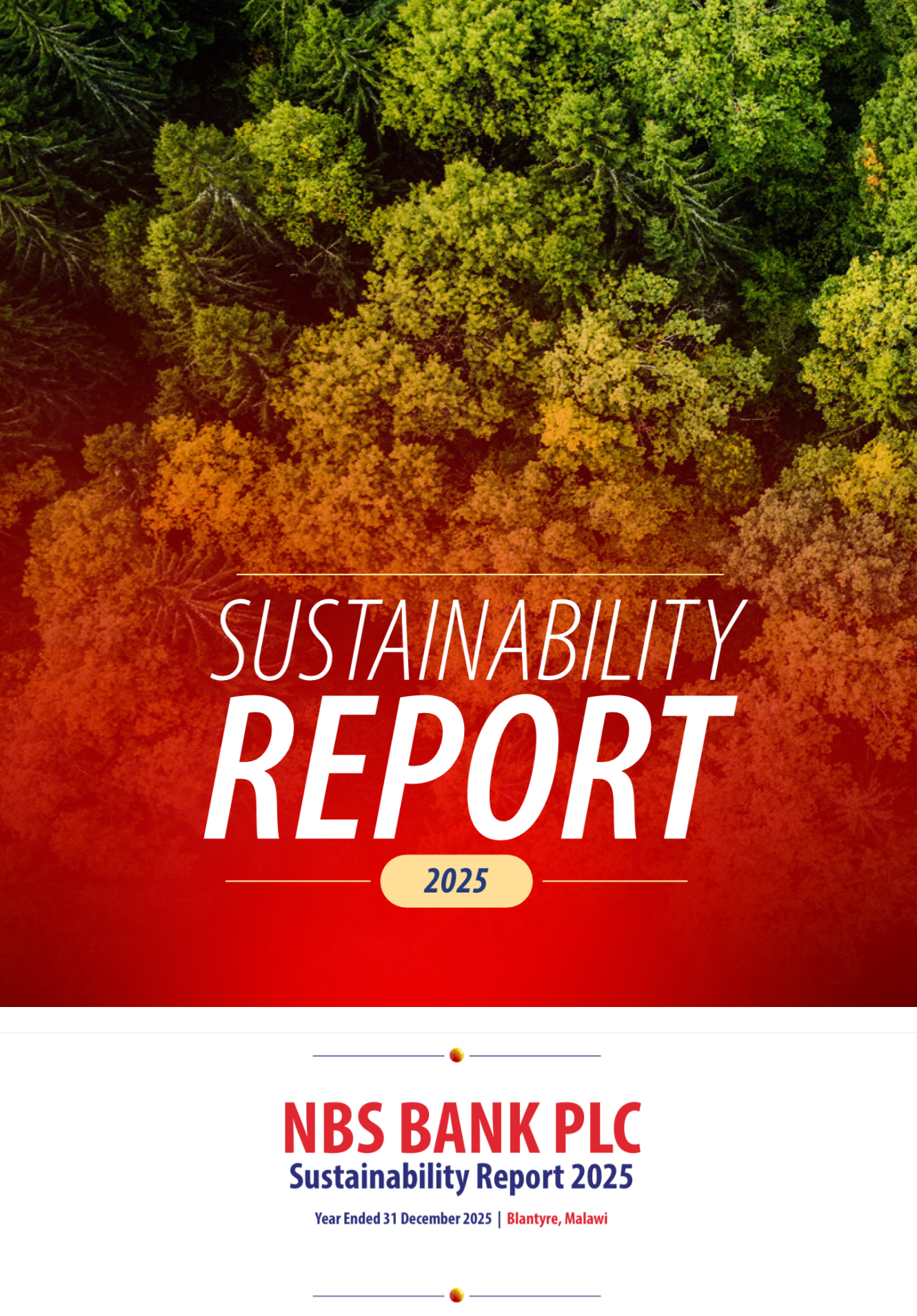
What has been described as a milestone to enhance transparent and responsible banking, NBS Bank Plc has published its inaugural ‘Sustainability Report, a stand-alone sustainability disclosure outlining the Bank’s approach, priorities, and progress in embedding sustainability across its operations, governance structures, financing activities, and stakeholder engagement.

Advertisement
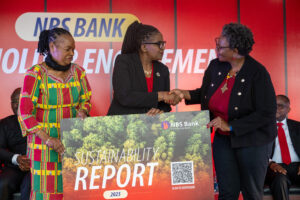
The report, launched on Thursday, May 29, during a stakeholders engagement at Bingu Convention Centre (BICC) in Lilongwe — and is available on NBS Bank Plc’s website; www.nbs.mw — is an initiative that “reflects the Bank’s commitment to transparency, responsible banking, financial inclusion, climate resilience, and long-term value creation in Malawi”.
“The report provides an overview of how the Bank is responding to environmental, social, and governance priorities within a rapidly evolving operating environment shaped by climate-related risks, economic pressures, changing stakeholder expectations, and evolving regulatory requirements,” says the bank in its public statement.


It has been prepared with reference to the Global Reporting Initiative (GRI) Standards 2021, International Financial Reporting Standards (IFRS) S1 and S2, and the recommendations of the Task Force on Climate-related Financial Disclosures (TCFD) — to strengthen the Bank’s sustainability reporting journey and support transparent communication with customers, regulators, investors, employees, development partners, and communities.
GRI standards are the world’s most widely used framework for sustainability reporting, providing a globally recognised, standardised language for institutions to publicly disclose and measure their economic, environmental, and social impacts.
The standards act as a modular, interconnected system designed to help companies identify and manage their most material sustainability issues transparently — while the IFRS are a globally recognised set of accounting guidelines designed to bring consistency, transparency, and comparability to financial statements worldwide.
Developed by the International Accounting Standards Board (IASB),IFRS serve as a universal language for business accounting across international borders.
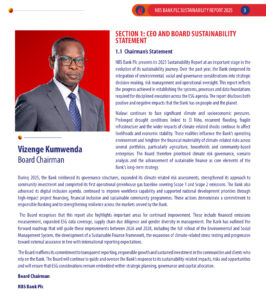

NBS Bank thus says it is continuing in integrating sustainability considerations into its strategy and decision-making processes through its four sustainability pillars: ‘People’, ‘Planet’, ‘Prosperity’, and ‘Governance’ — which “guide the Bank’s approach to responsible finance, financial inclusion, environmental stewardship, employee development, ethical conduct, and stakeholder accountability”.
“As part of its environmental commitments, the Bank continued implementing initiatives aimed at strengthening climate resilience, expanding renewable energy adoption across selected service centres, improving operational efficiency, and strengthening climate-related risk management processes.
“The report also highlights the Bank’s ongoing work in sustainable finance, climate-informed lending, environmental restoration initiatives, and support for agricultural resilience in communities vulnerable to climate shocks.’
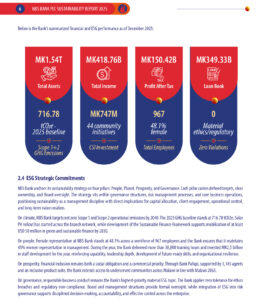
NBS Bank Plc, which is listed on the Malawi Stock Exchange (MSE) and is majority-owned by NICO Holdings Plc — serving individuals, small businesses, large corporations, and public institutions through a network of 32 real-time Service Centres and numerous nationwide ATMs — maintains that the Sustainability Report further outlines its continued investment in financial inclusion.
This is through the expansion of its ‘Banki Pafupi’ agency banking network and the tailored financial solutions for underserved communities, women entrepreneurs, youth, and smallholder farmers.

Community investment programmes highlighted in the Sustainability Report 2025 focused on humanitarian assistance, education, agriculture, enterprise development, and broader social resilience initiatives across Malawi.
“Employee wellbeing, workforce development, diversity, and responsible business practices also remained important areas of focus during the reporting period,” says the statement. “The Bank continued investing in employee training, governance systems, ethical business conduct, cybersecurity, customer privacy, and enterprise risk management — while maintaining strong regulatory compliance standards.”

NBS Bank Plc Chief Executive Officer, Temwani Simwaka
At the announcement of its publication, NBS Bank Plc Chief Executive Officer, Temwani Simwaka said “the report reflects the progress achieved in building the systems, governance, and data foundations required for disciplined environmental, social and governance (ESG) execution”.
“NBS Bank operates in a country where climate shocks are real, where financial exclusion remains a development challenge, and where transparency from institutions is fundamental to public trust.
“We publish this report because accountability to our customers, communities, regulators, employees, and investors demands it,” she said, adding that looking ahead, NBS Bank plans to continue strengthening ESG governance, sustainable finance capabilities, climate risk management, stakeholder engagement, and sustainability reporting systems — as part of its long-term strategy to support a more resilient institution and inclusive economic growth in Malawi.
ESG is a framework used by investors and businesses to evaluate a company’s sustainability, ethical impact, and long-term risk management beyond just traditional financial performance.

Advertisement