

* Prof. Malata frequently anchored her speeches with a defining question: “After all is said and done, what difference will you have made?”
* Beyond the brick and mortar, one of the most powerful values she has engraved in our hearts is her commitment to mentorship
By Duncan Mlanjira
On June 2026, the University Council of the Malawi University of Science and Technology officially announced the retirement of its Vice-Chancellor, Professor Address Mauakowa Malata by unveiling Associate Professor Mwapatsa Mipando as her replacement.
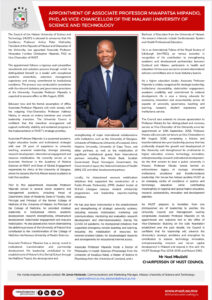
Mipando is a prominent Malawian physiologist, medical educator, and academic administrator who will formally assume the office on August 9, 2026, succeeding Prof. Malata after her 10-year tenure of office marked with profound achievements.
Established on December 17, 2012, by an Act of Parliament, MUST opened its doors to students in March 2014 to fill critical gaps in higher education and human resource development.



Under her leadership, one remarkable success of this institution, that developed into a premier public university in under a few years — dedicated to science, technology, innovation, and entrepreneurship — includes the much-lauded MUST-Endowment-Fund-as-a-testament-to-the-universitys-dedication-to-fostering-inclusivity-and-academic-achievement.
As she exits, Dr. Atikonda Mtenje-Mkochi — Executive Dean of MUST’s Bingu School of Culture and Heritage (BISCH) — has shared on her LinkedIn platform nine lessons on leadership attributed to Prof. Malata as follows:
Last month, MUST Council announced the appointment of the university’s new Vice-Chancellor, Associate Professor Mwapatsa Mipando — a highly accomplished academic leader who I am confident will guide MUST to even greater heights over the next decade.
I look forward to working with him, and I extend my warmest congratulations to Dr. Mipando on this well-deserved appointment.

Dr. Mtenje-Mkochi (right) with Prof. Malata
Today, however, I want to honour our outgoing Vice-Chancellor, Professor Address Malata.
In many of my past social media posts, I hinted that I would one day write a comprehensive feature about her. I promised myself I would do so when she neared her exit.
With her tenure at MUST concluding on August 8, 2026, and a series of farewell events underway, the time has come to fulfill that promise.
This is not just a post; it is a profound tribute to an extraordinary leader.
Prof. Malata frequently anchored her speeches with a defining question: “After all is said and done, what difference will you have made?”
Prof. Malata is, above all things, a legacy builder. If you were to ask me to detail everything she has done to grow MUST from its infancy, I would need entire pages of a national newspaper to do it justice.
She has left an indelible mark on the institution. Yet, beyond the brick and mortar, one of the most powerful values she has engraved in our hearts is her commitment to mentorship.

Advertisement
Prof. Malata firmly believes in building others. When she takes you under her wing, she intentionally shapes you into the leader you were destined to become.
Her mentees include CEOs, high-level managers, and prominent academic leaders across the region. I am incredibly proud to count myself among them.
When I joined MUST eight years ago as an emerging leader taking on the role of Head of Department (HOD), she looked at me and said directly; “I will mentor you” — she kept that promise.
Over the last eight years, she has guided my leadership journey. She has sat me down for one-on-one strategy sessions, brought me along to high-level forums to observe global speakers, offered constructive critique when I fell short, and intentionally delegated complex tasks so I could learn to navigate institutional crises.
She sponsored my growth championing my name and capabilities in rooms I hadn’t even entered yet and stood firmly by me during challenging times.
Over time, she became a maternal figure to me. As the only two women on the Executive leadership team at the time, we also shared lighthearted moments, laughing and talking about fashion, hair, and life. I will deeply miss those moments.

Drawing from my observations, direct conversations, and shared experiences with her, here are nine invaluable leadership lessons I learned from Prof. Address Malata:
1. A Good Leader Leads with Passion
Prof. Malata lived by a simple rule: love your cause. She consistently urged us to have a deep passion for our roles, our institution, our people, and our country. She embodied this completely.
Her drive was fueled by an unwavering belief in Malawi’s potential, the capabilities of MUST staff, and the transformative power of education.
To her, higher education was not just an academic pursuit; it was the ultimate catalyst for socio-economic transformation. This passion was beautifully reflected in her alignment with larger developmental visions. She inspired the MUST Big strategy — MUST’s ambitious strategic plan of 2024-2030. She fiercely championed the MW2063 national vision — deeply understanding how science, innovation, culture and heritage and technology could turn our country into an inclusively wealthy and self-reliant nation.

Her strategic horizon, however, stretched far beyond our borders; she intentionally aligned MUST’s mission with global and continental frameworks, working tirelessly toward the UN Sustainable Development Goals (SDGs) and the African Union’s Agenda 2063: The Africa We Want.
She believed with every fiber of her being that African institutions could produce global-level innovations.
Another profound passion of hers was the potential of young people — specifically wanting girls to thrive in fields traditionally denied to them.
In pursuit of all these passions, Malawi and MUST were always at the centre of her prayers; she even dedicated specific days to pray for the university and its workforce.
She often told me:
“You have to love the people you are leading. How can you effectively lead them, or how can they support your vision, if you don’t understand their drives, their struggles, and their aspirations?”
She made it a personal habit to ask about my husband, my parents, and my children, reminding me that leaders are human beings first.

Whenever I faced leadership turbulence, she instinctively stepped in as a pillar of support. There was a time I was going through a difficult time in my leadership. She instinctively knew that and she needed to come in as my pillar.
She would, therefore, call daily to let me vent, reassure me, and remind me to pray, often saying: “The devil knows you are on to something great, and this is just a distraction. Do not get sidetracked.”
2. A Good Leader Masterfully Communicates
Effective communication with the public, stakeholders, and subordinates is non-negotiable. I remember a day she called me into her beautiful office during my time as HOD. She told me frankly: “I see immense potential in you. You have strong leadership traits. A good leader needs communication skills. Let’s talk about that.”
She explained that a great leader must communicate seamlessly across departments and with external stakeholders. She gave me practical toolkits that transformed my career and I have heard her share these insights in her talks too:
* Speak with intention: Make it a point to contribute to every meeting;
* Prepare rigorously: Read all meeting documents in advance to formulate sharp, informed questions;
* Write it down: Write your thoughts on paper to keep your comments concise, focused, and free of the rambling I was prone to at the time;
* Stick to the script: Even for public speeches, script your thoughts, stick to the text to maintain focus, and practice beforehand;
* Study the masters: Find excellent speakers to emulate. She shared her admiration for British Prime Minister Margaret Thatcher, particularly her masterful use of the pause.

Margaret Thatcher
3. A Good Leader Never Stops Reading
Prof. Malata validated something I had always known but needed the discipline to sustain: the absolute power of reading. She told me:
“Atikonda, you have to step outside of reading just linguistics. Your PhD proves your technical skills, but institutional leadership requires holistic capability — communication, emotional intelligence, and financial literacy. You need to know a little bit about everything.”
She emphasised that a leader needs to understand what was happening across all departments, as well as global, economic, and higher education trends, because a leader must be ready to speak intelligently on diverse issues at any moment. Those who read, lead.
4. A Good Leader is Visionary and Strategic
If there is anyone who possesses an extraordinary blend of vision and strategy, it is Prof. Malata. She possesses the rare ability to see long-term opportunities that others overlook.
She knows precisely when to act, when to stay silent, and exactly who to bring to the table to execute a vision.
Under her leadership, MUST became a pioneer and a trendsetter in the higher education space. Crucially, she was never paralysed by a lack of immediate answers; she was quick to act and unafraid to innovate.
She would confidently announce a new strategic direction in public, and as her subordinates, we knew we simply had to run with it. Zitheke basi! (it must happen!).
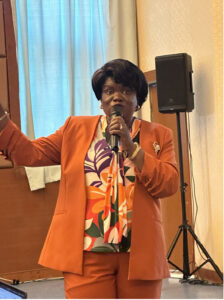
5. A Good Leader Develops Other Leaders
One of Prof. Malata’s greatest missions was leadership replication. She prioritised mentorship and deliberate delegation because she genuinely wanted others to rise. At MUST, she turned the workplace into a leadership laboratory.
As Executive Deans, she reminded us that we were part of Executive Management and fully capable of representing her.
When she delegated an event or a meeting to me, she would say: “In this moment, you are the Vice-Chancellor. Do not think lowly of yourself. Carry yourself with the same demeanor because you represent the Office.”
She was not afraid to throw us into the deep end to accelerate our growth. I vividly recall a time when both she and the Deputy Vice-Chancellor were away, and a highly sensitive issue arose involving disgruntled external stakeholders that threatened MUST’s reputation.
The situation was escalating rapidly. I was tasked with leading the university delegation to negotiate. It was an incredibly intense experience, but we successfully de-escalated the crisis.
That trial by fire taught me more about crisis management than any textbook ever could. She built an ecosystem where the university could move seamlessly in her absence because she trusted the leadership capacity she had developed.
When Prof. Malata is invited to an event she always takes a mentee or two for them to learn how it is done.
6. A Good Leader is Deeply Prayerful
Faith was the absolute cornerstone of Prof. Malata’s leadership. Everything was anchored in prayer. As she approached her exit, she shared with me how deeply she was praying for the future of MUST and I joined her in my own private space.
Throughout her tenure, she routinely invited staff to join her for lunchtime prayers, and she personally prayed for individual staff members, including myself.
Whenever institutional storms brewed, she sought divine peace. She is, in the truest sense, a prayer warrior.

Advertisement
7. A Good Leader Cultivates Exceptional Interpersonal Relationships
Leadership requires a sophisticated ability to interact with people across different socio-economic backgrounds, cultures, and sectors.
Prof. Malata understood that institutional milestones are achieved through collaboration. She lived the truth that your network is your net worth.
Her vast network continually opened doors for funding, international research collaborations, and infrastructural growth for MUST.
I was always mesmerised watching her enter a room; she would greet almost everyone by name, effortlessly recalling a personal or professional detail about them.
8. A Good Leader Intentionally Manages Their Personal Brand
In dedicated development sessions she held for the women leaders at MUST, Prof. Malata taught us that every individual is a brand.
She emphasised that we must be highly intentional and responsible about how we present ourselves both physically and online.
She coached us on executive presence — from professional dress and hair to the way we speak and behave.
One piece of practical advice I have kept to this day is her insistence on having high-quality, professional corporate photographs taken for our social media profiles, media releases, and event posters 😂😂😂😂. She taught us to project the authority of the positions we hold.

9. A Good Leader Champions the Marginalised
Those who know Prof. Malata well know that her heart beats for the less privileged. She has been a fierce, unapologetic advocate for girls in Science, Technology, Engineering and Mathematics (STEM), vulnerable youth, and needy students.
Under her visionary guidance, MUST introduced the landmark Girls-Science-Camp to inspire young women to enter science and technology fields.

MUST’s Girls Science Camp tour of EGENCO at the Nkula B hydro power plant intake in July 2024



Furthermore, MUST became the first public university in Malawi to establish an institutional Endowment-Fund ensuring that no deserving student would ever have to drop out due to financial constraints.
She actively uplifted both academic and non-academic women within the university, ensuring safe working spaces and clear pathways for promotion, while quietly sponsoring numerous vulnerable students out of her own pocket.
Conclusion
I could write endlessly about the leadership principles I have absorbed from Prof. Address Malata, but these nine encapsulate the essence of her historic tenure.
As her exit approaches, it has been beautiful to witness the outpouring of praise and gratitude from across the globe.
The individuals celebrating her legacy belong not just to MUST, but to diverse sectors nationally and internationally. That is the definition of true impact; that is what it means to make a lasting difference.
As she steps into this exciting new chapter of her life, I want to wish Prof. Malata the absolute best and express my profound gratitude. In the story of my life, she holds an entire chapter to herself.
Thank you, Madam VC, for the indelible impact you have made on my life, our institution, and our nation. You understood your calling perfectly.
May you continue to pursue God’s purpose through your extraordinary leadership — signed off Dr. Mtenje-Mkochi and her tribute immediately attracted an avalanche of affirmative responses:
Wanangwa Kenneth Msowoya wrote: “Reading this tribute reminded me of my own experience with Professor Address Malata during my Master of Science in Entrepreneurship, when she was the Vice-Chancellor.
“I had the privilege of serving as the Class President, and just a day before our graduation, an issue arose regarding the naming of our academic award.
“After our concerns had been brushed aside by some members of management, I unexpectedly received a brief phone call from Professor Malata. Her voice was calm, reassuring, and confident.
“She simply assured us that the matter would be resolved. True to her word, it was, and we graduated with the academic award exactly as it had been advertised and approved for our programme of study.
That experience left a lasting impression on me. It showed that effective leadership is not always about making grand statements; it is about listening, treating people with respect, and taking timely action.
“Professor Malata demonstrated those qualities at a moment when they mattered most, and it is a leadership lesson I continue to value in my own professional journey.”
Dean Chilewani: “Anything to do with leadership catches my attention and I have thoroughly read this. Thank you so much Doc for sharing this classic analysis of Prof. Malata’s tenure at MUST.
“I have learnt a lot out of this write up, she has indeed left a legacy. Wishing her very best. May God continue blessing her.”
Chiyembekezo Kapitapita: “She is one of the most exceptional leaders I know. She really walks the talk and above all, a voice to the voiceless. This was an excellent and inspirational read!
Annie Chimphango: “Prof Malata’s legacy will last for a long time. What an inspirational and visionary leader she is! It was a great honour to have interacted with her! Be Blessed in your next chapter!”
Alexander Kude: “Very well articulate Prof. It explains every detail of her to the core. She is one, exceptional Iron woman of valour. No word can indeed finish talking of her excellence.”
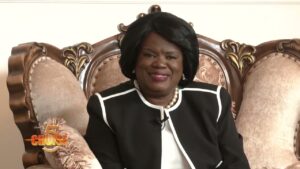
About Prof. Address Mauakowa Malata
She holds the historic distinction of being the first female Vice-Chancellor of a public university in Malawi and also holds the NYU Rory Meyers College of Nursing (Courtesy Appointment, October 2023).
She is former vice-president of International Confederation of Midwives; former president of Africa Honor Society of Nursing of Sigma Theta Tau International; former Principal of Kamuzu College of Nursing and spearheaded it to become a World Health Organisation Collaborating Centre for Inter Professional Education and Leadership in 2016.
She has spearheaded the development and implementation of various undergraduate and postgraduate in the fields of Nursing, Midwifery, Health, Science, Innovation and Technology and has facilitated capacity building for faculty and other staff in various fields.
Prof. Malata is a renowned international speaker, author and editor of various journals in the field of health, nursing, midwifery, and health workforce.
She serves on various international, regional and national boards and is an advocate for girls and women empowerment through education.
Her research work focuses on maternal and new-born health, quality of care, health workforce and innovation and technology.
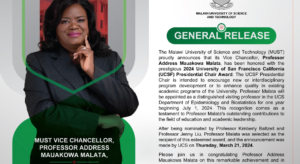
She is a Virginia Henderson Fellow of Sigma Theta Tau International (STTI), an Adjunct Professor at Michigan State University, a Fellow of the American Academy of Nursing (FAAN); a Global Health Fellow at University of California San Francisco University; an Adjunct Professor in the Department of Obstetrics and Gynaecology, Baylor College of Medicine.
She was awarded a Doctor Honoris Causa by University of Oslo in Norway, 2018, ECU Distinguished Alumni and ECU Honorary Award of Doctor of Nursing honoris causa, 2019 in Australia.
She was in 2022 nominated as one of the Champions for MW2063 Vision under enabler; Human Capital Development.
In 2023 she was in receipt of National Outstanding Award (educational achievements, women change makers in science and research) under Pan African Learning and Global Network and Plan Malawi International.—Source: Malawi University of Science & Technology (MUST)

Advertisement