

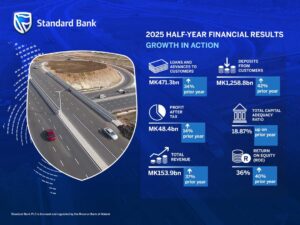
* Representing a 14% increase from the previous year’s same period as total revenue is at MK153.9 billion, up by 37%
* Earnings per share for the half year increased from MK180.31 in 2024 to MK205.93 in 2025 but in light of uncertain economic environment, the Board of Directors has resolved not to pay an interim dividend for the half-year results
* Our continued growth reflects the trust of our customers, partners and stakeholders, and your belief in our journey of Driving Malawi’s Growth
By Duncan Mlanjira
From the total revenue that Standard Bank Plc made of MK153.9 billion in the financial results for the six months ended June 30, 2025, a profit after tax of MK48.4 billion has been posted — representing a 14% increase from the previous year’s same period.

Advertisement
The total revenue is an increase 37% year-on-year, with net interest income growing by 44%, while earnings per share for the half year increased from MK180.31 in 2024 to MK205.93 in 2025 — as reported the unaudited financial results, posted this morning through; https://www.standardbank.co.mw.
The report further says the growth “was supported by a 34% growth in loans and advances to customers and a 65% increase in financial investments, whilst reference rates and yields on government securities remained stable year-on-year”.
“Non-interest revenue increased by 21% compared to the prior year. Net fees and commissions income rose by 23%, primarily due to higher transaction volumes.”
However, says the report, “this increase was partially offset by a decrease in foreign currency-based fees due to a shortage of foreign exchange [and that] trading revenue rose by 20% due to improved margins despite the impact of revised foreign exchange regulations.

“Trading volumes remained low due to ongoing foreign exchange shortages. Credit impairments increased by 166% compared to the previous year, reflecting growth in the customer loan portfolio and an increase in credit downgrades.
“The macroeconomic environment additionally contributed to a rise in forward-looking impairments related to financial investments and customer loans. The Group continues to focus on recovering previously written-off loans, maintaining prudent risk management and responsible lending practices.
“Operating costs increased by 43% year-on-year, primarily due to elevated inflation, which averaged 28.95% during the period and impacted the prices of goods and services. Furthermore, the prior year’s operating costs reflected a one-time reversal related to outsourced services resulting from a change in billing methodology; this reversal did not recur in the current year.
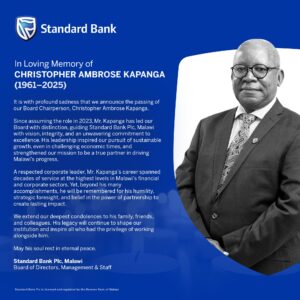
“Consequently, the cost-to-income ratio increased from 37% in the prior year to 39% in the current year,” said the report, signed on May 31, 2025 by Board chairperson, late Christopher Kapanga, who sadly passed in a sudden death on August 9.
In its economic outlook, Standard Bank highlights that “foreign exchange demand and supply imbalances persisted in the first half of the year, worsened by the withdrawal of funding by some international development agencies following global foreign policy shifts; the expiry of the International Monetary Fund’s (IMF) Extended Credit Facility; and lower earnings from tobacco sales”.
The US dollar closed the first half selling at MK1,750.48 compared to MK1,749.51 at the end of June 2024. Public debt levels worsened and remained high. High food prices and foreign exchange shortages exerted significant pressure on headline inflation for the most part of the first half.
“However, when food availability improved at the onset of the harvest season, headline inflation started to ease, and it closed at 27.10% in June 2025 — significantly lower than the 33.3% in June 2024.
“Both the policy rate and the reference rate (which is also the base lending rate) were maintained at 26% and 25.10%, respectively. However, the liquidity reserve requirement (LRR) for local currency was adjusted upwards from 8.75% in June 2024 to 10.00% in June 2025.
On the performance, the Bank maintains that it “operated in an economic environment characterised by high inflation and foreign currency supply-demand imbalances — but despite these conditions, it achieved higher revenue and strengthened its balance sheet”.
“Our continued growth reflects the trust of our customers, partners and stakeholders, and your belief in our journey of Driving Malawi’s Growth. We remain committed to working with you to create sustainable value and enable your ambitions.”

On the future outlook, Standard Bank maintains that “the operating environment is expected to remain challenging in the second half of the year, given the inflationary pressures emanating from foreign exchange supply shortages and food price pressures during the lean season”.
“As the Malawi Government is expected to negotiate a new financing package with the IMF post the general elections date, most macroeconomic variables may move adversely in the last quarter to pave the way for a correction, especially in the money markets.
“In light of the uncertain economic environment, the Board of Directors has resolved not to pay an interim dividend for the half-year ended June 30, 2025. The Board will continue to monitor the economic situation and declare a dividend when macroeconomic conditions improve.”


Advertisement