


Learners from Standard 1 to 8 classes have no desks
* Recorded 100% success rate in both 2022 and 2023 academic years of Primary School Leaving Certificate Examinations (PSLCE)
* What’s more, in 2023, out of 110 learners, 64 secured places in secondary schools and with only 11 teachers
Feature by Vincent Khonje, MANA
Nestled over 60km from Mchinji Boma; facing challenges of a poor access road network; lacking essential social amenities — Lipunga Primary School is defying all these odds by recording 100% success rate in both 2022 and 2023 academic years of the Primary School Leaving Certificate Examinations (PSLCE).

Advertisement
What’s more, in 2023, out of 110 learners, 64 secured places in secondary schools and with only 11 teachers, this number is considered adequate compared to other schools in such remote areas which usually have fewer teachers since they run away to other better schools.
Lipunga school, however, continues to provide quality education against all odds of the remote area of sub-traditional authority Kapunula in Mchinji, on the Malawian border with Zambia.
The school sits in the middle of hills with essential social amenities, apart from the school itself, not available and it takes the members of the community hours to access the nearest hospital at Mkanda Trading Centre.
Lipunga Primary School, with 1,008 learners, currently faces challenges with inadequate teaching and learning resources and, to cap it all, the classes from Standard 1 to 8 have no desks.

Advertisement
Despite the school finding itself in the face of adversity, it has emerged as a shining example of resilience and success by defying the odds — that is to the strong bond between the community members, the teachers and the learners themselves.
Headteacher Nephtari Safali proudly shares the secret to their success story, saying the relationship between the community and the teachers has been a motivation for teachers to stay despite being in a hard-to-reach area.
The community’s commitment goes beyond words, ensuring the teachers have a place to call home, gifting rewards to teachers when students excel, and even providing pieces of land for teachers to cultivate crops.
The awesome gesture from the community has made it possible for teachers to be retained in the hard-to-reach area unlike in other schools.
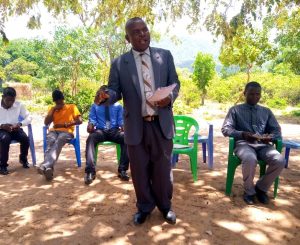
Headteacher Nephtari Safali
However, the community’s warm-heartedness to the teachers is not for nothing, there has to be a favour the teachers have to return to the community too.
Azele Zimba, the Parents and Teachers Association (PTA) chairperson, emphasises the community’s commitment to education: “We sit down with teachers and understand their needs. In return, we support them, knowing this area lacks basic amenities.
“We aim to ensure teachers are happy so that our children receive quality education,” Zimba said.
News of Lipunga’s triumphs has spread beyond Mchinji that attracted the attention of education authorities in Karonga District, who sent a delegation comprising headteachers, school management committee (SMC), district education network (DEN), PTA members, primary school education advisors (PEAs), and other educationists to visit Lipunga School to learn a few things.

The trip was facilitated by Governance for Solutions (GFS) and William Ngwira, chairperson of Karonga DEN, expressed his admiration, saying: “Karonga has many hard-to-reach areas, but it’s difficult to retain teachers, thereby compromising education quality.
“We came to learn from the inspiring news from Lipunga, to understand what they do differently and see if we can replicate it,” he said.
The fact that the Karonga delegates travelled over 600km to Mchinji just to learn from a school in the far-flung areas of the district has excited Samson Kawiya, Mchinji’s principal education officer.


Advertisement
Kawiya has praised Lipunga’s approach and stressed the importance of community-teacher collaboration, saying: “This is the kind of mutualism we need between the community and professionals if we want to realise quality education.”
It is not the first time that Lipunga has been associated with success as the headteacher, Safali was chosen the best in Mchinji and received an award and a bicycle at the World Teachers Day celebration in Mzuzu on October 18, 2023.
Mchinji education office oversees other schools in hard-to-reach areas like Kazyozyo, Kavunguti, Katonda and Gumba Zones and it is common for teachers to request to be moved from hard-to-reach areas to places close to towns and trading centres — but not for one, Dyson Jereman, a teacher at Lipunga.
Despite being at the far end of the country on the borders of Malawi and Zambia with fewer amenities, Jereman has served the area for 12 years and feels at home, saying he is motivated to stay at Lipunga because the community is accommodative and understanding.

Advertisement
“I cherish the unity which is here between the community and among ourselves as teachers. The loving community provides us with necessary needs and we feel we are welcome, so there is no need to leave.”
Jereman cherishes that he was given a dimba land by the community which affords him to grow various crops to support his family while Blessings Khumalo echoes Jereman’s sentiments, saying the community at Lipunga is just pure at heart to the extent that she really feels at home.
Khumalo, who is one of the two female teachers at the school, says they are treated well and this serves as motivation to reciprocate the gesture by making sure the learners are given full support.
“The bond is just tight, this is what keeps us going despite some challenges,” said Khumalo, who has even gotten married to a man from the same area.
The school has eight teachers’ houses and the community on its own constructed five of those.
In Mchinji, Lipunga Primary School stands not just as a school but as a testament to the remarkable heights that can be achieved when communities and educators join forces to defy the challenges of a hard-to-reach landscape.

Advertisement