
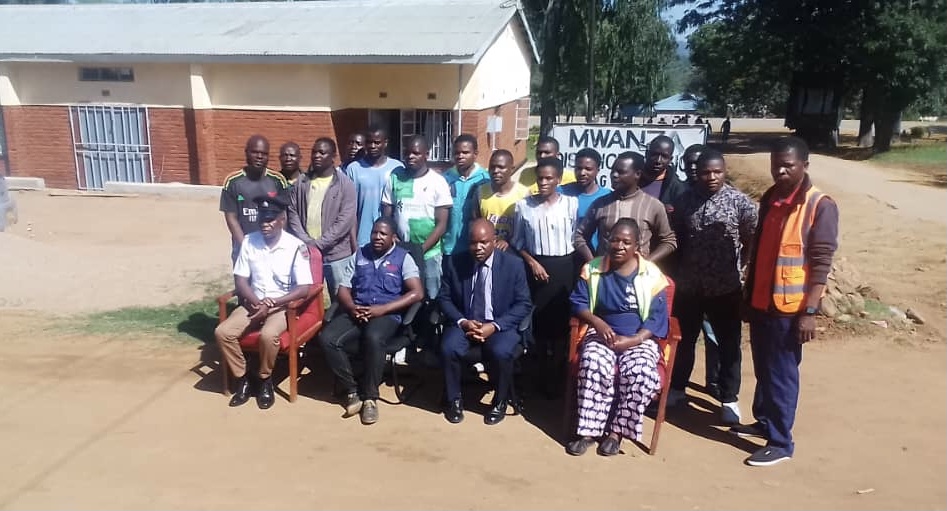
Mwanza District Council officials, the police and motorcycle taxi operators leaders in group photo after signing MoU.— Picture by Cassandra Mangulama, MANA
* But while all efforts are being done to reign kabazas in, traffic police mostly don’t stop them on the public roads to check whether they have all the requirement to ply along public roads
* Even when quite visible that they are using unregistered motorcycles — most them not road-worthy — the traffic police ignore their impunity
* Of not using safety helmets; failure to observe traffic rules; speeding unnecessarily by weaving in and out of cars along slow traffic movement and operating at night without headlights or reflector lights
By Cassandra Mangulama, MANA & Duncan Mlanjira, Maravi Express
Motorcycle taxi (kabaza) operators and Mwanza District Council on Wednesday signed a memorandum of understanding (MoU) which aims at strengthening collaboration that shall see the operators adhering to road safety regulations for the benefit of passengers and other road users.

Advertisement
Representing Mwanza District Commissioner, Feston Kwezani commended the kabaza operators association for its willingness to sign the MoU with the Council, noting that it will go a long way in enhancing the collaboration between the two entities.
Chairperson of the Malawi Coalition for Kabaza Stakeholders Association (MACOKASA), Moses Mwalabu applauded the MoU, saying this marked a new chapter in formalising relationship between the Kabaza operators and the authorities.
“The MOU outlines expectations around safety, discipline and legal operation of motorcycle taxi operations,” Mwalabu said at the signing ceremony at Mwanza District Council offices — which was witnessed by various stakeholders, among them, officials from Mwanza Police, council representatives and district Kabaza taxi operators’ association leadership.

Mwanza Kabaza Association chairperson, Wilson Mpita hailed the initiative that led to the MoU, saying the agreement will help bring order among the motorcycle taxi operations.
“This is a move in the right direction. The MoU shows that we are willing to work with the council and the police to ensure that road safety regulations are adhered to all the time,” he said.
Mwanza Police Station public relations officer, Hope Kasakula described the MoU as a positive move in improving road safety in the district, saying: “We believe this agreement will reduce accidents and it will also make it easier to engage Kabaza operators through awareness campaigns and regular dialogue.”
Since they started their operations in the country, Kabaza operators have earned more negatives over their behaviour on public roads — and while all efforts are being done to reign them in, traffic police mostly don’t stop them on the public roads to check whether they have all the requirement to ply along public roads.

Overloading is part of a kabaza operator
Even when quite visible that they are using unregistered motorcycles — most them not road-worthy — the traffic police ignore their impunity of not using safety helmets, failure to observe traffic rules; speeding unnecessarily by weaving in and out of cars along slow traffic movement and operating at night without headlights or reflector lights.
The traffic police, in engagements with kabaza operators — especially when other stakeholders are involved as they did in Mwanza, always highlight that most accidents involving the kabazas are avoidable and are often caused by their failure to follow road safety rules.
Every accident involving a motorcyclist, no matter how minimal the impact might be on collision, the rider and its passenger always sustain very serious injuries.
The Malawi Orthopaedic Association (MOA) has always maintained that there is a huge burden of treating road accidents victims in the country’s hospitals, with 49% of them being from kabaza operators.

In September, during a kabaza safety awareness campaign function at Area 25, Nsungwi in Lilongwe, attended by Deputy Minister of Health, Halima Daudi, MOA president Maureen Sabao gave an example of Lions Hospital, which has a bed capacity of 65 but they are times they on 135-bed capacity due to increased kabaza accident victims.
The ripple effect is that many of the patient sustain multiple fractures, which means that if they are admitted for long, they use resources that could have been covered by five people — adding that such fractures take time to heal to a period of not more than two to three months.
“Thus, if a person was working then he will not work for that period and economically that person is suffering and as a country we are using a lot of health budget,” she had said.


Advertisement
On her part the Deputy Minister of Health also observed that statistics of road traffic accidents involving kabaza are alarming — emphasising that such rise presents a public health crisis that touches every aspect of the nation, including the health system, families and the economy.
She quoted data of motorcycle accidents for 2022-2023, which showed that 1,800 people died from injuries sustained from accidents involved by kabaza operators, saying: “These are not just numbers behind each statistic, but a story of pain, loss, struggle — particularly among young men aged between 15-59 most of whom are bread winners in the families.
“The ripple effect of these injuries extend beyond the immediate trauma, leaving long lasting socio economic scars on both families and community.”
Why the traffic police only render lip service when other stakeholders are involved in voicing concerns over kabazas, only remains with the law enforcers, most of whom are known to own motorcycles, which are operated on their behalf.
