

Trade Minister Mumba at the press briefing last evening in Lilongwe
* Lifts guided values on Zambian imports as supply agreements with Chilanga Cement Company and Sinoma Company will ensure adequate availability
* The two Zambian companies will supply up to 300 tonnes of cement daily at reduced prices to stabilise the local market
By Innocent Manda, MANA
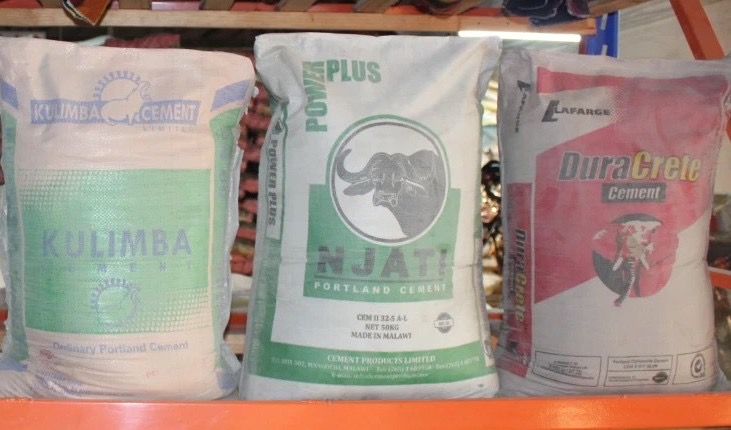
Minister of Trade & Industry, Vitumbiko Mumba has announced that Malawi Government’s new measures to curb rising cement prices by removing the 10% surcharge on imported cement and lifted guided values on Zambian imports.

Advertisement
At a press briefing yesterday, Mumba said supply agreements have been made with Chilanga Cement Company and Sinoma Company, that will ensure adequate availability as the two Zambian companies will supply up to 300 tonnes of cement daily at reduced prices to stabilise the local market.
The Minister indicated that Chilanga Cement Company has agreed to supply Malawi with 300 tonnes of 32.5N Portland cement per day at US$105 per tonne, which is US$9 less per tonne — with a similar engagement with officials from Sinoma Company Ltd, who have proposed to supply cement at US$105 per tonne for 32.5N and US$118 per tonne for 42.5N, which is US$7 less per tonne
According to Mumba, 12,000 bags of cement will arrive in the country this week, signalling government’s commitment to ensuring imported cement is available in the country at affordable prices.
Initial consignments are expected this week, targeting central and northern regions where supply challenges have been most acute for buyers and traders.
“These measures are designed to reverse the price hikes that have seen a 50kg bag jump from MK26,000 to MK50,000 and ensure cement is affordable and readily available to Malawians,” Mumba said, while warning traders in the country against taking advantage of the scarcity of cement to overcharge the product.
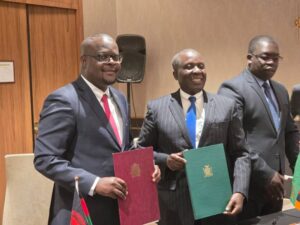
Mumba also officially announced that Malawi and Zambia signed a Mutual Recognition Agreement under the COMESA framework on Monday, August 11, which enables mutual recognition of product certification, reducing costs and eliminating duplicate testing requirements.
“Commodities covered under the agreement include maize, groundnuts, beans, rice, soybean, and sorghum, which constitute a significant portion of Malawi’s agricultural exports,” he said. “The move aligns with government efforts to facilitate cross-border trade efficiently and sustainably.”
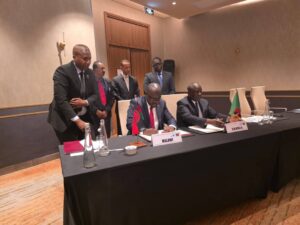
Signing the Mutual Recognition Agreement with Zambia
He further revealed that Malawi signed a protocol with China on June 12, allowing direct exports of macadamia nuts — which removes intermediaries, increases farmers’ earnings, and enhances the country’s competitiveness in international markets.
“These agreements will remove major non-tariff barriers, open new export markets, and empower our farmers to earn more from their produce, calling them a milestone in Malawi’s export growth strategy.”
The Minister thus warned traders against exploitative pricing and hoarding, offences prohibited under the Competition and Fair Trading Act, which carry penalties of up to 10% of annual gross turnover.
“Enterprises that exploit Malawians through hoarding or overpricing will face the full arm of the law, warning that government will not tolerate abuse under the Buy Malawi Strategy.”
Mumba concluded by saying that the government will continue collaborating with regional and international partners to ensure market stability, affordable prices, and sustainable growth for producers, traders, and consumers across Malawi’s domestic and export markets.—Edited by Maravi Express


Advertisement