
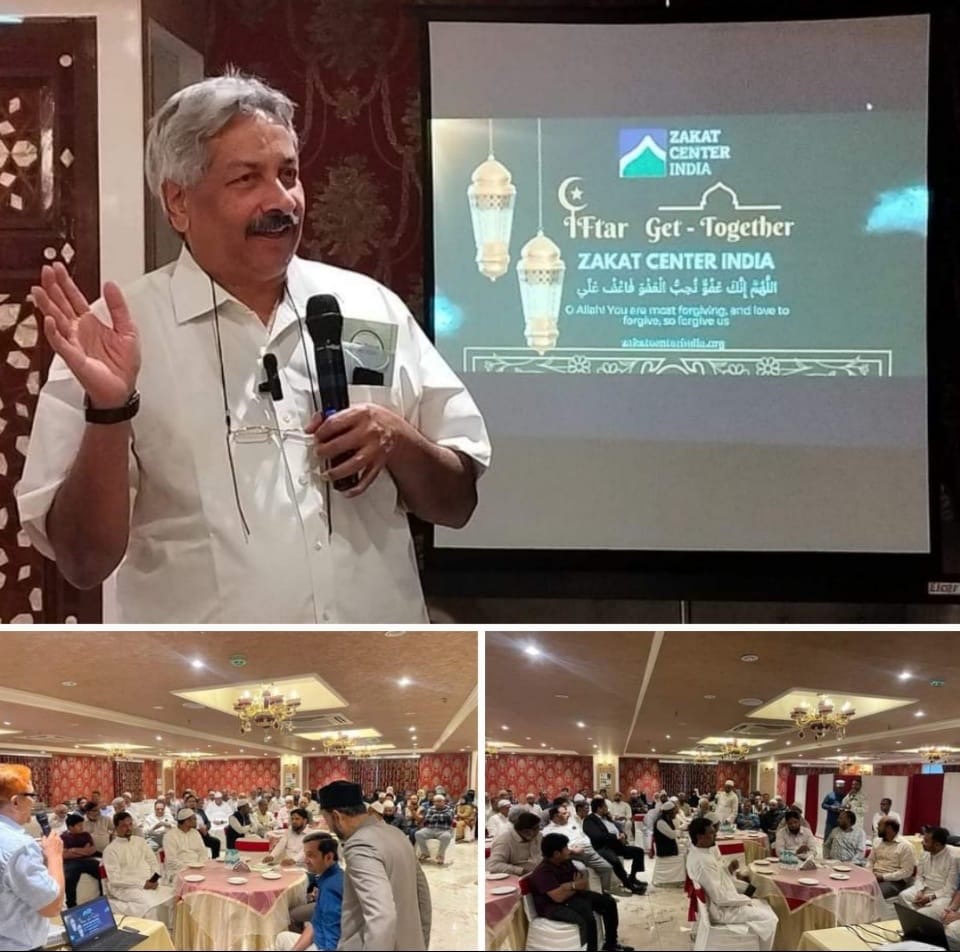
Andhra Pradesh Syed Anwarul Huda, Indian Police Service IPS (Rtd) exhorting Muslims to donate Zakat in Hyderabad, Telangana State, India
* Wealthy Muslims in Malawi are encouraged by several Muslim organizations to pay Zakat to alleviate poverty among the poor
* Zakat can be paid in cash — 2.5% of annual income or on farm produce if it reaches the required limit for payment of Zakat
By Dr Ahmed Mohiuddin Siddiqui
The Iftar Get-Together by Zakat Centre India (ZCI) was a sight to behold in Hyderabad — the southern Indian City. If ‘Collective efforts for poverty free self-reliant Ummah’ is the motto of the organization, it is surely in the right direction.

The ZCI fielded former Director General of Police (DGP) of the erstwhile united Andhra Pradesh Syed Anwarul Huda, Indian Police Service IPS (Rtd) to motivate the community in channeling its efforts to spend Zakat for productive purposes and educational development of Muslims.
Speaking as the guest of honour, Syed Anwarul Huda or SA Huda as he is popularly called, motivated the community and stressed the need to move away from more and more consumption expenditure of Zakat.
The supercop SA Huda ignited fire in the bellies of the fasting Muslims, who gathered at the Iftar Get-Together, by narrating his own experience and joy of giving away generously. On the advice of his better half, he takes out 2% every month on the income of that month.
This way, he urged the people to donate more and more and not restrict themselves to 2.5% mandatory Zakat on whom it is binding. He opined that we tend to do good deeds mostly in one month of the year — Ramzan. He felt that there is a Zakat fatigue because everyone comes for Zakat in this month only.


Advertisement
He pointed out that there are two clear trends visible:
1. Some people are loath to dip their hands in their pockets; and
2. People are generous too while it comes to good causes and the people involved are of integrity. The donors are then sure that their money will go for the purpose for which they are donating.
SA Huda highlighted that 80% of the time is spent on funds collection in some cases and only 20% on work. He commended the example of a non-voluntary organizations confederation COVA headed by Dr. Mazhar Hussain, which spent only 20% of their time in fund collection and 80% on work.
SA Huda appreciated the Zakat Centre India (ZCI) for spending the collected Zakat for productive and educational purposes also, apart from spending on consumption and pensions.
It is significant to note that the ZCI is on a mission to eliminate poverty and help the poor and needy with its livelihood, education, ration, and pension projects. It was established in 2022 and collected Rs. 2 Crore in its inaugural year.
It has ambitious plans to expand its Zakat collection activities in 20 cities from the existing 10 cities, and towns all over India in the current financial year. It is aiming to collect Rs. 20 Crores this year. The focus of spending is on livelihood projects, skill development, and educational programmes.

Advertisement
The ZCI collected Zakat from Indian Muslims only in the ZCI’s Indian Bank accounts. It did not accept foreign Zakat donations. It has supported several impoverished Muslims in setting up their livelihood through small businesses apart from sponsoring the education of children whose parents cannot afford it.
About 70% of the ZCI funds are spent on providing ration to the poor while the rest of the funds are used for education provision and other facilities for weaker sections of the Muslim community.
It is pertinent to note that the ZCI took guidance on Zakat utilization from the Zakat organizations of different countries like Malaysia, Turkey and South Africa. Only one person is a paid employee while others are working voluntarily.
Manzoor Ahmed of ZCI has shared a 13-page Annual Zakat Impact Report. The ZCI has appealed to the eligible Muslim community to donate their Zakat to the centre by calculating on the ‘Zakat Calculator’ available. The Zakat Calculator is available on their website — zakatcenterindia.org.
Similar to Zakat Center India (ZCI), the wealthy Muslims in the Republic of Malawi are encouraged by several Muslim organizations to pay Zakat to alleviate poverty among poor Muslims. Zakat can be paid in cash — 2.5% of annual income or on farm produce if it reaches the required limit for payment of Zakat.
The year is calculated according to lunar calendar. The requirement to pay Zakat is one bag of 50 kilograms of maize or any other farm produce for every 13 bags one has produced in his farm.
The Muslim Hands UK made efforts to empower communities to live sustainable independent lives in the Republic of Malawi. In order to alleviate the difficulties Muslim women face in Malawi, the Women Economic Empowerment Fund was established.
It was supported by Zakat – to support local women by providing them with the skills and financial means to reach their goals and set their business plans into action.
After receiving a range of business plans, the best eight project proposals were approved and the successful 22 participants were imparted training in 2017 in the following fields: tailoring, rearing chickens (poultry), knitting, butchery, beauty salon, transportation, restaurant management and agriculture.
I would say that Zakat is not an expenditure which goes away but it is an investment for the Life Hereafter and rich rewards will be reaped from our Creator. My fellow journalists have a prime role in making the masses aware about the need to pay Zakat and alleviate poverty.
The religious obligation and the economic social responsibility are combined in one noble act of paying Zakat to the poor and the needy. Let the poor also share the joys and blessings of the holy month of Ramadan and Eid ul Fitr festival!

Advertisement