

Analysis by Farai Chigaru
Our economic destiny has been sauced by mainly the Western direction. We were enclaved into a universal pathway that never worked to our advantage most of the time. The economic growth for Malawi has been epileptic since then.
Economic growth is a concept that is a goal for all countries; there are several sources of economic growth that are applicable to a developing country like Malawi.
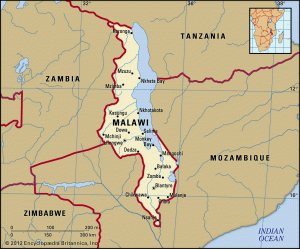
Economic growth can be divided into different forms such as: economic growth as a function of a different mix in factor endowment, thus the interplay between capital, labor and natural resources.
Another can be economic growth as a function of institutions, the interplay between the state, market and societal values; economic growth focus on the role of incentives, that play a major role in motivating individuals to increase their productivity.

Advertisement
The last source is the role of education, thus innovation as the source of economic growth.
For the past few years, the role of factor endowment as a source of economic growth has been adopted especially in developing countries.
This is a theory that was initiated by Professor Justin Yifu Lin in New Structure Economics(NSE).

Professor Justin Yifu Lin
His theory stresses on the relative abundance of the factor endowments that translates into comparative advantage. The relative factor abundance affects a country’s comparative advantage and thus implies what the country can relatively do better.
According to the World Bank, in the period between the end of World War II and 2008 (before global recession), among the 200 developing economies, only South Korea and Taiwan moved up from low-income economy to high income economy.

Mainland China
Mainland China may achieve that feet by the year 2025. Among the 101 middle-income countries in 1960 only 13 became middle-income economies by 2008.
The above statistics show that most developing countries have not been able to escape the low-income or middle-income trap in spite of a half century’s development efforts by the people and governments in the developing countries themselves and the supports and guidance provided by various multilateral and bilateral institutions — Malawi inclusive.

These past economic theories, from the early structuralism theories (import substitution) to the randomized control trials, have failed to provide a consistent solution to the problem of poverty.
These theories have tended to work on selected countries — they have, therefore, failed to explain this phenomena of selected economic growth.

Advertisement
New Structural Economics claims that the past theories dwelled much on dealing with the symptoms of failing countries, without being able to identify the real problem that consistently perpetuates poverty in developing countries.
In the spirit of New Structural Economics, this article agrees that the developed community mainly focuses on ‘what a country does not have’, such as good governance, solid institutions and adequate human capital.

Washington Consensus
This is evidenced by the Washington Consensus that was rolled out with the prescriptions that highlighted the “ten commandments” that developing countries had to fulfill in order for them to develop.
These requirements, therefore, highlighted what these developing countries were lacking (did not have) as a pre-requisite to development; and therefore attributed the poverty to the lack of these.
This article points out that these past theories and western programs have hugely ignored what a country possesses (its revealed comparative advantage) and what it could potentially do well (its latent comparative advantage).

Education vital to economic empowerment
A comparative advantage of any country is endogenous to their factor endowment, which changes over time. Malawi is currently a labor abundant country and therefore has a comparative advantage in labor intensive products.
Comparative advantage also provides solutions to the phenomenon of aid conditional ties that are imposed by the international developed community on developing countries.

Malawian entrepreneurs
As a country, Malawi has not been spared by this problem and we, therefore, lose ownership of our policies since the direction of the policies are held ransom by the aid donors.
In an effort to solve this therefore, we need to divert from the norm North-South aid, where the developed north provides charity aid to the poor south.

Hard working Malawian farmers
The North-South aid is motivated by the concept of absolute advantage, as developed by Adam Smith, where in absolute terms, the north are in control of everything and can easily dictate the conditions on the developing south.
The article therefore recommends Malawi to move towards the South-South development cooperation as championed by China, where partnership is made with fellow developing countries in the south.
This aid is, therefore, based on a comparative advantage principle, where both countries are expected to gain from their partner in the exchange — as developed by David Ricardo.

In an event where the partner country is also expected to gain from Malawi, it is therefore easier for Malawi to bargain on the terms of trade and has a bigger bargaining chip than when she has nothing to offer on the table.
It is imperative for Malawi to adopt comparative-advantage-following strategies (growth strategies should align with industries that Malawi does well); and most importantly, the strategies should identify what Malawi can potentially do well.

Tea, one of Malawi’s biggest industry
What Malawi can potentially do well is a hidden comparative advantage that can only be realized after removing some bottlenecks through government facilitation. This hidden comparative advantage is called the latent comparative advantage.
This article therefore aims to identify the hidden comparative advantage for Malawi, signifying to the country what industries Malawi should focus on.
In order to achieve this objective, the Growth Identification and Facilitation Framework (GIFF) can help us to focus on what can help us move ahead. The framework has been adopted in several countries including Senegal, Nigeria and Ethiopia.
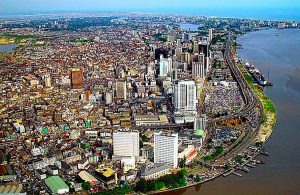
Nigeria, largest economy in Africa
One of the major issues why developing countries did not perform well over the past decades is in wrong benchmarking, which is the selection of countries in which a country tries to learn from and adopt their policies.
These developing countries, therefore, used size of a country as a proxy for identifying a benchmark country to adopt strategies and industries from.

Ghana’s former president Kwame Nkhrumah
This can be seen right after WWII, where developing countries including Ghana, led by Kwame Nkrumah, adopted capital-intensive industries in the wave of import-substitution theory.
These countries benchmarked against the developed countries and tried to locally produce the goods that they were importing form them- hence the name “import substitution”.

Agriculture
The spirit of the article therefore is to find the realistic benchmark countries for the specific developing country. From these benchmarked countries therefore, we aim to identify the sunset industries, industries that are losing the competitiveness due to the country’s evolving factor endowment and therefore evolving comparative advantage.
Thus to say, for Malawi, we identify the country that is also a labor abundant country and therefore also has a comparative advantage in labor intensive industries.

Sir Arthur Lewis’ theory of development
However, since these countries are ahead of Malawi on the welfare distribution, it would imply that, their wage costs are becoming relatively more expensive (as stated in Sir Arthur Lewis theory of development).
They are losing their comparative advantage in labor intensive industries and they are gaining comparative advantage in capital intensive industries.
This evolution to capital intensive industries therefore makes labor costs more expensive while making capital costs relatively cheaper. The companies in the labor intensive industries in these benchmark countries cannot therefore sustain operating in these countries and opt to migrate their operations to countries with lower wage costs — labor abundant countries.

Street vending popular in Malawi
This is where Malawi needs to create favorable environments and attract and court these companies in order to immigrate into Malawi.
Japan is one of the countries that adopted this strategy. Before WWII, Japan was a country of labor intensive industries but after the war it started to target capital intensive industries from the US.
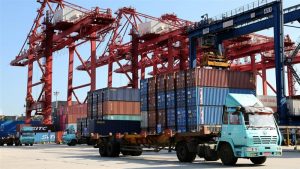
Japan’s shipping industry
This is shown historically where before WWII where Japan’s rising share in labor intensive sectors coincided with the US falling share in labor intensive sectors; where after WWII, Japan’s Revealed Comparative Advantage (RCA) in labor intensive industries fell sharply while its RCA in capital intensive manufacturing sectors rises sharply.

Malawi rice
Malawi can, therefore, do the same by identifying benchmark countries that have sectors that are losing their comparative advantage in the labor intensive industries that will be looking for a safer haven in other countries with lower wage costs.

Cotton farmers
In summary, combining subsectors from the benchmark countries as well as the self-discoveries by Malawi’s domestic firms, the following subsectors stand out — garments, plastic, cotton yarn, wood, rubber, agro-processing products (sesame seeds, molluscs, milled rice, unstripped tobacco), food products, vegetables, raw materials and stone and glass.
It is, therefore, important that Malawi examines herself to see the potential that is embedded in her and focus on exploiting them. It’s not too late to achieve!
* The author is a PhD Candidate (Economics) at Peking University, China. Feedback: chigaru2@gmail.com