
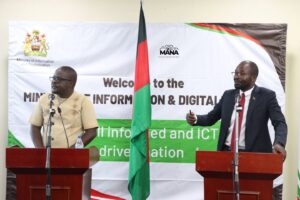
Trade Minister Mumba (left) at the press briefing last evening alongside Minister of Information Moses Kunkuyu
* Minister of Trade & Industry, Vitumbiko Mumba urges Malawians to participate in Illovo Sugar Malawi’s resale tender
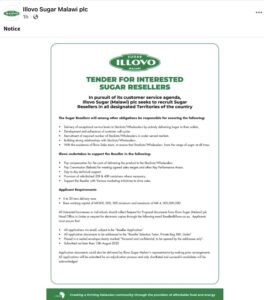
* But the resale tender was announced on August 4 and closes tomorrow, August 11 — in which interested applicants are required to have a base working capital of K300 million minimum and K4 trillion maximum
By Duncan Mlanjira
Minister of Trade & Industry, Vitumbiko Mumba has threatened that if distributors of Illovo Sugar Malawi will continue hoarding sugar to create its scarcity on the market so that they can inflate its controlled prices, the government will be forced to flood the market with imported sugar to protect consumers.

Advertisement
He is quoted to have said this last evening at a press conference in Lilongwe where he announced Malawi Government’s new measures to curb rising cement prices by removing the 10% surcharge on imported cement and lifted guided values on Zambian imports — measures are designed to reverse the price hikes that have seen a 50kg bag jump from MK26,000 to MK50,000 and ensure cement is affordable and readily available to Malawians.
A report by Malawi News Agency (MANA) indicates that the Minister urged Malawians to participate in Illovo Sugar Malawi’s resale tender — stressing that habitual hoarders will face restrictions under proposed amendments to the Business Licensing Act.
“If habitual offenders win these tenders and revert to their old practices, the Chakwera-led administration will flood the market with imported sugar from countries such as Brazil to protect consumers,” he is quoted as saying.
But the resale tender was announced on August 4 and closes tomorrow, August 11 — in which interested applicants are required to have 5 to 30 tons delivery vans and a base working capital of K300 million minimum and K4 trillion maximum.
However, while applauding Illovo Sugar Malawi “for its transparent nature in advertising for applications for sugar resellers around Malawi” Chifipa Mhango — Chief Economist for South Africa’s Don Consultancy Group (DCG), maintained that “the minimum capital base of MK300 requirement may discriminate against the involvement of indigenous Malawians in the distribution network”.
Mhango observed that the capital base requirement might discriminate Malawians, most of whom “are going through a tough path economically and capacity to raise the minimum of MK300 million, maybe out of reach for many”.
“It is important for Illovo to consider a process that supports the participation of indigenous Malawians in the sugar reseller process, by setting allocation with an affordable minimum capital base for indigenous participation in the sugar distribution or reselling points in Malawi,” he said a day after Illovo’s public notice.

Revered Chief Economist Chifipa Mhango
He was also of the opinion that the deadline of August 15 “is too soon for those who want to participate but need financial support from lending institutions”.
“I am of the hope that Malawi Government agencies involved in lending towards indigenous businesses will come to the party with a quick turnaround time for financial support required.
“A responsible government that wants to transform the sugar industry in Malawi through a dominance of indigenous Malawians’ participation in the sugar industry needs to heed this call.
“It’s unfortunate that a product produced locally by Malawians should be out of access to the majority of the population due to wrong policy choices.”
He suggests that Malawians of indigenous origins should dominate the distribution space and that “the government, through National Economic Empowerment Fund (NEEF) must urgently come in to support with the required base capital”.
He gave an example of his father, Dr. Du Mhango and his uncle Bazuka Mhango, who were in a sugar distribution business in Karonga, operating under Sumuka Limited in the 1980s.
“The Kamuzu Banda’s administration allowed for local indigenous dominance in rural economies with Asians only limited to doing business in the cities. From 1994, we just opened the country to everyone and that displaced indigenous businesses.”
“It’s the duty of the government to set business operating rules for equity participation. In countries like South Africa and even the USA, they have Black Economic Empowerment rules of operation in business for the purpose of transformation. It’s legislated by law.
“In South Africa, every industry is committed to the industrial transformation charter to increase participation for black businesses. It has nothing to do with profits.
“I was part of this process of Black Economic Empowerment policy drafting in South Africa across industries from 1998 to 2002. An economy needs interventions by Government on direction.”
In March 2025, at the peak of sugar scarcity due to unscrupulous distributors and retailers hoarding the commodity, Mhango issued a press statement, which Maravi Express published; government-needs-to-deal-with-the-root-cause-of-sugar-hoarding-its-an-industry-structure-issue, in which he maintained that Malawi Government needs to deal with the root cause of sugar hoarding.


Advertisement