
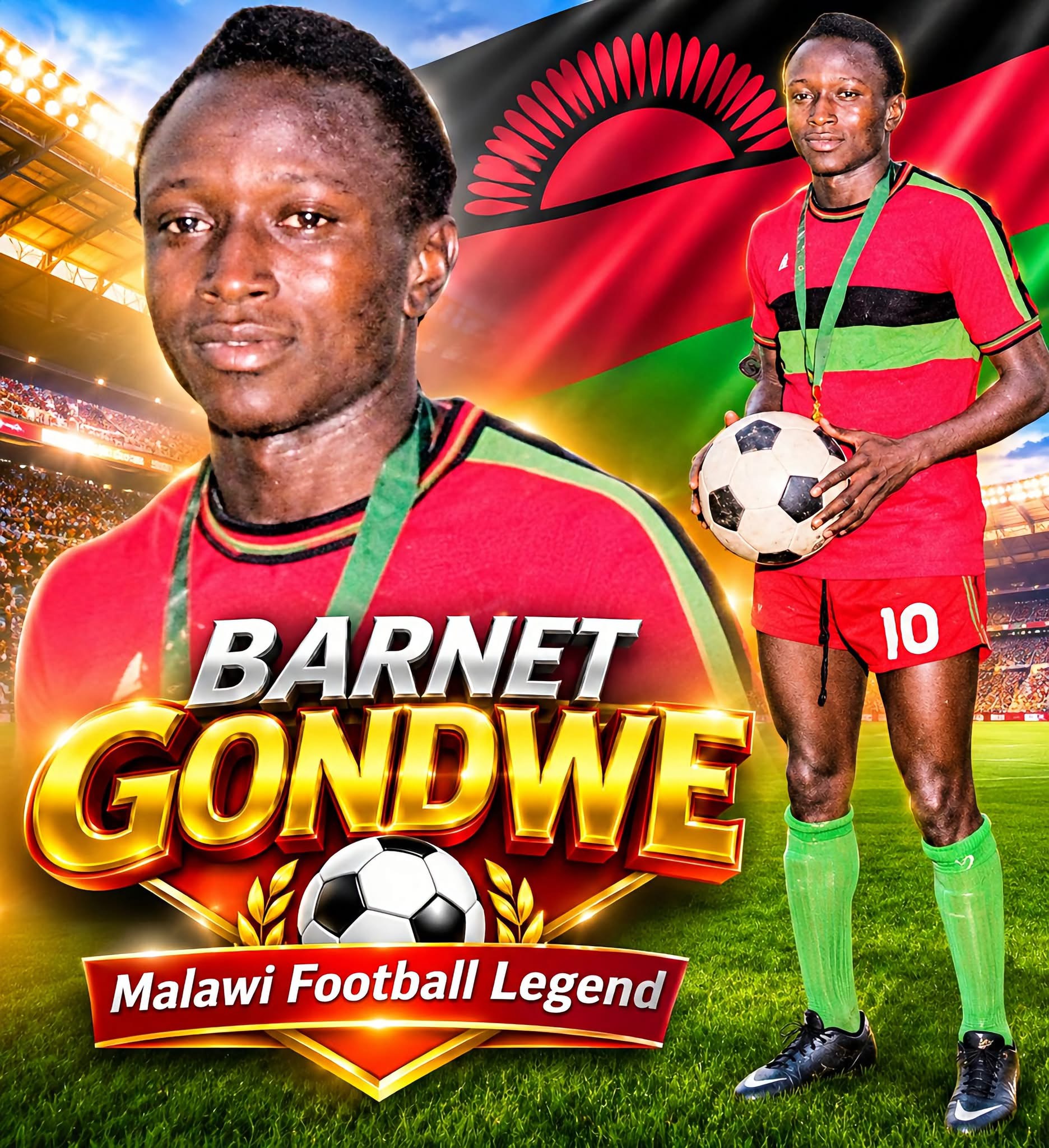
* Barnett Gondwe left Malawi before the Flames had fully enjoyed the benefit of his exceptional football talent
* The British coach Ted Powell, who worked with the Flames at that time, always maintained that Barnett was playing at only half of his potential
By Duncan Mlanjira
It’s always been said that we should honour people’s contributions to Malawi when they are alive than delivering emotional eulogies to the departed on their funerals and Barnet Gondwe comes to mind — whom Maravi Express has referred to before as Malawian football legend to remember.
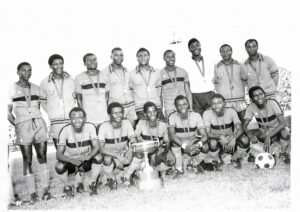
Barnet (squatting left) and the 1978 CECAFA winning squad— Standing: Thom Kazembe, Stock Dandize, Kinnah ‘Electric’ Phiri, Bernard Chirwa, Boniface Maganga, Patrick Bulldozer Chikafa, Dennis Saidi, Collins Thewe, Spy Msiska (Bata Bullets. Squatting after Barnett, Reuben Malola, Jonathan Billie, Michael Kaimfa, Henry Tewesa, Harry Waya. Not appearing is captain Jack Chamangwana
Kenya-based Jasuba Migori writes on his Facebook page of the great player, saying “some footballers needed to enter the penalty area before becoming dangerous [but] Barnet Gondwe was different”.
“Give him a little space outside the box, and a goalkeeper could suddenly find himself in serious trouble. He could deceive a defender with a clever body movement, accelerate down the left wing and unleash a thunderous shot.
Migori rightly observes that when Barnet Gondwe was taking a corner kick, opponents had reason to worry because he could score directly from such set piece.
“Barnet Gondwe was one of Malawi’s most gifted attacking footballers of the late 1970s and early 1980s. Playing for Yamaha Wanderers and the Malawi national team, Gondwe earned admiration for his powerful left foot, quick feet and remarkable ability to beat defenders.

Barnet (squatting 2nd from right)
“He was not the kind of winger who simply ran down the touchline and crossed the ball — Gondwe could dribble past opponents, change direction with clever body movements, deliver accurate passes and strike the ball with tremendous force.
“Those who watched him still remember his shooting power,” says Migori and quotes football analyst Charles Nyirenda describing Barnett Gondwe as one of the hardest hitters of a football he had ever watched.
“Other former spectators recalled his pace, nutmegs and ability to score directly from corner kicks,” says Migori. “One supporter even remembered him being nicknamed ‘Dynamite’ during his time in South Africa.
“But Barnett Gondwe’s reputation was not built on entertaining supporters alone — he delivered when matches mattered,” recalls Migori, citing the triumph on November 19, 1978, when Malawi faced Zambia in the CECAFA Cup final in Blantyre.
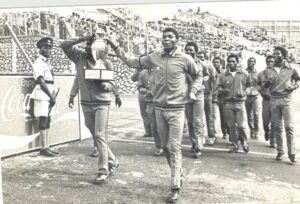
He recalls that just three minutes into the match, Barnett Gondwe struck a spectacular long-range volley and Malawi went on to win 3–2, securing the regional championship.
“And then came another unforgettable moment. On November 17, 1979, Malawi faced Kenya in the CECAFA Cup final in Nairobi. Kenya took a 2–0 lead. Malawi fought back, forcing the match into extra time.
“With the contest approaching its conclusion, Gondwe delivered the decisive blow in the 117th minute— Malawi 3-2 Kenya. The Flames were champions again!
“It was another reminder that Gondwe was much more than a skillful winger — he was a footballer who could produce a goal when his country needed one.”
Before leaving for greener pastures in South Africa, that earned him a FIFA ban due to international sanctions following that country’s apartheid regime, Barnett Gondwe had 66 caps and 17 international goals.

“For a player operating mainly from the wing, that was a remarkable contribution,” observes Migori. “Barnet Gondwe combined speed, intelligent movement, dribbling, accurate passing and powerful shooting.
“His left foot could create a chance or finish one,” says Migori of one of the country’s greatest ever, who was called into the national team whilst still at Zingwangwa Primary School — spotted playing in Mayor’s Trophy.

The legend in SA
Malawian fan, Hastings Chatsika, who passionately recalls to the tiniest detail of the country’s football history, responded to the post, saying: “Barnett Gondwe left Malawi before the Flames had fully enjoyed the benefit of his exceptional football talent.
“The British coach Ted Powell, who worked with the Flames at that time, always maintained that Barnett was playing at only half of his potential.
“Barnett eventually left Malawi for South Africa, which was then under a FIFA football ban because of the apartheid regime.
“His departure meant that Limbe Leaf Wanderers, his parent club, did not receive any transfer fee for losing such a talented player.
“As a Malawian, I have always wondered whether there was any mechanism through which FIFA could have protected Limbe Leaf Wanderers’ interests or facilitated compensation for the club.
“It would be interesting to understand how the football transfer regulations of that era dealt with such circumstances.”
Chatsika recalls that Barnet’s teammate, Kinnah Phiri managed to secure a contract in Saudi Arabia, “but the proposed move never materialised because the Football Association of Malawi (FAM), then responsible for clearing players for international moves, did not give him clearance”.

Great legend Kinnah Phiri
“Kinnah himself explained this in a 2020 interview with Confederation of African Football (CAF). He disclosed that he had received offers from Saudi Arabia and Zimbabwe, but neither move went ahead because he was not cleared by the football authorities.
Kinnah also revealed there was also an opportunity from Brazilian club, Colorado Panama, who visited Malawi for a friendly match and subsequently invited Kinnah and goalkeeper Boniface Maganga for trials.
“However, the FAM wanted the Brazilian club to sign them outright rather than take them for trials.
“The Brazilian club, Colorado Panama beat Malawi 2-1 and the consolation goal for Malawi was scored by Kinnah Phiri. Boniface Maganga saved a penalty from their star striker Galeno.”
Chatsika also said Kinnah revealed frustrated by the missed opportunities, Kinnah decided to leave for Swaziland, where he played for Manzini Wanderers for six years before becoming a player-coach in 1984.

Kinnah as Flames coach
He observed that this was “a significant episode in Malawi football history. Kinnah was arguably one of Africa’s most prolific strikers, and it is unfortunate that administrative decisions prevented him from exploring opportunities abroad at the height of his playing career.
“One unanswered question is why FAM refused to clear him. The published interview does not explain the Federation’s reasons, nor does it identify the Saudi Arabian club or the financial terms of the proposed deal.”
Barnet Gondwe opened the floodgate into South Africa. Great players such as Ernest Mtawali, Jimmy Mphamba, Lovemore Chafunya, Malunga brothers Holman and Kennedy and many others dared to be suspended by FIFA opting for the greener pastures in the apartheid regime.

Barnet (2nd left) at funeral of former fellow
legend Jimmy Mphamba in South Africa
Bennett Bowazi observed that this was the downfall of Malawian football: “Football was doomed in Malawi, and later parents were strongly advising their children not take football as a career, and this is what killed men’s football in Malawi.”
Malawi football never recovered through the massive trek of players, leaving a great vacuum without proper transition process.
Barnett Gondwe will be greatly remembered for opening that opportunity.

Advertisement