

Chief Economist Chifi Mhango
* China did not become a global economic powerhouse by exporting its natural resources alone
* It invested in the capacity to manufacture, transform and export value-added products
* Africa cannot continue being a supplier of the raw materials that power other economies while remaining a market for their finished products
Analysis by Chifipa Mhango-Chief Economist & Executive Director, Don Consultancy Group
According to the latest data released by China General Administration of Customs on the 10th of November 2026, China’s trade surplus reaching US$1.043 trillion in the first 10 months of 2026 is more than a trade statistic; it is a demonstration of the power of industrialisation, manufacturing capacity and strategic economic planning.
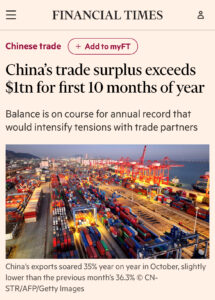
This data represents a topping of US$1 trillion for the second consecutive year and putting the annual figure on track to surpass last year’s record of US$1.2 trillion.
Even more revealing is China’s trade relationship with Africa. Between January and October 2026, China recorded a staggering US$101.4 billion trade surplus with Africa — almost matching its entire 2025 surplus of US$102 billion.
China exported US$224.1 billion worth of goods to Africa, while importing just US$122.7 billion from the continent.

Advertisement
Lessons for African countries should be:
1. Move beyond exporting raw materials: Minerals, agricultural products and natural resources must increasingly be processed locally;
2. Invest in manufacturing: Build industries that produce machinery, equipment, components and finished products;
3. Use trade strategically: Trade agreements must attract investment, technology transfer and local production, not merely facilitate imports;
4. Develop regional value chains: Through African Continental Free Trade Area (AfCFTA), African countries should pool markets, skills and resources to manufacture competitively; and
5. Build productive capacity: Industrialisation, energy security, infrastructure, skills and technology must become national economic priorities.
The lesson is simple, China did not become a global economic powerhouse by exporting its natural resources alone; it invested in the capacity to manufacture, transform and export value-added products.
Africa cannot continue being a supplier of the raw materials that power other economies while remaining a market for their finished products.
It is time for African governments to move beyond talking about economic growth and prioritise the productive capacity that creates it.
The future of Africa’s economic independence lies not just beneath its soil, but in what it can produce from what lies beneath it.
Editor’s Note:
As Chief Economist & Executive Director-Economic Research & Strategy at Don Consultancy Group (DCG), Chifi Mhango has more than 30 years of experience spanning economic research, macroeconomic and fiscal analysis, corporate strategy, financial services, development finance, trade policy, investment advisory and strategic planning across Africa.
He has held senior leadership roles in both the public and private sectors in South Africa, providing economic intelligence and strategic advice to businesses, government institutions and other decision-makers.
His work focuses on translating economic and policy developments into practical strategic insights that support informed decision-making, competitiveness and sustainable growth.

Advertisement