

Chifipa Mhango
* Malawi’s second largest item on imports is vehicles, at US$362 million in 2025 alone while fertilizer is at $297 million and plastic at US$191 million
* An economic analysis by Chifi Mhango, Chief Economist and Executive Director-Don Consultancy Group
1. Introduction
Malawi’s economic challenges are frequently discussed in terms of foreign exchange shortages, inflation, public debt, unemployment and slow economic growth.

Advertisement
However, there is another fundamental question that deserves greater national attention: ‘How much of the money Malawi spends importing goods could instead be supporting production, employment and industrial development within the country?’
According to UN Comtrade data, in 2025, Malawi imported merchandise valued at approximately US$4.05 billion. Using an illustrative exchange rate of MK1,750 to the US dollar, this translates to approximately MK7.09 trillion spent on goods produced outside Malawi.
This is a substantial amount for an economy with nominal GDP estimated at approximately US$14.2 billion.
The annual value of goods entering Malawi was equivalent to approximately 28.5% of GDP.
This does not mean imports consumed 28.5% of GDP, because imports and GDP measure different things. Nevertheless, it illustrates the scale of Malawi’s reliance on international markets.
Imports are not inherently undesirable. Every modern economy imports products it cannot produce competitively, including machinery, advanced technology, medicines and industrial inputs.
Imports can improve productivity and support exports. The concern arises when an economy repeatedly imports products it could potentially manufacture, process or supply domestically at competitive prices, while its own productive capacity remains underdeveloped.
2. What is Malawi spending its foreign exchange on?
Malawi’s 2025 merchandise import requirements extend well beyond consumer products.
They include mineral fuels & oils (US$803.30 million); vehicles (US$361.51 million); agricultural input fertilizer (US$297.45 million); industrial machinery & mechanical equipment (US$333.44 million); pharmaceuticals (US$182.63 million); construction materials (cement, lime and related minerals-US$69.85 million); iron and steel (US$97.10 million); and electronic and electronic equipment (US$203.54 million); plastics US$191.87 million); and cereals (US$82.80 million).
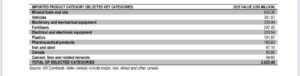
Source: UN Comtrade. Note: cereals include maize, rice, wheat and other cereals
These 10 categories alone account for approximately US$2.62 billion, equivalent to about 65% of the reported merchandise import bill.
Many support sectors in which Malawi is already active; agriculture, requires fertilisers and machinery; construction requires steel and cement; manufacturing needs machinery, chemicals and packaging; and telecommunications depends on imported electronics and network equipment.
Malawi is producing economic value domestically, but a significant part of the supply chain supporting that production originates outside the country.
Having economic activity is not the same as developing deep domestic productive capacity.


Roadside car sales
3. The bigger problem: Malawi imports far more than it exports
UN Comtrade-based figures indicate merchandise exports of approximately US$913.79 million in 2025, compared with imports of US$4.05 billion. This implies a merchandise trade deficit of approximately US$3.14 billion.
For every US$1 Malawi earned from exporting goods, it spent approximately US$4.43 importing goods.
This imbalance helps explain why foreign exchange shortages persist. Malawi needs foreign currency to import fuel, medicines, fertilisers and machinery, yet its export base does not generate enough to finance those requirements.
Additional foreign currency must come from sources such as remittances, investment, external financing and development assistance, creating vulnerability when those flows weaken.
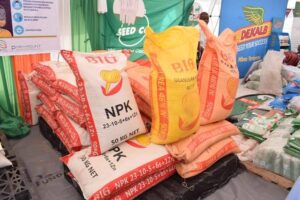
Fertilizer

Maize field

Malawi over rely on tobacco as forex earner

Soya grown in Malawi
4. Agriculture: Why is an agricultural economy importing nearly US$300 million in fertilizer?
Agriculture remains central to Malawi’s economy, yet the country imported approximately US$297.45 million in fertilisers in 2025.
The question is not whether fertiliser imports should stop; productivity depends on reliable quality inputs. It is whether Malawi can progressively develop domestic blending, distribution and, where feasible, manufacturing capacity.
Even when chemical inputs must be imported, domestic blending and packaging can generate employment and skills.
Agricultural processing presents similar opportunities: processing soya beans into cooking oil and animal feed, for example, adds local industrial activity beyond the export of raw commodities.
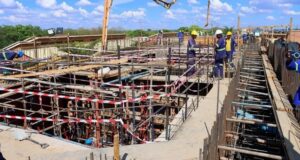

5. Construction: Buildings are rising, but who produces the materials?
Imports of iron and steel (US$97.10 million) and cement, lime, stone and related minerals (US$69.85 million) together reached approximately US$167 million in 2025.
These broad product categories do not all go into construction, nor does the second category represent cement alone.
They nevertheless illustrate demand for materials relevant to infrastructure and industry.
Roads, housing, schools and hospitals can stimulate domestic producers of fabricated steel, roofing, doors, windows and other building inputs.
Public procurement can support local suppliers where their products meet quality and price requirements, without forcing contractors to buy uncompetitive materials.
6. Manufacturing: The missing link in economic transformation
Manufacturing connects agriculture, mining, construction and consumer markets. Yet Malawi’s manufacturers face foreign exchange shortages, energy constraints and expensive inputs.
Imports included US$333.44 million in machinery, US$191.87 million in plastics and US$203.54 million in electrical and electronic equipment.
Some imports are investments in productive capacity and should be welcomed. Imported machinery that enables local production may reduce future import dependence.
The crucial distinction is between imports that build future productive capacity and imports that simply satisfy current consumption demand.

Kayelekera Mine in Karonga
7. Mining: Mineral wealth must support domestic industry
Mining needs machinery, specialised vehicles, engineering services and processing equipment, much of which Malawi may initially need to import.
Over time, however, major projects can create local opportunities in maintenance, fabrication, logistics, laboratory services, construction and technical support.
Mining investors should develop credible, measurable local procurement and skills plans.
The aim should not be immediate domestic production of highly specialised machinery, but progressive expansion of what Malawian enterprises can supply competitively.
8. Telecommunications: A digital economy must create local opportunities
Electrical and electronic equipment imports reached approximately US$203.54 million in 2025, covering products used in telecommunications, computing, electricity and other industries.
Malawi will continue to need imported phones, computers and network equipment.
Rather than attempting to manufacture semiconductors, Malawi can strengthen commercially viable device servicing, software development, cybersecurity, digital services and business-process outsourcing.
Some of these services can earn foreign exchange without the infrastructure demands of heavy manufacturing.

Advertisement
9. What would a modest reduction in import dependence achieve?
Suppose Malawi competitively replaced 5%, 10% or 15% of merchandise imports with domestic alternatives over several years.
Against a US$4.05 billion import bill, the gross values would be US$202.5 million, US$405 million and US$607.5 million, respectively.
These are illustrative scenarios, not forecasts of net foreign exchange savings.
Domestic producers still import equipment, fuel, raw materials and components. If US$100 million of finished imports were replaced with local output requiring US$60 million in imported inputs, the direct net import reduction would be closer to US$40 million before other effects.
Success must be measured by net foreign exchange savings, domestic value added, competitiveness and jobs, not gross import replacement alone.

10. A practical industrialisation strategy for Malawi
Malawi should undertake a product-by-product assessment of its import bill, led collaboratively by trade and industry authorities, the Ministry of Finance, Reserve Bank of Malawi, National Statistical Office, Malawi Revenue Authority and private sector.
The assessment should identify import values, market size, domestic capacity, investment requirements, energy needs, raw materials and potential jobs.
A manageable group of priority opportunities could include agro-processing, fertiliser blending, packaging, selected building materials, pharmaceutical packaging and formulation where feasible, engineering services and digital exports.
Incentives should depend on measurable production, employment, export and foreign exchange outcomes, not permanent subsidies or excessive protection.
Key to this is blended financing. Regional markets under SADC and the African Continental Free Trade Area should be central to the strategy.
The objective is competitive production, not simply replacing imports with more expensive domestic goods.

11. Conclusion: Malawi must measure what it can produce, not only what it imports
The country’s US$4.05 billion merchandise import bill is more than a trade statistic — it is a starting point for identifying industrial opportunities.
Not every import can or should be produced locally. But recurring imports alongside underused resources, limited industrial capacity and unemployment demand a more ambitious response than import restrictions or foreign exchange rationing.
Malawi must build productive capabilities that reduce avoidable import dependence while expanding exports.
The central economic question should change from ‘Where will Malawi find the foreign exchange to finance its imports?’ to ‘Which industries can Malawi develop to earn more foreign exchange and reduce its dependence on imports?’
Until that question becomes central to national planning, Malawi risks remaining an economy that consumes substantial volumes of goods produced elsewhere while struggling to generate enough domestic production, employment and export earnings.
Editor’s Note:
Chifipa Mhango is a Chief Economist & Executive Director-Economic Research & Strategy at Don Consultancy Group (DCG), who has more than 30 years of experience spanning economic research, macroeconomic and fiscal analysis, corporate strategy, financial services, development finance, trade policy, investment advisory and strategic planning across Africa.
He has held senior leadership roles in both the public and private sectors in South Africa, providing economic intelligence and strategic advice to businesses, government institutions and other decision-makers.
His work focuses on translating economic and policy developments into practical strategic insights that support informed decision-making, competitiveness and sustainable growth.

Advertisement