


The launch of AfCRA in Port Louis, Mauritius on Tuesday, October 6
* Says Chief Economist and Strategy Executive Director at Don Consultancy Group Chifi Mhango
* The real test is not whether an African credit rating agency gives African countries better ratings
* The real test is whether global investors eventually trust its ratings
By Duncan Mlanjira
The African Union (AU) has launched the Africa Credit Rating Agency (AfCRA), which been described as an important milestone in Africa’s efforts to strengthen its financial architecture, advance economic sovereignty and ensure that African economies are assessed with greater depth, context and independence.
Chief Economist and Strategy Executive Director at South Africa’s Don Consultancy Group, Chifi Mhango has since welcomed the establishment of AfCRA, which was officially launched in Port Louis, Mauritius, describing it as “an important development in strengthening Africa’s financial architecture and broadening the way African sovereign and corporate credit risk is assessed”.

DCG Chief Economist, Chifi Mhango
“The establishment of an African credit rating agency is a development that should be welcomed,” says Mhango.
“Credit ratings have significant consequences for African economies because they influence sovereign borrowing costs, investor perceptions, access to international capital and, ultimately, financing conditions across the wider economy.”
However, Mhango cautioned that the purpose of an African credit rating agency “should not be to give Africa better ratings simply because it is African”.
“Its value will depend on whether investors regard its analysis as independent, transparent, methodologically rigorous and credible.
“If it is perceived as politically influenced or established merely to produce favourable ratings, international markets will discount its assessments.”

Advertisement
The DCG Chief Economist further says the establishment of AfCRA “provides an opportunity to broaden the analytical perspective applied to African economies”.
“African countries have long raised concerns that conventional sovereign-risk methodologies may not always sufficiently capture the continent’s institutional, developmental and structural characteristics.
“An African perspective can potentially deepen understanding of factors such as domestic capital markets, natural-resource endowments, infrastructure investment, regional economic integration, informal economic activity, demographic potential and the developmental context within which governments borrow.”
He adds that this does not mean ignoring risk, rather “it means ensuring that risk is understood within the full economic context in which it exists”.

Mhango stresses that the AfCRA should, therefore, “not become an ‘Africa versus international rating agencies’ debate, but rather the objective should be better information, greater competition and more credible assessment”.
“Africa should not seek to replace one perceived bias with another,” says Mhango, while emphasising that: “The creation of an African agency does not remove the responsibility of governments to address underlying economic weaknesses.
“No credit rating methodology can make excessive public debt, persistent fiscal deficits, weak foreign-exchange reserves, governance challenges or poor economic growth disappear. “Ultimately, African countries will achieve stronger and more sustainable credit ratings by improving their economic fundamentals and strengthening institutional credibility.”
According to Mhango, the more fundamental question is whether AfCRA can eventually influence the actual allocation and pricing of capital: “The real economic issue for Africa is the cost of capital.
“A credible rating system should contribute to reducing information asymmetry between African borrowers and investors and allow risk to be priced more accurately.”


He adds that “investors are unlikely to abandon established international agencies such as Moody’s, S&P Global Ratings and Fitch simply because an African alternative has been established”.
“AfCRA is more likely initially to serve as an additional source of analysis against which investors can compare existing assessments.
“Its influence will, therefore, have to be earned through the consistency and predictive credibility of its ratings over time.”
Mhango further argues that AfCRA should form part of a much broader effort to deepen African capital markets, mobilise African institutional savings and strengthen African development and financing institutions.
“Ultimately, the credibility of an African credit rating agency will be strengthened if its ratings become relevant to actual capital-allocation and lending decisions.
“Africa, therefore, needs to deepen its own capital markets and financing institutions alongside the rating agency.
“Otherwise, irrespective of the quality of the ratings, international investors and lenders may continue relying predominantly on the established global agencies.”

Advertisement
Mhango concludes to say: “The real test is not whether an African credit rating agency gives African countries better ratings.
“The real test is whether global investors eventually trust its ratings. Credibility, independence and analytical rigour will determine whether this becomes a transformative African financial institution or simply another institution in the market.”
The AU media platform reports that when launching the AfCRA in St. Louis, AU Commission chairperson, Mahmoud Ali Youssouf highlighted that Africa is building a stronger and more resilient financial architecture — thus AfCRA is set to become an important pillar.
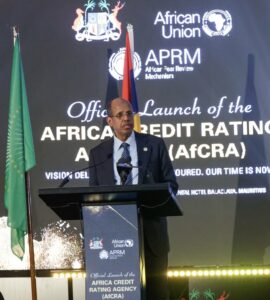
AU Commission chairperson, Mahmoud Ali Youssouf
The AU reports that Youssouf maintained that the agency “will provide African and international investors, as well as economic partners, with reliable, independent and technically rigorous analysis of African economies and credit risk”.
“He underscored that credit ratings directly affect the cost and availability of capital,” said the report. “Where assessments do not sufficiently reflect African data, realities and context, countries can face higher borrowing costs, constraining their ability to finance infrastructure, health, education, energy, industrialisation and other development priorities, at a time when many Member States are already facing significant debt-servicing pressures.”
“AfCRA, explained Youssouf, will help address information and analytical gaps by bringing African data, expertise and realities more fully into the assessment process.
“It is not intended to replace existing international credit-rating agencies, shield borrowers from scrutiny or guarantee favourable ratings — rather, it will provide an additional, independent and Africa-focused perspective to the market.”

Advertisement
Editor’s Note:
Chifipa Mhango is a Chief Economist & Executive Director-Economic Research & Strategy at Don Consultancy Group (DCG), who has more than 30 years of experience spanning economic research, macroeconomic and fiscal analysis, corporate strategy, financial services, development finance, trade policy, investment advisory and strategic planning across Africa.
He has held senior leadership roles in both the public and private sectors in South Africa, providing economic intelligence and strategic advice to businesses, government institutions and other decision-makers.
His work focuses on translating economic and policy developments into practical strategic insights that support informed decision-making, competitiveness and sustainable growth.

Advertisement