
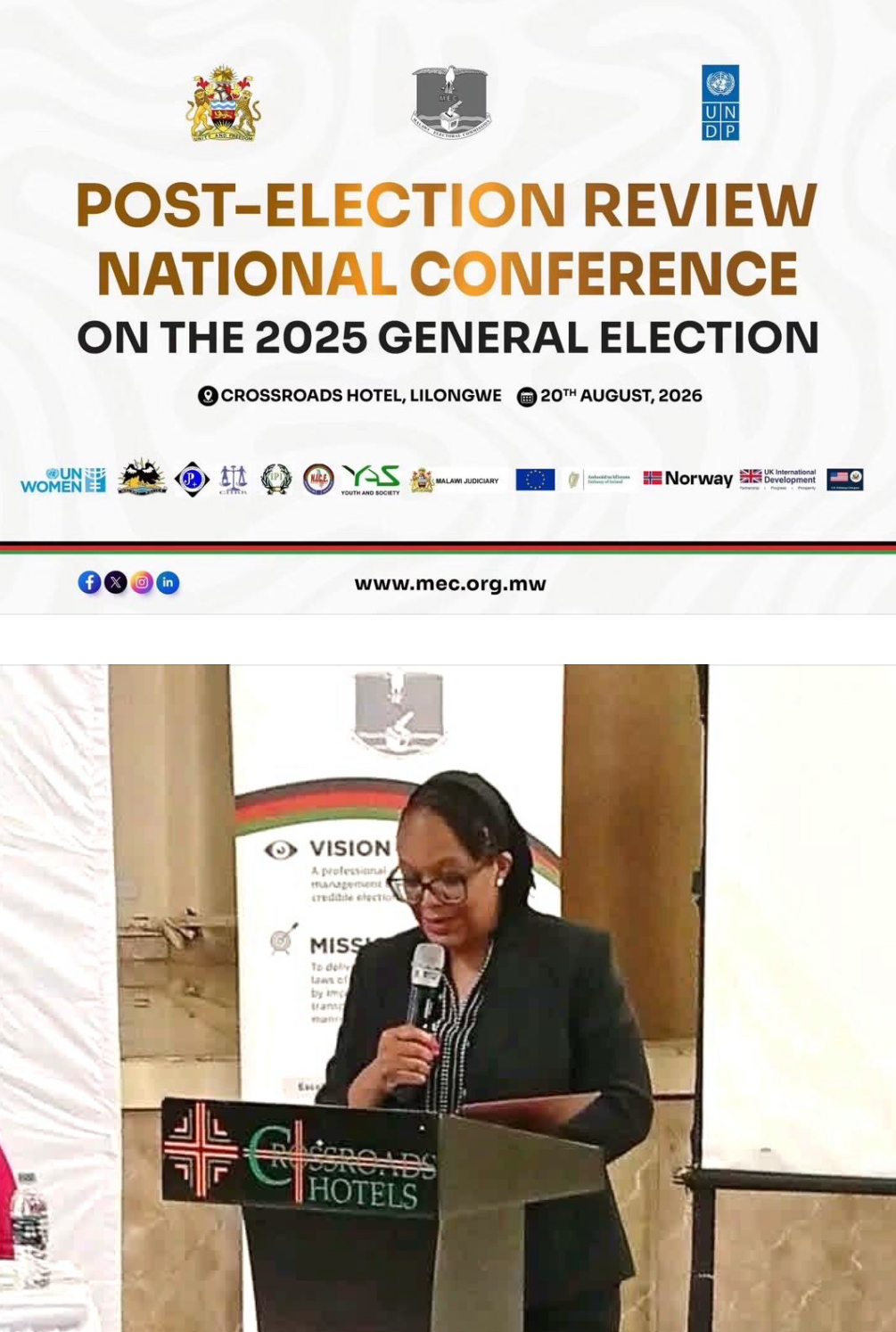
* When opening the Post-Election National Conference on the 2025 General Election
* A good election is not the end of the journey — it is a foundation upon which we must build
* Every election gives us an opportunity to identify areas where the system can be strengthened
By Duncan Mlanjira
When opening the Post-Election National Conference on the 2025 General Election to day at Bingu International Convention Centre (BICC), Malawi Electoral Commission chairperson, Justice Annabel Mtalimanja highlighted that “a good election is not the end of the journey — it is a foundation upon which we must”.

Advertisement
She stated that the conference has come at an important moment in the electoral cycle of the country — thus following the 2025 General Election, MEC embarked on a comprehensive post-election review process.
This involved consultations and engagements with political parties, candidates, civil society organisations, the media, the Judiciary, the legal fraternity, Government institutions, election officials, development partners, observers, academia and other stakeholders.
“The purpose was not simply to look backwards, but to learn,” said Mtalimanja. “We wanted to take stock of and understand what worked well, what did not work as expected, what challenges were encountered, what lessons could be drawn and, importantly, what could be done differently to make future elections even better.
“The exercise was deliberately designed for broad reach because elections do not belong to the Electoral Commission as an election management body alone.
“Elections are national processes; they are democratic processes. They are processes in which many institutions and individuals have distinct but interconnected responsibilities.

Justice Annabel Mtalimanja at the pre-inspection of voting materials in Dowa for the 2025 Elections
“The quality of an election, therefore, depends not only on the work of the Commission, but also on the conduct of political parties and candidates, the role of the media, the contribution of civil society, the commitment of Government institutions, the professionalism of security agencies, the support of development partners and, ultimately, the participation and confidence of citizens.”
Justice Mtalimanja thus applauded all stakeholders who participated in the post-election review with particular appreciation of the honesty with which many of they shared their experiences, concerns, observations and recommendations.
She took note of the positive and encouraging feedback — with some being “confronting” challenged MEC “to do better”.
“We value all of it,” she said. “As a Commission, we therefore approach this conference with humility and with a willingness to listen.
“That said, let me emphasise that the Post-Election Review Report before us should not be interpreted as the end of it all — it definitely is not a final catalogue of electoral reforms.
“The issues captured in the report are observations, concerns, experiences and proposals raised by stakeholders during the review process.
“They provide a foundation for further reflection and discussion. The ensuing formal electoral reform process will provide the appropriate platform for stakeholders to examine these issues in greater depth, develop concrete proposals and determine which reforms should ultimately be pursued through the appropriate legal and institutional processes.”
Thus Justice Mtalimanja emphasised that “it is imperative to record that the 2025 General Election was, by many accounts, a successful election for Malawi”.
“Observer Missions and other independent assessments highlighted several positive aspects of the electoral process.
“Malawi’s progress has also been reflected in international assessments of electoral integrity and democratic performance.
“The Electoral Integrity Index recently identified Malawi among only five countries worldwide that registered the most significant improvements in electoral integrity following the elections held in 2025, together with the Philippines, Poland, Gabon and Egypt.
Malawi improved its score by 10 points on the Perceptions of Electoral Integrity Index, making it one of the most improved electoral democracies in the world.

“This achievement belongs not only to MEC, but to all stakeholders who contributed to the success of the electoral process.”
She then stated that “a good election is not the end of the journey — it is a foundation upon which we must build”, adding that “every election gives us an opportunity to identify areas where the system can be strengthened”.
“We must continue asking ourselves whether we can make the next election more transparent, more inclusive, more efficient, more accessible and more trusted — this is why today’s conference is so important.”
She reiterated that MEC has adopted the electoral cycle approach to election management, saying: “Under this approach, an election is not regarded as a single event that ends with the declaration of results.
“Rather, an election is a continuous process involving activities before, during and after polling. The conclusion of one election, therefore, provides the foundation for commencement of preparations for the next election.
“This means that effectively, preparations for the 2030 General Election have already begun. It is imperative to underscore the point that this is not because we are rushing into another election.
“It is because credible elections cannot be prepared for overnight. Legal reforms, voter registration, inspection, voter education, procurement, technology, recruitment and training, stakeholder engagement and institutional strengthening all require adequate time.”
She, therefore, encouraged every stakeholder to embrace and implement the electoral cycle approach in their spaces, while encouraging them that they all have important roles to play between elections, “not only during the formal electoral period”.
“The law itself recognises the importance of civic and voter education and expressly stipulates that it should be continuous.
“It is for this reason that the Commission’s accreditation of civic and voter education providers extends beyond a single election.
“We want citizens to remain informed and engaged throughout the democratic process.
“This, however, requires sustained investment. If civil society organisations are expected to undertake civic and voter education between elections, they need predictable and adequate resources to do so.
“For this reason, it is imperative for development partners to view electoral support as a continuous investment in democratic governance rather than assistance that begins shortly before polling and ends once results are declared.
“The same principle applies to political parties, which require continuous support for institutional development, policy formulation, internal democracy, leadership development and engagement with citizens.

“All this is to emphasise that we must collectively move away from an event-based understanding of elections and recognise that democracy requires continuous investment.
“The quality of the 2030 general election will depend significantly on what we, again collectively, do between now and then. We must strengthen every strand of the electoral process and ensure that no weak link undermines the integrity of the whole chain.
“Our task is not merely to prepare for another election, but to strengthen our democratic governance. This effectively means we must make deliberate efforts to build and sustain independent institutions.
“… including the election management body, which of necessity must operate free of any interference, protect the rule of law, enhance civic participation, and enhance transparency and accountability.
“This in turn will consolidate the gains made this far, concretise the success of the 2025 General election. It will also ensure that every subsequent election is better than the one before it.
“To buttress this, we must all remain alive to the fact that democracy is not practised only on polling day. Beyond free, fair and credible elections, democracy is practised in the months and years between elections — in respect for the rule of law, human rights protection, and civic participation.
“This distils to how the mandate of the Election Management Body (EMB) is being discharged, how institutions operate, how political parties engage with citizens, how leaders are held accountable, how information is shared, how conflicts are resolved and how citizens participate in public affairs.
“The ballot is one very important expression of democracy, but democracy is much bigger than the ballot.”

Voting process
She thus encouraged the conference’s participants “to be candid but constructive, critical but respectful, and ambitious but practical and to listen to one another”.
“Let us respect different perspectives. This moment is not for finger pointing. Let us avoid viewing reform through partisan lenses and instead ask one fundamental question: ‘What kind of electoral systems do we want for the citizens of Malawi, on whose behalf we steward the roles that we have in the democratic spa ce band indeed for future generations?’
“If we can keep that question at the centre of our deliberations, I am confident that today’s Conference will make a meaningful contribution to the strengthening of Malawi’s democracy.”

Advertisement