
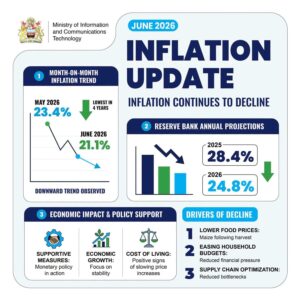
* Year-on-year inflation fell to 21.1% in June from 23.4% recorded in May—National Statistical Office (NSO) Consumer Price Indices June 2026 report
* As Reserve Bank of Malawi (RBM) Deputy Governor, Kisu Simwaka assures that single digits are possible
* With coordination, 5% inflation by 2030 can be an outcome, not just an inspiration
By Innocent Manda, Malawi News Agency (MANA) & Duncan Mlanjira, Maravi Express
Malawi’s annual inflation rate eased by 2.3 percentage points in June, driven largely by slowing food price increases, offering a positive signal for the country’s fight against the rising cost of living even as economists caution that sustained progress will depend on prudent fiscal management.

Advertisement
In its Consumer Price Indices June 2026 report released on Wednesday, the National Statistical Office (NSO) indicates that year-on-year inflation fell to 21.1% in June from 23.4% recorded in May.
According to the report, food inflation declined to 14.7% from 17.6%, while non-food inflation also moderated from 33.0% to 32.1% during the same period.
“The year-on-year inflation rate declined to 21.1% in June 2026, representing a 2.3 percentage point decline from 23.4% recorded in May 2026,” says the report.
The NSO attributed the improvement mainly to easing food prices, although the cost of non-food goods continued to exert pressure on overall consumer prices.
Despite the annual decline, the report shows that monthly inflation edged up to 0.1% in June from negative 0.2% in May, reflecting modest movements in both food and non-food prices.
“Food inflation increased to negative 0.3% from negative 1.0% in May 2026, while non-food inflation slowed to 0.7% from 1.0% over the same period.
The also reported differences between urban and rural areas, with urban centres recording a monthly inflation rate of negative 0.2%, while rural areas registered 0.3%, largely on account of higher non-food prices.

Economics Association of Malawi president, Bertha Bangara Chikadza
Commenting on the latest figures, Economics Association of Malawi president, Bertha Bangara Chikadza, who is University of Malawi senior lecturer in macroeconomics, observed that the downward trend reflects progress towards restoring macroeconomic stability.
She, however, said maintaining the momentum would require strong coordination between monetary and fiscal policy: “The Reserve Bank has established a credible medium-term target for achieving single-digit inflation.
“The effectiveness of this monetary policy, however, is significantly influenced by the actions of fiscal authorities,” Chikadza said.
She urged Government to build on improved revenue performance by reducing the fiscal deficit while increasing investment in food security initiatives, particularly irrigation, to help sustain lower inflation in the months ahead.
The latest inflation figures come as Government continues implementing economic recovery and fiscal reform measures under the K10.978 trillion national budget aimed at strengthening macroeconomic stability and building long-term economic resilience.
Meanwhile, Reserve Bank of Malawi (RBM) Deputy Governor, Kisu Simwaka posted on his LinkedIn platform yesterday, on why the inflation rate has stayed high and how the country can get to single digits.

RBM Deputy Governor Kisu Simwaka
He said for “five years, Malawi’s inflation has been stuck above 20%” and that while the mandate of the RBM is control price stability, they “haven’t met it”.
He added that, Sub-Saharan Africa peers like Tanzania, Rwanda, Zambia and Mozambique are back in single digits because they fixed foundations.
He gave four reasons why Malawi’s inflation is still high:
1. Forex pass-through — 55%-60% vs 25%-30% in peers. Because of low reserves and import dependence, any extra shock goes straight to prices;
2. Food & climate change — 55% of Consumer Price Index (CPI) is rain-fed food. As a result, every dry spell becomes an inflation problem;
3. Fiscal dominance — High borrowing crowds out credit and undermine monetary policy; and
4. De-anchored expectations — Years of high inflation make people price-off the past.
On the way forward, Simwaka call on fiscal discipline, saying 3-4 months of forex reserves, export diversification, irrigation and grain reserves, and credible policy can anchor expectations.
“Single digits are possible,” concludes the Deputy Governor. “With coordination, 5% inflation by 2030 can be an outcome, not just an inspiration.”

Advertisement