
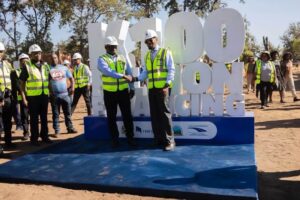
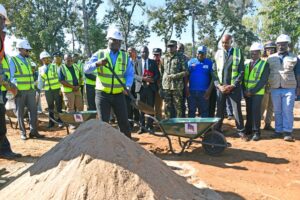
Minister Mhango and FDH Holdings CEO William Mpinganjira at the groundbreaking site
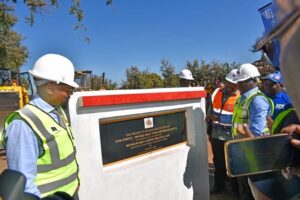
* As Minister of Transport & Public Works officially launches the rehabilitation of Lot 1 of Golomoti-Monkey Bay Road corridor financed by FDH Bank at K100 billion credit facility
* National Bank to finance the corridor’s Lot 2 rehabilitation, a project that Government describes that it represents another milestone in its agenda to build a modern, resilient and integrated transport network
* That supports tourism, trade, investment and inclusive socio-economic development
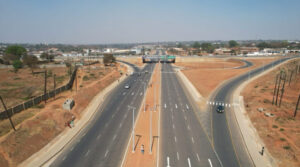
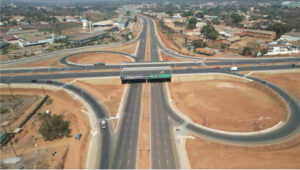
* Standard Bank played a role as lead arranger in mobilising funding for the Dr Saulos Klaus Chilima Highway in Lilongwe along with Old Mutual while NBS Bank financed the Capital’s modern Interchange
Analysis by Duncan Mlanjira
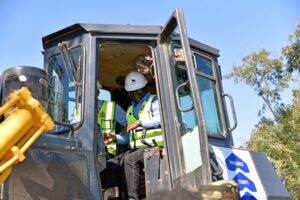
FDH Financial Holdings Ltd today joined Minister of Transport & Public Works, Jappie Mhango to officially launch the rehabilitation of Lot 1 of the Golomoti-Monkey Bay Road corridor financed by the Group’s FDH Bank at K100 billion credit facility.

Advertisement
National Bank of Malawi is financing the corridor’s Lot 2 rehabilitation — which represents the country’s financial institutions taking a huge role to support Malawi’s major road rehabilitation projects.
In a statement announcing the partnership with the Government, FDH Financial Holdings Chief Executive Officer William Mpinganjira indicates that, through its Corporate and Institutional Banking (CIB) division, FDH Bank has extended the K100 billion credit facility to Roads Fund Administration — a partnership which “aligns with the Malawi Government’s strategy to enhance connectivity and strengthen Malawi transport sector”.
“Additionally, the project aims to unlock economic activity by boosting trade and tourism. As a homegrown and homebred bank, FDH Bank Plc recognises that robust road infrastructure is the backbone of Malawi’s economic growth.
“Financing this project underscores the Bank’s deepening commitment to fostering sustainable economic development. Once completed, the project is expected to significantly spur economic and tourism activities, as the route serves as a key gateway to Lake Malawi.”
The statement adds that through the CIB division, FDH Financial Holdings delivers “impactful solutions that drive real socio-economic progress”.
“The rehabilitation of Golomoti-Monkey Bay corridor demonstrates FDH Bank’s underlying philosophy that infrastructure development is a pathway to a thriving economy.
“FDH Bank is proud to contribute to national economic priorities, delivering impactful infrastructure investments that support economic growth and enhance the lives of Malawians.”
On his part, Minister Mhango described the partnership with the corporate financial institutions as representing another milestone in Government’s agenda to build a modern, resilient and integrated transport network that supports tourism, trade, investment and inclusive socio-economic development.
This also follows the role played by Standard Bank Malawi as a role as lead arranger in mobilising funding for the Dr Saulos Klaus Chilima Highway in Lilongwe along with Old Mutual while NBS Bank financed the Capital’s modern Interchange.
A report by Ministry of Transport & Public Works, quotes Mhango commending FDH Financial Holdings, describing the partnership as “a significant milestone in Government’s efforts to mobilise domestic resources for infrastructure development”.
“He said the collaboration demonstrates the important role local financial institutions can play in complementing Government’s investment in national development and encouraged other commercial banks and private investors to partner with Government in developing the transport sector.”
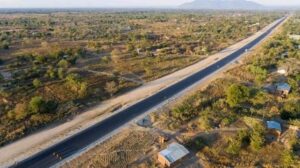
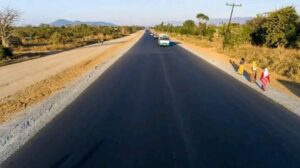
The report indicates that the road corridor to the Lake Malawi shore district provides the shortest route from Lilongwe to Mangochi and other lakeshore destinations — expected to transform access to key tourism, agriculture and fishing sectors.
The stretch, to be rehabilitated by a Chinese contractor for Lot 1 and Mota Engil for Lot 2, is reported to be designed with climate-resilient features as the upgraded road will also withstand flooding and other environmental challenges that have affected the route over the years.
“This is one of the most important roads in the country because it supports key sectors such as tourism, fishing and agriculture,” the Minister is quoted as saying. “Government remains committed to developing quality infrastructure that drives economic growth and improves the lives of Malawians.”
As part of Government’s broader programme to rehabilitate and modernise the country’s road network, the Minister cited ongoing works on the Nsipe-Chingeni-Liwonde Road, the launch of the Liwonde-Matawale Road project with support from the World Bank, preparations for the reconstruction of the Karonga-Chiweta Road and the upgrading of rural roads as evidence of Government’s commitment to improving connectivity across the country.
The Minister further said Government is pursuing partnerships to strengthen not only the road subsector but also aviation, rail and marine transport.
He disclosed that the Ministry is seeking strategic investment in the Plant and Vehicle Hire and Engineering Services (PVHES) to enhance its capacity to support national infrastructure development.
He also stressed that all infrastructure projects must be completed on time, within budget and to the required quality standards, while warning against encroachment into road reserves and reiterating Government’s commitment to enforcing the provisions of the Public Roads Act, 2023 to protect public infrastructure.
On the 55-kilometre Nsipe-Chingeni-Liwonde Road project, the Roads Authority (RA) has reported its steady progress, which has now reached 26% of completion being undertaken by Jiangxi Construction Group.
Malawi News Agency (MANA) quotes RA public relations officer (PRO), Lawrent Kumchenga, saying construction works are progressing steadily despite challenges affecting the project timeline.
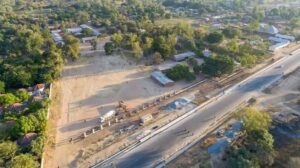
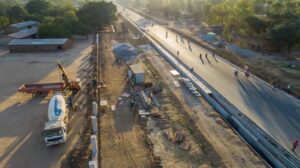
“The contractor is performing well, although we have faced some challenges, including compensation issues involving people affected along the road construction path,” Kumchenga is quoted as saying, adding that the challenges have led to an extension of 380 days beyond the original schedule, meaning the completion date has been pushed to 2027 instead of the initial target.
The Nsipe-Chingeni-Liwonde Road is being funded by the Europeann Union, the African Development Bank and the Government of Malawi.
In April 2026, when Standard Bank held an audience with President Arthur Peter Mutharika at Sanjika Palace, Chief-Executive-Philip-Madinga-emphasised-that-institutions-do-not-grow-nations-but-partnerships-do — as he highlighted the opportunities as well as challenges ahead on the road to a more prosperous self-reliant and inclusive Malawi.
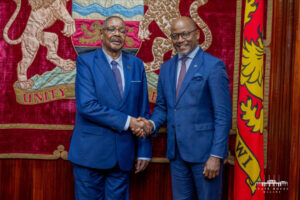
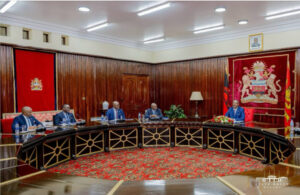
As well as what role Standard Bank, can play as a partner in driving Malawi’s growth, while unveiling that the institution has several proposals, which they believe, “if and when, timely executed will be key to meeting Malawi’s aspiration of becoming a self-reliant and inclusive wealthy nation by 2063 and become a middle income country by 2030 despite the challenges we currently face”.
Meanwhile, Transporters Association of Malawi has welcomed progress on the Nsipe-Chingeni-Liwonde Road project but raised concern over the revised timeline, particularly as the rainy season approaches and fertiliser distribution under the Farm Input Subsidy Programme (FISP) is expected to intensify.
The association’s PRO, Frank Banda, said road transport remains central to the economy and called on government to prioritise completion of the project to avoid disruptions in transport operations.
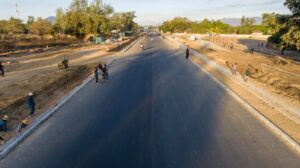
“Road transport is the backbone of our economy. Government needs to prioritise resources to ensure this road is completed. We are just a few months away from the rainy season, and distribution of fertiliser for the Farm Input Subsidy Programme will be commencing shortly.
“If there are delays in moving fertiliser to the right places at the right time, it will affect national maize output,” said Banda, adding that poor road infrastructure increases transport costs, which in turn affects the prices of goods.
“When roads are in bad condition, it becomes expensive to transport commodities, including fertiliser, to different parts of the country. Ultimately, this affects prices and economic stability.
“We are urging government to prioritise road infrastructure so that the economy can grow and the cost of goods and services can be reduced,” he said.

Advertisement
Economist Levison Chiwaula said the Nsipe-Chingeni-Liwonde Road connects key production areas including Nsipe, Liwonde and Machinga, and also links to the Mangochi Road.
He further noted that the project links to the Nacala Corridor, which provides access to international trade routes: “This project is even more significant because it connects the country to the Nacala Corridor, opening up international trade routes.
“It also includes the construction of a one-stop border post at Chiponde, which will improve efficiency in processing imports and exports,” said Chiwaula — adding that road users are expected to benefit through reduced travel time and lower vehicle operating costs once the project is completed.—Additional reporting by Frank Humphreys, MANA

Advertisement