
* I am concerned about the chances of an African team going all the way—Former Nigeria midfield maestro Jay-Jay Okocha
* Reaching the World Cup is complicated and playing there is even harder—Egypt coach and former star Hossam Hassan
* Why not?, Africa is going there to win the tournament—Former Liverpool and Senegal star El Hadji Diouf
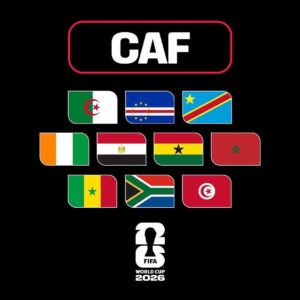
* The African representatives are Senegal, South Africa, Côte d’Ivoire, Ghana, Democratic Republic of Congo, Cape Verde, Algeria, Egypt, Tunisia and Morocco
Maravi Express
Former African great internationals are divided on whether an African team can win the FIFA World Cup 2026 to be co-hosted by the United States, Mexico and Canada from June 11 to July 19.
The opening match of the global football showpiece — which features 10 African representatives — Senegal, South Africa, Côte d’Ivoire, Ghana, Democratic Republic of Congo, Cape Verde, Algeria, Egypt, Tunisia and Morocco — will be between Mexico and South Africa.

Advertisement
Speaking to AFP, former Nigeria midfield maestro, Jay-Jay Okocha — who featured for the Super Eagles at several FIFA World Cups, including the 1994 tournament staged in the United States — is unsure of Africa’s prospects, saying:
“My abiding memory of 1994 was the amazing atmosphere. Add the fact that it was the first World Cup appearance by Nigeria and it was special.
“Regarding the 2026 tournament, I am concerned about the chances of an African team going all the way. We talk a lot about the title contenders from Europe and South America, but what about the North Americans and Asians? — they are improving rapidly.
“I will be very happy to be proven wrong. African footballers have shocked the world before. Let us hope it happens again,” Okocha is quoted as saying by AFP.
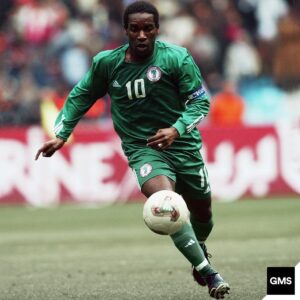
The great Jay Jay Okocha
On his part, former Egypt star Hossam Hassan, who is now coach of the Pharaohs for the World Cup 2026, told reporters in Cairo that “reaching the World Cup is complicated and playing there is even harder. However, I see great ambition in my players. They want to achieve more than what Egypt did in the past.”
Egypt first competed in a World Cup 92 years ago and have made just two subsequent appearances. The record seven-time African champions are still seeking a first victory at the global event.
Senegal coach Pape Thiaw, who was a substitute when the Teranga Lions stunned then defending champions France in the opening match of the Seoul 2002 World Cup, is once against against France — alongside Norway and Iraq in Group I, which is considered among the toughest pools.
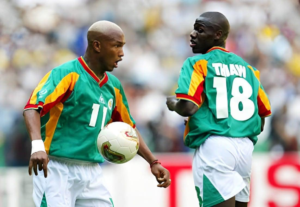
Pape Thaw and El Hadji Diouf at the Seoul 2002 edition
“That (2002 tournament) is history. We know the current French team well. It is going to be a special match and let us hope we win again,” he said of this 2026 edition,
— while former Senegal star El Hadji Diouf, alongside Thiaw in Seoul 2002 edition, shares the belief that an African captain could lift the trophy near New York on July 19.
“Why not? Take my own country. We have amazing players like Sadio Mane, Idrissa Gueye and Edouard Mendy. They can match stars from any country. The 2026 World Cup? Africa is going there to win the tournament,” responded the ex-Liverpool striker.
At the last global showpiece in Qatar four years ago, Morocco stunned Spain and Portugal en route to the semi-finals before falling to France — and now that the United States, Canada and Mexico prepare to co-host a record 48 nations, the football world wonders whether Africa can go even further, or was 2022 a flash in the pan?
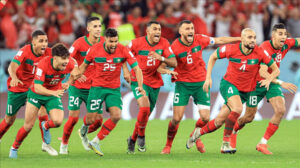
Morocco in Qatar
Confederation of Africa Football (CAF) president Patrick Motsepe Motsepe, the 64-year-old South African billionaire, who transformed from being chairman of CAF Champions League 2016 champions, Mamelodi Sundowns, to head of continental football governing body, echoes Diouf’s views:
“We are confident that the 10 African national teams at the 2026 World Cup will make us proud and that an African nation will be champions. What we lacked in the past was self belief — Morocco changed that in Qatar four years ago.
“We can match the best in the world. I will work relentlessly until I see the captain of an African nation lifting the greatest football prize,” he told AFP.
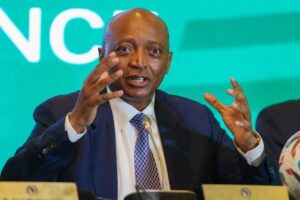
Motsepe
Morocco, Senegal strongest?
The widespread belief among African footballers, coaches and officials is that Morocco and Senegal are the strongest of the 10 qualifiers from the continent.
Senegal beat Morocco in the Africa Cup of Nations 2025 final, but CAF overturned the result after an appeal by the losers based on a temporary walk-off by some Senegalese over a penalty.
The Senegalese reacted to being stripped of the title by appealing to the Court of Arbitration for Sport (CAS) and await the verdict.
Achraf Hakimi-captained Morocco are in Group C with record five-time world champions Brazil, Scotland and Haiti — with the Atlas Lions expected to finish second at least.

Advertisement
While Africans dream of lifting the ultimate football prize, some competing coaches have lesser immediate goals. Recently appointed Tunisia coach Sabri Lamouchi was blunt when discussing a nation that has qualified for six World Cups, and exited after the first round each time.
“I am not going to tell stories by pretending we will repeat what Morocco did in 2022. But who knows, maybe one day,” he told the Tunisian media.
The draw for the 2026 edition was designed to ensure no two African teams were drawn in the same group as they are spread across 10 of the 12 groups — from which the top two, plus the eight best third-placed finishers in each group advancing.
Thus there is a likelihood of a strong African presence in the knockout Round of 32, however, it is difficult to predict if any of the African representatives will eclipse Morocco’s performance in the 2022 edition in Qatar.
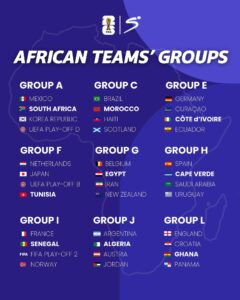
The only Council of Southern Africa Football Association (COSAFA) representatives, South Africa — drawn in Group A alongside co-hosts Mexico, Korea Republic, and Czech Republic — will have their work cut out to finish in the top two to automatically advance.
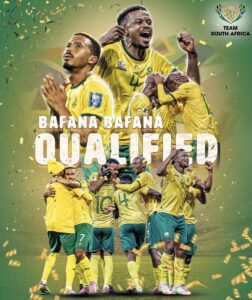
They may have to rely on being one of the best third-placed finishers. However, finishing bottom of their group is an all-too-real possibility, and despite this tournament being the first FIFA World Cup that South Africa has qualified for since the 2002 edition — since in 2010 they gained automatic entry as hosts.
As much as Bafana have achieved by making it to the event, actually performing on the biggest stage may be a bridge too far.
DR Congo — returning to the World Cup for the first time since 1974 — adds further significance to Africa’s presence, while Cape Verde are making their debut appearance, with established teams such as Ghana and Côte d’Ivoire will aim to build on previous experiences.
The presence of 10 African teams is expected to boost the continent’s visibility and influence in world football, while also inspiring a new generation of players and fans — as well as reflecting the continued investment in football development across Africa, with improved structures, coaching and talent pathways contributing to stronger national teams.
For Africa, the 2026 edition represents more than just increased participation — it is a moment of validation by not only be present in record numbers, but to also carry heightened expectations of making a lasting impact on the global stage.—Reporting by AFP, IOL Sport & CAFonline; edited by Duncan Mlanjira, Maravi Express

Advertisement