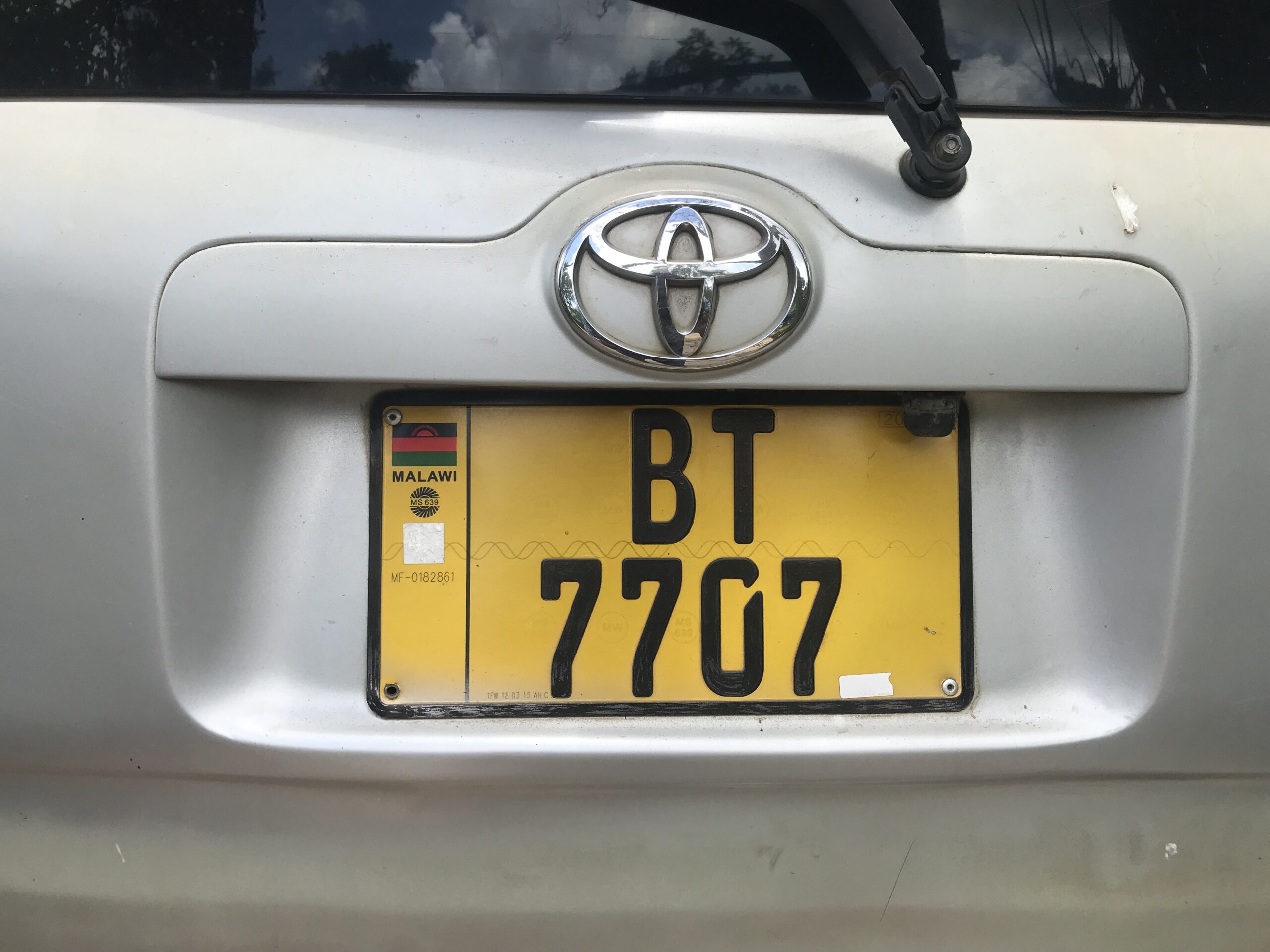
* Where the seven-year period has elapsed but the number plate remains clear, legible, visible and compliant with the law, the plate may continue to be used on the vehicle
* The inclusion of an expiry date is intended to safeguard motorists against the purchase of substandard number plates and not to impose arbitrary replacement requirements
By Duncan Mlanjira
The enforcement of the expiry date on vehicle number plates is based on the condition and quality of the reflective material as prescribed under Regulation 15A of Road Traffic (Registration and Licencing) Regulations, 2010 that stipulates that ‘the reflective material on the registration number plate shall be valid for a period of seven (7) years from the date it is affixed to the plate’.

Advertisement
This is a clarification from the Directorate of Road Traffic & Safety Services (DRTSS) in a public statement issued yesterday following misleading information that is circulating on social media platforms advising motorists to replace their motor vehicle number plates allegedly deemed expired.
The DRTSS took note that the misinformation caused unnecessary anxiety and confusion among motorists as the Directorate is on the campaign to force people not to use vehicles that do not have registration number plates.
The DRTSS explains the rationale for the expiry date that include that a number plate is expected to remain in good condition for up to seven years from the date it was affixed to a vehicle and where the reflective material deteriorates or the quality of the plate is compromised, enforcement action may be taken to remove the defective plate from the vehicle.
Where the reflective material or characters deteriorate before the expiry date, enforcement includes confiscation of the defective plate and referring the vehicle owner to the embosser who produced the plate for replacement.
In such a case, the DRTSS emphasises that the embosser shall bear the cost of replacement and must seek redress from the importer is their substandard materials.

Defective licence plates


“Where the seven-year period has elapsed but the number plate remains clear, legible, visible and compliant with the law, the plate may continue to be used on the vehicle,” assures the DRTSS.
“The inclusion of an expiry date is, therefore, intended to safeguard motorists against the purchase of substandard number plates and not to impose arbitrary replacement requirements.”
The correct legal position regarding motor vehicle number plates — specifically on expiry dates and proper affixing — is provided under the Road Traffic Act, 1997 Section 11(2) that proves that ‘no person shall operate on a public road any motor vehicle that is not registered and licenced in accordance with the Act’.
Under the Road Traffic (Registration and Licencing) Regulations, 2010 19(2) ‘requires the owner of the motor vehicle to ensure that registration number plates are affixed to the vehicle from the date of licensing in the prescribed manner, whether or not the vehicle is operated on a public road’.

Advertisement
Prohibited practices
The DRTSS further cautions the public that in accordance with Regulation 19 of the 2000 Regulations, the following practices are strictly prohibited:
* Use of number plates that have not been authorised by the DRTSS;
* Alteration, modification or tampering with approved number plate embossing or reflective standards;
* Embossing registration numbers using characters or spacing that contravene the provisions of the 2000 Regulations and the 2020 amendments;
* Fixing number plates in a manner that renders them unclear or illegible;
* Displaying number plates inside the windscreen or in any position other than the prescribed locations on the vehicle;
* Displaying a number plate not assigned to that specific vehicle; and
* Use of a registration number plate that is obscured or illegible, except where such obstruction is temporarily caused by circumstances beyond the driver’s control.

Seized motor vehicles plying public roads without licence plates




The DRTSS further emphasises that “it is the responsibility of every motor vehicle owner and operator to ensure full compliance with all number plate requirements [and that] failure to comply may result in enforcement action, including fines, confiscation of the number plates of the vehicle, or other penalties as provided for under the law”.
For further clarification or assistance, members of the public are encouraged to call toll free number 4040 (Airtel subscribers only) or to visit the nearest DRTSS office.
Meanwhile, as the enforcement of registration continues, the DRTSS engaged with Driving Schools Association of Malawi (DRISAM) last week to discuss measures aimed at improving the issuance of driver’s licences through enhanced coordination between the two institutions.
Chaired by Director, Christopher Madalitso Kuyera, the meeting deliberated on several key issues, including the training and licensing of motorcycle taxi (kabaza) operators, particularly in districts and rural areas.


The DRTSS reports that one of the key resolutions was the DRTSS and DRISAM to jointly conduct outreach programmes in rural areas to educate and license kabaza operators, whose activities will be carried out in close coordination with respective traditional leaders “to ensure effective community mobilisation”.
“The initiative is part of the Directorate’s broader efforts to bring services closer to the people and to reduce the need for kabaza operators to travel long distances to access DRTSS services.
“To date, the Directorate has established new service centres in Ngabu, Karonga, and Mangochi, and plans are underway to open additional centres in Mzimba, Kasungu, Salima, Balaka, Mwanza, Mchinji, and Mulanje.”
The DRTSS also reports that of the positive response from kabaza operators who are turning up in good number to have their motorcycles registered and getting trained on the road traffic regulations.

Risky manouvres by kabaza operators