

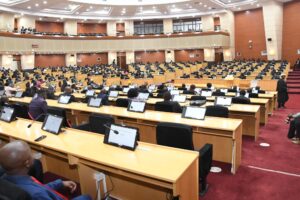
Mwanamveka in the august House this morning
* 25% tax bracket has been abolished, with 30% now applying to incomes between K170,100 and K1.57 million
* 35% applying from K1.57 million to K10 million, and a new 40% rate introduced for incomes above K10 million
* Mobile money transaction limits also revised — increasing daily transaction and cash-out ceilings from K750,000 to K5 million
* As government rolls out stringent expenditure and operational reforms aimed at restoring fiscal discipline and strengthening the efficiency of public institutions
Maravi Express
The Minister of Finance, Economic Planning & Decentralisation, Joseph Mwanamvekha, has delivered the Mid-Year National Budget review, outlining President Arthur Peter Mutharika’s administration’s commitments on food security, disaster response and fiscal consolidation as government seeks to stabilise national spending amid ongoing economic pressures.

Advertisement
The highlight, is the restructuring of pay-as-you-earn (PAYE) tax system, whose zero-rate threshold has been increased from K150,000 to K170,000 per month to cushion low-income earners
The 25% tax bracket has also been abolished, with 30% now applying to incomes between K170,100 and K1.57 million, 35% applying from K1.57 million to K10 million, and a new 40% rate introduced for incomes above K10 million.
The Minister said these reforms reflect government’s commitment to modernising public finance, supporting vulnerable households and enhancing fairness in the tax system.
Mwanamveka also unpacked that the government is “promoting electronic transfers across the economy, and these new limits will support safe, fast and transparent transactions for both individuals and businesses” — thus it has immediately revised mobile money transaction limits, increasing daily transaction and cash-out ceilings from K750,000 to K5 million.
“The holding limit for individual wallets now rises from K1 million to K5 million, while merchant accounts increase from K25 million to K50 million,” said the Minister, adding that the adjustments are intended to reduce the amount of physical cash circulating in the economy and strengthen digital payment systems.

“Our objective is to move money electronically and minimise unnecessary cash withdrawals that expose the system to risks,” emphasised Mwanamvekha, while also indicating that the key financial reforms are aimed at improving electronic transactions, protecting low-income earners and strengthening revenue collection.
He added that the government is rolling out stringent expenditure and operational reforms aimed at restoring fiscal discipline and strengthening the efficiency of public institutions — designed to safeguard public resources, curb wasteful spending and ensure that ministries, departments and agencies (MDAs) operate strictly within approved allocations.
“No institution will commit government resources where funding does not exist,” he told the august House. “Treasury will enforce the Public Finance Management Act without exception.”
He said the reforms will require all MDAs to rely strictly on quarterly Treasury allotments, with suppliers only allowed to deliver goods and services backed by IFMIS-generated local purchase orders, saying: “Any goods or services supplied without a system-generated LPO will not be paid for by government.”
However, Mwanamveka said government is also moving aggressively to reduce operational costs across the public sector: “Fuel entitlements for ministers, deputy ministers and senior officials have been reduced by 30% with immediate effect.”

He also added that MDAs are encouraged to hold physical meetings within their premises and limit delegation sizes for travel and that the Chief Secretary to Government will determine and approve all delegations traveling outside the country, including those on donor-funded trips, which will no longer attract government top-up allowances.
Mwanamvekha also said government will enforce tighter procurement rules, eliminate advance payments, and reject all extra-budgetary requests except in exceptional circumstances approved by Treasury.
On mineral resources, the Minister further disclosed that mineral licences and contracts will undergo a full review, with any mining licence left idle for more than five years set to be revoked to promote efficiency and value generation in the sector.
The government will reduce the number of embassies and limit staffing levels as part of foreign service reforms, saying each mission will now operate with no more than five officials, including the Ambassador or the High Commissioner.
Addressing public sector management, Mwanamvekha said the Accountant General’s office is activating the SAP-based human capital and payroll module to eliminate ghost workers and better control the wage bill.
All statutory corporations will implement performance-based contracts for boards and management, with non-performing chief executives facing contract reviews or possible removal.

Advertisement
Government will also enforce compliance with dividend remittances to strengthen revenue flows — all these reforms aimed to transform state-owned enterprises into financially viable and accountable institutions capable of contributing meaningfully to economic growth and fiscal resilience.
The Minister, however, noted that several utility parastatals in the water, electricity and fuel sectors continue to post losses, adding pressure on the national budget — and to address this, the government will enforce cost-reflective pricing and require utilities to operate more efficiently.
On decentralisation, Mwanamvekha assured President Mutharika’s commitment to constituency-level development, announcing that the Democratic Progressive Party (DPP)-led administration will implement the K5-billion allocation for each constituency beginning April 1 2026.
Meanwhile, President Mutharika has mandated Vice-President Justice Jane Ansah (Rtd), to oversee disaster management functions and ensure effective coordination of food support programmes across all affected districts nationwide.
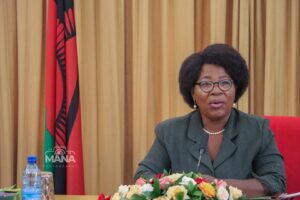
Jane Ansah
Mwanamvekha acknowledged the extensive assistance from development partners following the declaration of a national disaster, noting their contributions towards procuring and distributing maize and other food items to vulnerable households experiencing shortages in various districts.
However, he assured Malawians that the administration will safeguard nationwide food availability, emphasising that no citizen should die of hunger, and commended local commercial banks for supporting maize purchases, including FDH Bank, National Bank, NBS Bank and Standard Bank.
Turning to fiscal matters, the Minister has described public debt management as a strategic priority, reporting that Malawi’s debt has reached K21.6 trillion, which translate to 86% of GDP and is a significant increase from K4.1 trillion recorded in 2019.
Mwanamvekha has attributed the surge to what he called fiscal indiscipline under the previous administration, stressing that high debt levels continue to constrain investment in productive sectors and limit government’s operational flexibility across key national programs.
To address this, Mwanamvekha said government is pursuing fiscal reforms, including debt restructuring, concessional borrowing, improved oversight of state-owned enterprises and strengthened expenditure controls to restore long-term debt sustainability and ensure economic stability.
The Minister reported that the State House and the Office of the President & Cabinet spent 100% of the K67 billion allocation for the 2025-2026 national budget that Parliament approved in just six months.
Thus he highlighted strict expenditure measures, including limiting external travel for senior public officers to three trips annually, adopting cash budgeting and conducting nationwide payroll audits to eliminate irregularities in the public service.—Reporting by Malawi Government Media


Advertisement