
By Dr Ahmed Mohiuddin Siddiqui
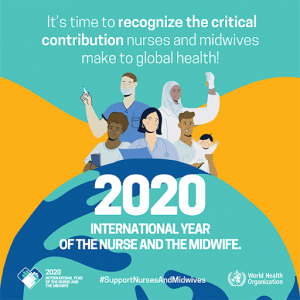
The World Health Organization (WHO) designated 2020 as the year of the nurse and midwife when nothing was heard about the novel Coronavirus.
Even before the dreaded disease went on a rampage and claimed nearly 270,000 lives to date, the world acknowledged the commitment and diligence displayed by the nurses and the midwives all over the world.
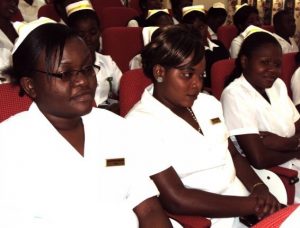
The health workers on the frontline in fight
against COVID-19
Now, with their zeal and passion to save human lives, the health professionals command our respect all the more. Many doctors, nurses and other health professionals have sacrificed their lives in the line of duty.
Nurses and midwives are making the world a healthier place to live in. Nurses are the unsung heroes of the COVID-19 response. Nobody can predict the end time of COVID-19.
WHO Chief Tedros Adhanom Ghebreyesus warned us: ‘the worst is yet ahead of us’ in the Coronavirus outbreak.

WHO chief Tedros Adhanom Ghebreyesus
The likely future spread of disease in Africa and other parts of the world could be dangerous as health systems are far less developed and unable to cope with the magnitude of the problem.
Many African countries have just one ventilator per million of population. There are not enough intensive care unit (ICU) beds too.
It is in this context that the role of nurses and midwives assume more importance. Many babies are born in this trying period and some of them are getting COVID positive within days of birth.

Advertisement
The global nursing force consists of 28 million nurses out of which 19 million are professional nurses. The world still needs 9 million more nurses and midwives if it is to achieve universal health coverage by 2030.
Oman Nursing Association (ONA) president, Abdallah bin Ahmed Al Rubaeiy strongly feels that nurse shortages must be overcome in hospitals worldwide if we are to fight COVID-19 effectively.

He pleads for more professional incentives to attract the youth to the noble profession. He has appreciated strong legislative measures from some of the governments for the security of nurses and other health professionals in the light of attacks and violence by the general public, who ignorantly blame the health professionals for the spread of COVID-19 in their areas.
In the light of attacks against health professionals mainly against doctors and nurses in several places like Madhya Pradesh, Telangana, Karnataka and other places, the Government of India has come out with an ordinance for the security of the health professionals.

Coronavirus alert
This welcome ordinance will boost the morale of doctors and nurses. There are jail terms ranging from 6 months to 7 years for those who attack or misbehave with the health professionals.
The nursing profession evolved over time. Rufaida bint Sa’ad Al Aslamiya (May Allah be pleased with her) was the first female nurse and surgeon in the Arab world in the 7th century.
She sought permission from Prophet Mohammed (Peace Be Upon Him) to provide nursing care to soldiers during battles. Her father was a physician and also her mentor under whom Rufaida initially obtained clinical experience.

Coronavirus alert
Her social work is also recorded in history. She was the first ‘Lady with the Lamp’ when nursing was not yet a recognized profession. Each year, the Royal College of Surgeons in Ireland, at the University of Bahrain, awards one student, the prestigious Rufaida Al Aslamiya Prize in Nursing for Excellence in delivering superb nursing care to patients.
Many, many centuries later after Rufaida Al Aslamiya, nursing came to Europe and America.
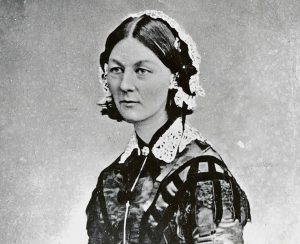
Florence Nightingale
In the 19th century, British social reformer and founder of modern nursing — Florence Nightingale — transformed nursing into a professional skills based science.
Nightingale’s birthday will be celebrated on Tuesday, May 12. She is remembered as the ‘Lady with the Lamp’.
The great lady once remarked: “I attribute my success to this: I never gave or took an excuse”.
In the COVID-19 times, Florence Nightingale’s message has become all the more important and worth emulating as COVID-19 is nothing but a disease which is spread through infection.
The sweet Florence Nightingale hummed thus: “Wise and humane management of the patient is the best safeguard against infection”.
In the Sultanate of Oman, after the blessed Renaissance in 1970s, the late wise ruler, His Majesty Sultan Qaboos bin Said transformed health and education sectors.
Many hospitals, health centres and nursing institutes were opened all over the country for a trained professional Omani nursing workforce. In 2001, the Oman Specialised Nursing Insitute was opened, which was later upgraded as the Higher Institute of Health Specialties (HIHS).

Coronavirus Alert
The state-of-the-art HIHS has become the Sultanate’s premier higher institute with advanced programs in different nursing specialties.
Oman’s popular community activist, environmentalist and board member of Oman Cancer Association (OCA) Dr. Manal Abdul Majeed Al Zadjali guides the destiny of the HIHS presently.
The Sultanate of Oman’s world-class healthcare under the Ministry of Health has been much appreciated by the WHO many times.
His Majesty Sultan Haitham bin Tariq, who made a smooth and remarkable ascension to power after his illustrious cousin Sultan Qaboos is making monumental efforts to make Oman a regional power while continuing the policy of moderation in all respects.

Coronavirus alert
His thoughtful formation of a Supreme Committee to tackle COVID-19 in Oman has saved many lives and earned him many accolades as a futuristic leader.
Midwives did not get their due respect for their services all through the centuries for the work which is hard labour. During 1400-1600 AD, midwives ran the risk of being accused of witchcraft in Europe.
The 1484 ‘Malleus Maleficarum’, a famous book about witches, claimed that midwives were the most dangerous kind of witch for all the damage they could do to a new family.

Coronavirus alert
Midwives fought prejudice and bias to live up to this day to deliver mankind! Along with the doctors and nurses, they deserve the highest applause.
In 1902, Great Britain set up a central Midwives Board to train, license and regulate midwives, which provided midwifery a much-needed sense of professionalism. Midwives never looked back since then.
Recently, India turned to midwives to reduce maternal mortality as 32,000 women used to die during pregnancy or childbirth every year.

Advertising
The Narendra Modi government in India is planning to implement the National Population Register (NPR) and the National Register of Citizens (NRC).
Modi is demanding the citizens to produce not just the citizens’ birth certificate but also their parents’ birth certificates. As people make a beeline to hospitals to procure their parents’ birth certificates (after the lockdown), do not forget to salute the nurses and the midwives there.
Honour the nurses and midwives with a bouquet of 1.3 billion salutes!