
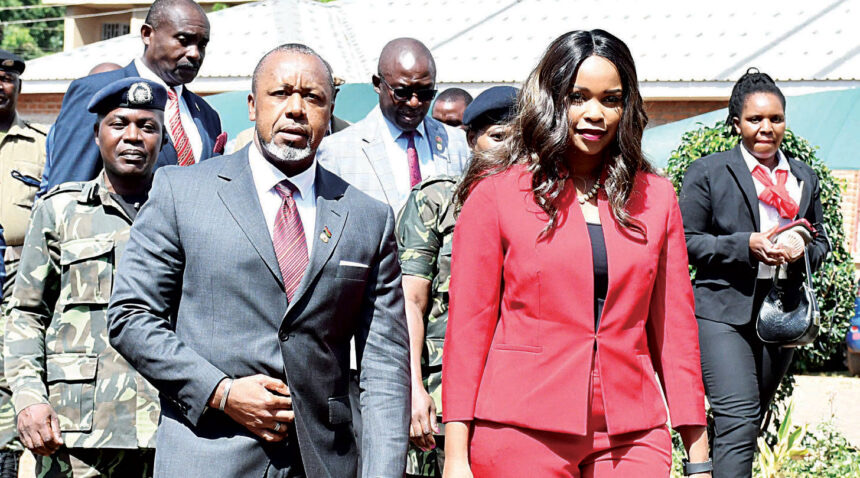
Chilima at the court on Tuesday
* The State wondered how Chilima became privy to information about the existence of the type of documents that he was requesting
* It is premature for Chilima’s defence in the corruption case to seek some of the disclosures from the State at this stage of the case
By Duncan Mlanjira
In agreeing with the argument from Malawi Defence Force (MDF) — that some of the documents Vice-President Saulos Chilima is asking to be furnished in his corruption allegations — are indeed highly sensitive in nature to be made public, Justice Redson Kapindu, took cognizance “that the law does not recognise the Vice-President as Deputy Commander-in-Chief of the MDF”.

“It only says that the President is the Commander-in-Chief. In this regard, Counsel argued that his clients were, therefore, actually curious as to how the Vice President [Chilima] became privy to information about the existence of the type of documents that he was requesting in these proceedings.”
Chilima was seeking disclosures include minutes of the Defence Council meeting held on October 16, 2020 authorising the procurement of armoured personnel carriers (APCs) and a memorandum of March 2021 from the MDF to President Lazarus Chakwera seeking authorisation to procure APCs from Malachite FZE, a company linked to corruption suspect Zuneth Sattar, using single sourcing.
Delivered in open court on Tuesday, April 2, Justice Kapindu ruled that it is premature for Chilima’s defence in the corruption case to seek some of the disclosures from the State at this stage of the case.
But the Judge stressed that if during the trial such sensitive documents will prove to be relevant to a fair trial for the accused, then the Anti-Corruption Bureau (ACB) will have to decide whether to have such sensitive information disclosed or to discontinue the case.

Advertisement
The court directed that Chilima’s legal team as well as the Attorney General (AG) and lead counsel for ACB will be allowed access to “only see basis” of the sensitive documents just to appreciate the court’s observations that the information is highly sensitive.
“The Court acknowledges that these are very interesting legal arguments,” said the Judge in his ruling. “However, as mentioned above, considering that essentially the substantive issues of the case have already been disposed of, and also that an elaborate discussion of the issue would necessarily involve expansive interpretation of the Constitution — which would arguably best be decided by a panel of at least three Judges under section 9(2) of the Courts Act, Cap 3:02 of the Laws of Malawi — the Court will not belabour the issue.
“The Court takes the view that the Vice-President (as in First Vice-President only, and not the second Vice-President where a second Vice-President exists), as the second highest ranking official in the country after the State President, under the scheme of the Constitution of the Republic, should necessarily be privy to national security information through necessary briefings, by virtue of his oath and position as Vice President.

“However, in the view of this Court, such access must always be subject to the directives of the President, who, in the capacity of Commander-in-Chief, holds the authority to restrict certain national security details from the Vice-President as deemed appropriate.
“The Court acknowledges its lack of competence to delineate the specific nature of such national security information that may be withheld from the Vice-President.
“Nevertheless, it is the Court’s firm view that within the overall framework of Malawi’s Constitution, it would be ill-advised to propose that the Vice-President, by virtue of his or her office, should be excluded from accessing at least some national security information, including pertinent details concerning the deliberations of the Defence Council.”
On the argument on how Chilima became privy to information about the existence of the type of documents that he was requesting, Justice Kapindu ruled that the Court did not find it necessary to inquire into such a question on how Chilima — who holds the position of second in command of the country, “might have become aware of the existence of the kind of information that he sought”.
Thus said, Justice Kapindu ruled that Chilima’s “application therefore fails, for the time being, subject to issues that may transpire during trial.


Advertisement
The documents which Chilima’s defence is seeking to access and to use for purposes of defence during his trial, included:
(a) Minutes of the Defence Council meeting held on 16th October 2020 authorising procurement of Armoured Personnel Carriers (APCs);
(b) Memorandum of March 2021 from the Malawi Defence Force Commander (MDF) to the President of the Republic of Malawi (the President) seeking authorisation to procure APCs and to use single sourcing from Malachite FZE;
(c) Memorandum in (b) above with the President’s Minute(s) authorising the procurement or any other documents by which the authorisation was given; and
(d) Letter dated 13th April 2021 from MDF to Ministry of Finance requesting for allocation of funds for procurement of APCs.
Chilima believes that these documents are of substantial significance for purposes of his defence in which he is facing charges of corruption under section 27(4) of the Corrupt Practices Act (CPA) as read with section 34 of the CPA.

Advertisement